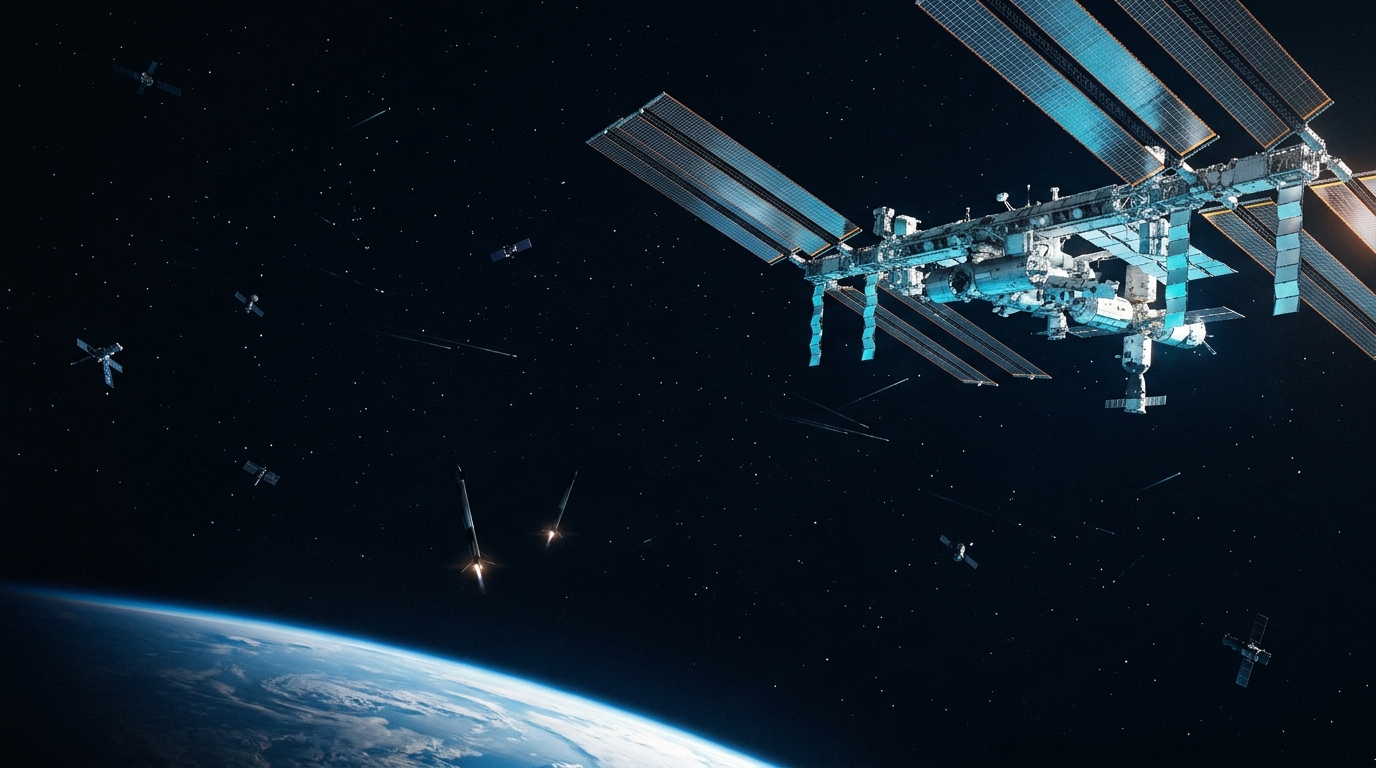
700 Falcon Flights and a Crowded Sky: What It Means for ISS Spotting
Every time a rocket roars off the launch pad and punches through the dense layers of Earth's atmosphere, the invisible architecture surrounding our planet transforms a little more. While commercial launch cadences shatter historical records and populate various orbital altitudes with satellites, for any backyard stargazer the primary goal remains unchanged: spotting the majestic, serene streak of the International Space Station with the naked eye.
For those of us who look up night after night in search of that unmistakable white dot, the dizzying pace of modern space missions raises an obvious question: How does this proliferation of hardware affect our ability to enjoy watching the orbital outpost and understand the environment it navigates?
What happened
American company SpaceX has successfully deployed three O3b mPOWER communications satellites for operator SES, marking a massive operational milestone: the 700th mission for the Falcon rocket family in its history, as reported by Space.com. The launch, conducted aboard a Falcon 9 from Florida, solidifies a launch cadence that seemed unthinkable in the aerospace industry just two decades ago.
This achievement does not stand alone on the international space calendar. At the same time, the European agency and Avio are finalizing the operational return of the Vega C launcher from the Kourou spaceport, tasked with orbiting Earth-observation satellites such as Sentinel-3C and the FLEX environmental mission. This accelerated access to space contrasts sharply with the historical memory of exploration: on September 13, 2007, Japan captivated the world by launching the Kaguya probe to map the Moon in high definition, during an era when every orbital launch was still seen as an extraordinary, singular event rather than an almost routine logistics service.
Why it matters
Reaching 700 flights within a single rocket family is not merely a corporate triumph for SpaceX; it is the technical backbone of an infrastructure that sustains human life beyond Earth, both directly and indirectly. The very same Falcon 9 booster that sends these connectivity repeaters into medium Earth orbit also propels the Dragon spacecraft carrying critical supplies and crew rotations to the orbital complex.
The station is permanently inhabited by an international crew rotated every few months; you can see who is currently part of the crew onboard in our dedicated section. For them, the reliability of these launch systems is not an abstract commercial metric, but the lifeline ensuring food, spare parts, scientific experiments, and a safe return home.
Nevertheless, today's launch volume heightens a quiet challenge: orbital traffic management in low Earth orbit (LEO) and medium Earth orbit (MEO). O3b mPOWER satellites head to medium orbits around 8,000 kilometers in altitude, well above the station's inhabited corridor. Yet every orbital insertion, discarded upper stage, and temporary satellite train must cross the lower altitudes where the orbital laboratory operates.
Flight control centers in Houston and Moscow must continuously monitor tens of thousands of cataloged objects to assess collision probabilities. Although safety protocols are extraordinarily strict and flight corridors are calculated to the millimeter, the net increase in orbital tracks around Earth requires the complex to maintain round-the-clock vigilance and hold propellant in reserve to fire its thrusters and boost its orbit whenever space debris approaches its protective bubble.
Our take
Anyone stepping outside at dusk to watch the night sky faces a radically different view than a decade ago. Stargazers increasingly mistake freshly deployed communications satellites, deorbiting rocket stages, or transient glints from solar panels for the space station.
Learning to tell these signals apart is an essential skill for the modern skywatcher. Satellites like those launched on this 700th Falcon flight travel to altitudes where they are not prominently visible to the naked eye, but the early stages of many missions produce faint, fragmented trains of light. In contrast, according to our tracker data, the ISS currently orbits at an altitude of 435 km, traveling at a steady speed of 27,541 km/h. That blend of low orbit and massive dimensions—roughly the size of a football field covered in reflective panels—turns the station into an unmistakable moving beacon.
To avoid getting lost in an increasingly crowded sky, keep these basic visual differences in mind:
- Brightness and stability: The ISS does not flash or twinkle; it shines with a steady golden-white light that can outshine Jupiter or even Venus.
- Smooth trajectory: It crosses the sky in a silent arc typically lasting between 3 and 6 minutes, moving from west to east without sudden turns or acceleration changes.
- Prior identification: While most small satellites barely scrape the threshold of naked-eye visibility under dark rural skies, the station is clearly visible even from bright city centers with heavy light pollution if you check ahead of time what time the ISS passes over your exact location.
Even as the aerospace industry continues to shatter records and fill the skies with autonomous technology, the space station retains an unmatched aesthetic and symbolic value. Knowing that human beings are living and working in microgravity inside that brilliant point of light crossing overhead adds a deeply human dimension to stargazing. To master the best viewing times and enjoy passes without confusion, we recommend checking our guide to spotting the ISS before your next night out.
The night sky is changing rapidly, but the path of humanity's home in space remains wide open above us. Check our real-time tracker to see when it will rise above your horizon and get ready to watch it glide across the night.
Source: Space.com ↗