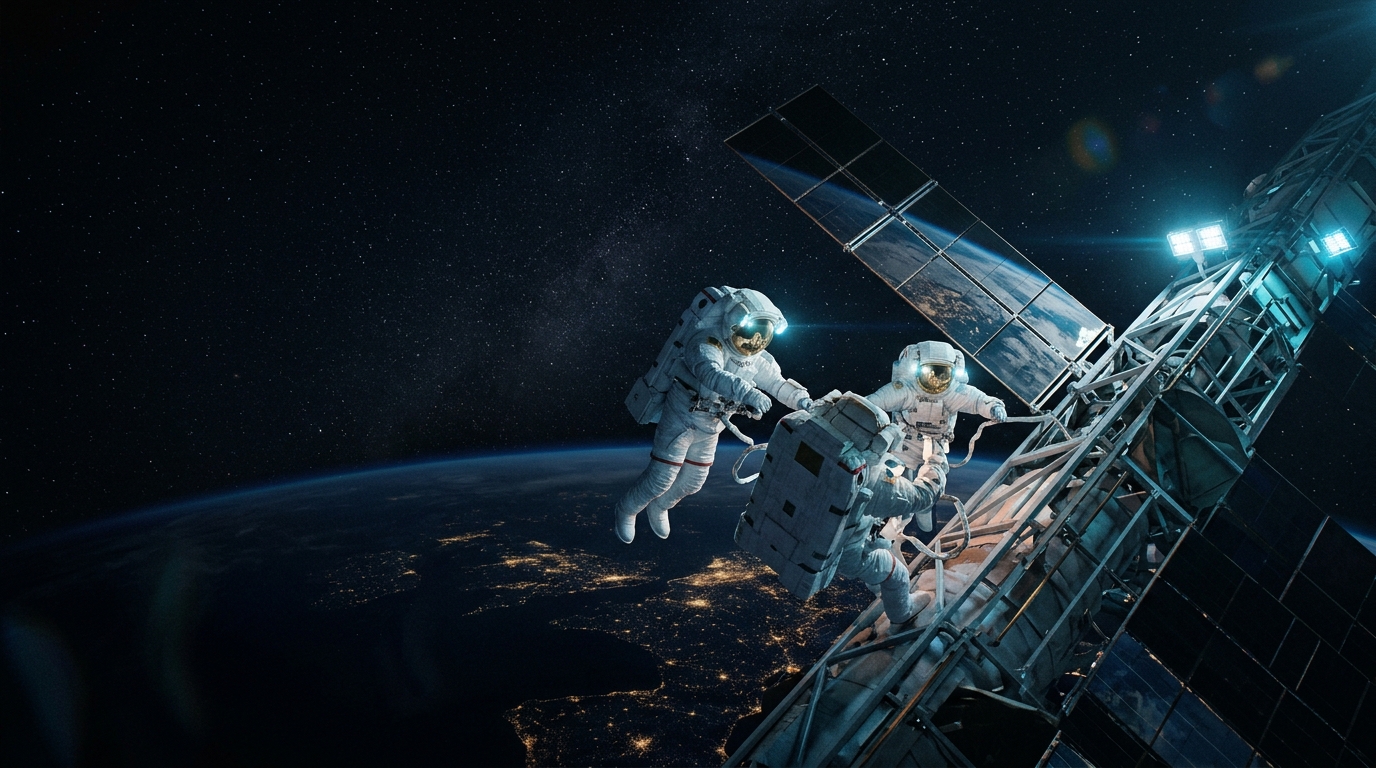
Three Spacewalks to Upgrade the ISS: Key to Its Power and Brightness
If you look up at night and see a bright point of light streaking across the sky at over 27,000 km/h, you are gazing upon a masterpiece of human engineering that never rests. Over the coming weeks, the International Space Station faces a marathon of three spacewalks designed to upgrade its power arteries and communication links with Earth. Here is what this technical challenge outside the orbital complex entails and how it affects what you can spot right from home.
What Happened
Activity on the orbital laboratory is about to ramp up dramatically in the vacuum of space. According to the U.S. space agency (NASA), the operations team has scheduled a series of three spacewalks—technically known as extravehicular activities, or EVAs—aimed at carrying out critical maintenance, electrical upgrades, and communications infrastructure work on the orbiting outpost.
To coordinate every detail of this complex sequence of outside missions, flight directors and technical leads have scheduled a preview briefing to detail the exact roles of each astronaut pairing, enhanced safety measures, and the precise timeline of the operations. The crew on board the station brings together astronauts and cosmonauts from multiple agencies who rotate on roughly six-month shifts. Members of this team will take on the challenge of suiting up in pressurized spacesuits to work directly exposed to the vacuum of space.
The tasks set for these three outings cover three main fronts that ensure the technological survival of the complex:
- Power preparation and deployment: Installing mechanical brackets and preliminary electrical connections to accommodate new roll-out solar arrays that will augment the original photovoltaic wings.
- Telecommunications component replacement: Replacing a high-priority communications antenna that guarantees the uninterrupted transfer of commands, telemetry, and data between the complex and ground stations.
- External cable routing: Running power and data cables along the central truss structure to feed future experiments and infrastructure.
Why It Matters
To understand why these interventions are needed, one must look back to the station's inception. The central truss and the primary solar arrays have been operating continuously since the early 2000s. In space, two decades is not merely the passage of time—it represents non-stop exposure to an exceptionally hostile environment.
Our real-time tracker shows that the ISS currently orbits at an altitude of 439 km, completing a lap around the planet every 90 minutes. This means its external components endure 16 sunrises and 16 sunsets every 24 hours. During each transition, the structure swings from braving temperatures of nearly +120 °C under direct solar radiation to plunging into extreme chills of -120 °C in Earth's shadow. This relentless thermal cycling causes constant expansion and contraction of materials, degrading circuits, solder joints, and protective coatings.
Compounding this thermal stress is the destructive impact of atomic oxygen in the upper thermosphere and a steady bombardment of microscopic micrometeoroids. The solar cells on the original arrays have gradually lost reflective efficiency and power-generation capacity. At the same time, the station's energy demand has continued to surge. Modern science modules, biological research racks, and preparations to host commercial missions all require a steady stream of power that the legacy photovoltaic wings can no longer deliver on their own.
On the other hand, replacing the communications antenna serves a vital purpose for both ground control and scientific outreach. The station transmits massive amounts of data every second. If external antennas fail or degrade, the ability to receive critical subsystem telemetry or stream high-definition video is severely compromised. Routing cables along the exterior in pressurized gloves—a task akin to trying to repair fine watchwork wearing stiff work gloves—demands hundreds of hours of prior training in neutral buoyancy pools before executing the mission in low Earth orbit.
What to Look for in the Sky
As someone tracking the orbital complex, you might wonder whether these three spacewalks will alter your viewing experience from Earth. The short answer is yes, whether you are following operations on a screen or watching the night sky from your window.
First, work on the solar arrays directly alters the geometry and reflective surface of the station. The ISS does not emit light of its own; it shines in our sky because its immense aluminum and silicon structures reflect sunlight as it flies at 27,528 km/h. Adding and reconfiguring solar arrays shifts the angle and amount of light bounced down to Earth's surface. This can influence the station's visual magnitude and peak brightness during certain evening or morning passes over your area.
On days when spacewalks take place, visible passes take on special meaning. Knowing that at the very moment you see a brilliant streak gliding across the celestial dome, two human beings are working outside the pressurized modules—suspended over the void more than 400 kilometers up—completely transforms the viewing experience.
To make the most of these orbital events, we suggest following these steps:
- Check our guide to spotting the ISS with the naked eye to learn how to distinguish the steady glow of the station from the blinking lights of an airplane or a fainter satellite.
- Verify the pass predictions for your exact location to make sure you step outside right as the laboratory rises above the horizon.
- Cross-reference the tracker's map position with the live NASA broadcast to see exactly which continent or ocean the astronauts are soaring over while working outside.
Don't miss this opportunity to bridge space engineering with your backyard stargazing. Use our real-time tracker to find out exactly when the International Space Station will fly over your roof next.
Source: NASA ↗