How to Set ISS Pass Alerts: Reminders That Actually Work
The challenge of spotting the International Space Station isn't technical difficulty—it's remembering to look. Good passes last five minutes, occur at specific times, and bunch together in week-long streaks every two months. Without an alert, most are missed simply by forgetting.
Why you need a reminder
ISS visibility follows a cycle. For seven to ten consecutive days, there are visible passes—sometimes two or three a night. Then come a couple of weeks with nothing worth seeing because all the flyovers happen while the station is in Earth's shadow. And then it starts all over again.
On top of that, within each viewing window, passes shift about twenty minutes earlier each night. If it passed at 10:40 p.m. yesterday, it won't pass at 10:40 p.m. tonight. Relying on memory is a surefire way to head outside too late.
And the window is narrow: between three and six minutes per pass, with the best viewing concentrated in the minute or two of peak elevation. Arriving five minutes late is the same as not going out at all.
The three ways to set alerts
App push notifications. This is the most convenient option and practically the only solid reason to install a dedicated app instead of using a website. Set an elevation threshold if the app allows it, so it only alerts you to passes above a certain height. Otherwise, you'll end up getting notified about low twelve-degree passes you won't even see, and you'll mute the app within two weeks.
A manual phone alarm. Less elegant and surprisingly effective. Check the week's passes all at once, pick the top two or three, and set an alarm ten minutes before each one, labeled with the pass name and the direction of appearance. It works without relying on any app and never fails.
A calendar event. The best choice if you want to involve other people. An event with an alert, the exact time, peak elevation, and a meeting spot turns a flyover into a planned outing rather than a coincidence.
How much notice you need
Ten minutes is the sweet spot for a typical pass from home: it gives you enough time to step outside, let your eyes start adjusting to the dark, and locate the west.
If you're traveling to a spot with an unobstructed horizon, work backward from the start time and factor in travel. And if you plan to take photos, give yourself at least thirty minutes: setting up a tripod, focusing to infinity, taking test shots, and dialing in your exposure can't be rushed in five.
An alert hours in advance is useless. By the time the pass happens, you'll have forgotten all about it.
What the reminder should say
A reminder that merely says "ISS pass" isn't enough. With these three details included, you step outside knowing exactly what to do:
- The start time, not peak elevation, so you don't step out halfway through the pass.
- The direction of appearance, or azimuth. The ISS orbits from west to east, so it almost always appears in the western sky, but knowing whether it crosses to the north or south dictates where to stand.
- The maximum elevation, which tells you if it's worth it. Above thirty degrees, head outside. Below ten in an urban area, don't even bother.
How to interpret these numbers in detail, along with magnitude, is covered in our viewing guide.
A routine that works
The most effective approach isn't reacting to random alerts, but spending two minutes at the start of each viewing window. Check the next seven days of passes in the pass schedule calculator, find the highest pass of the week, and set it as your main target. Add one or two backups in case of clouds that night.
Once the viewing window ends and predictions come up empty, don't delete anything: check back in a week or two. The cycle is regular and will return.
And if you want to understand why this pattern happens, the station's current position and trajectory are on the live tracker. Watching the path on the map helps you anticipate where the next pass will appear.
The ISS passes over your house several times a day. The difference between seeing it and missing it is an alert at the right time.
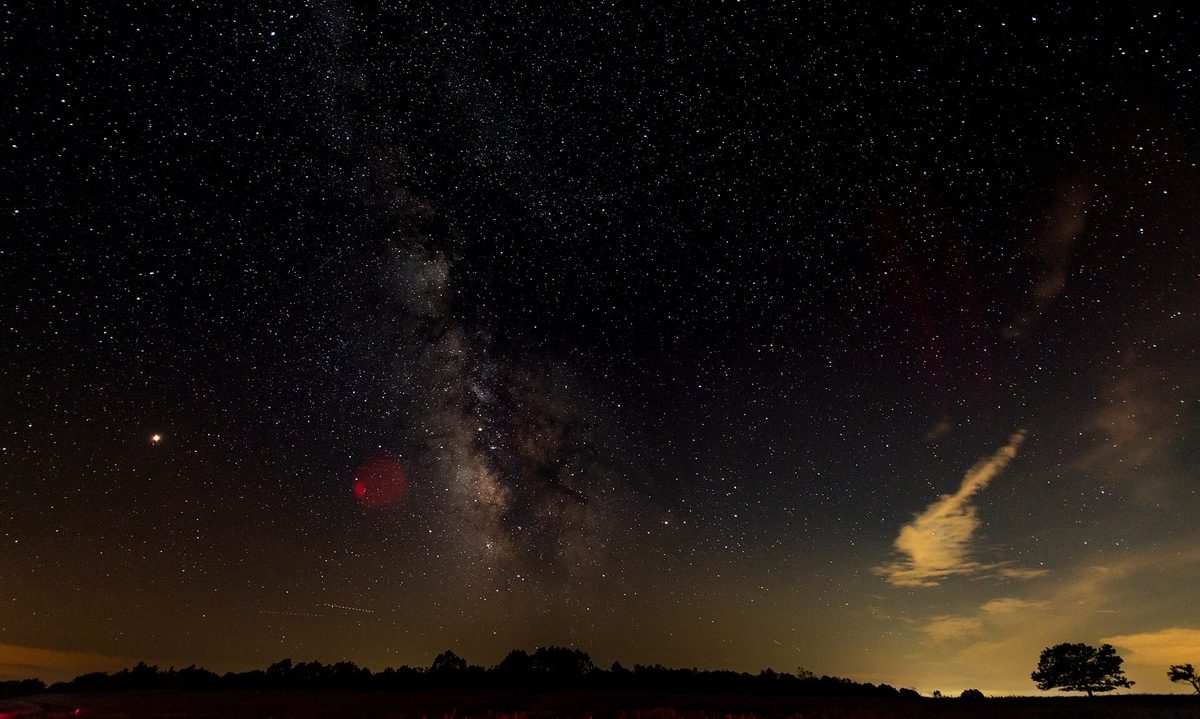
Images: cover, 2018 Night Sky Festival- Stargazing in the Meadow (44025266484) — ShenandoahNPS (Public domain). Body, ISS-53 New York City, Night Lights — NASA (Public domain).
Source: ISS Tracker ↗