How High and How Fast Does the ISS Fly?
Four hundred kilometers up and 27,600 kilometers per hour. These are the two numbers that define the International Space Station, and neither is arbitrary: each is a direct consequence of the other.
Altitude: Around 400 Kilometers, but Variable
The ISS flies in what is known as low Earth orbit, typically between 400 and 420 kilometers above sea level. To put that into perspective, it is roughly the distance between Madrid and Valencia—straight up.
That number is not fixed, and that is the interesting part. At that altitude, traces of the atmosphere still remain. Very little, but enough to constantly drag against a 420-ton object moving at nearly eight kilometers per second. This atmospheric drag causes the station to lose between 50 and 100 meters of altitude each day.
If nothing were done, it would reenter the atmosphere within a few years. That is why periodic reboost maneuvers are carried out, during which the thrusters of a docked spacecraft push the station back up to its operational altitude. Seeing the altitude figure slowly decline and then suddenly jump back up is completely normal.
Why Exactly 400 Kilometers
It is a compromise between three competing pressures.
- Lower down, atmospheric drag skyrockets, requiring far more fuel to maintain orbit.
- Higher up, the Van Allen radiation belts come into play, bringing much harsher radiation levels for both crew and electronics.
- The cost of reaching orbit: every additional kilometer drives up the cost of every cargo and crew launch—of which there are many each year.
Four hundred kilometers is the sweet spot where these three curves intersect most favorably.
Speed: 27,600 km/h, and It Is Not Optional
In more manageable units, that is 7.66 kilometers per second. In the time it takes you to read this sentence, the station has traveled about thirty kilometers.
Here is the concept that is hardest to grasp: that speed is not a choice. For any given orbital altitude, there is only one speed that sustains the orbit, and at 400 kilometers, that is the exact speed required. Go slower, and it falls. Go faster, and it climbs into a higher orbit.
And there is something even more counterintuitive: the ISS is permanently falling toward Earth. Gravity up there is roughly 90% of what you feel on the ground, so the pull is nearly identical. What happens is that the station travels sideways so fast that, as it falls, the curved surface of the Earth drops away beneath it at the exact same rate. It never hits the ground. That is what an orbit is: a perpetual fall that keeps missing the planet.
That is also where microgravity comes from. Astronauts do not float because there is no gravity; they float because they are falling along with the station, just as you would float inside an elevator in free fall.
What These Figures Mean in Practice
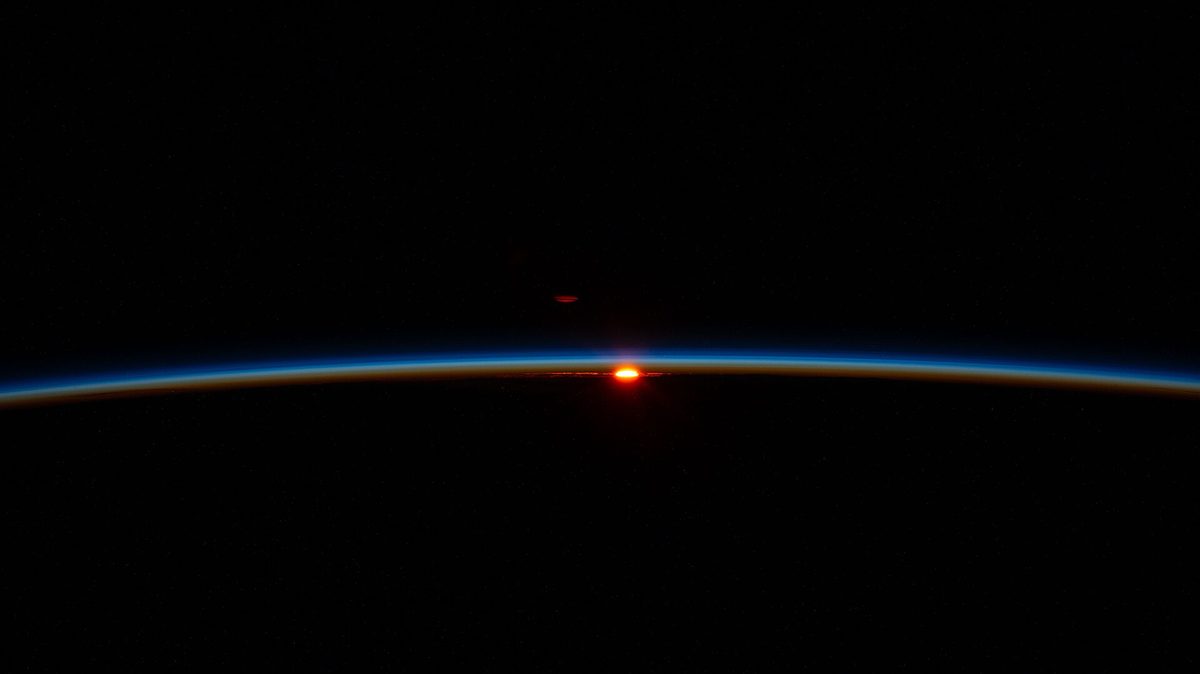
At that speed, the ISS completes one orbit around the planet roughly every 92 minutes. That means about sixteen orbits a day, and therefore sixteen sunrises and sixteen sunsets every twenty-four hours for anyone on board.
It crosses the Iberian Peninsula from end to end in under two minutes. It covers the distance between Madrid and New York in about twenty. And during a single visible pass over your home—lasting between three and six minutes—it traverses two or three countries.
That speed is precisely what makes the station recognizable when you look up from the ground. An airplane takes far longer to cross the sky; the ISS does it in just a few minutes, in a steady straight line, without flashing and in complete silence. You can find all identification criteria in our spotting guide.
How to See It with Your Own Eyes
All these numbers stop being abstract the moment you see them in action. On our live tracker, you can watch the position, altitude, and speed update in real time, and see how the altitude gradually decays week by week until the next reboost.
The next step is to look up at the right moment: check the next visible pass from your location with our pass predictor. When you watch that bright point of light streak across the sky in four minutes, 27,600 km/h ceases to be just an encyclopedia stat.
If you want to delve deeper into the orbital mechanics behind it, explore how the ISS orbits Earth.
Four hundred kilometers up and eight kilometers per second sideways. Those two numbers explain virtually everything else.
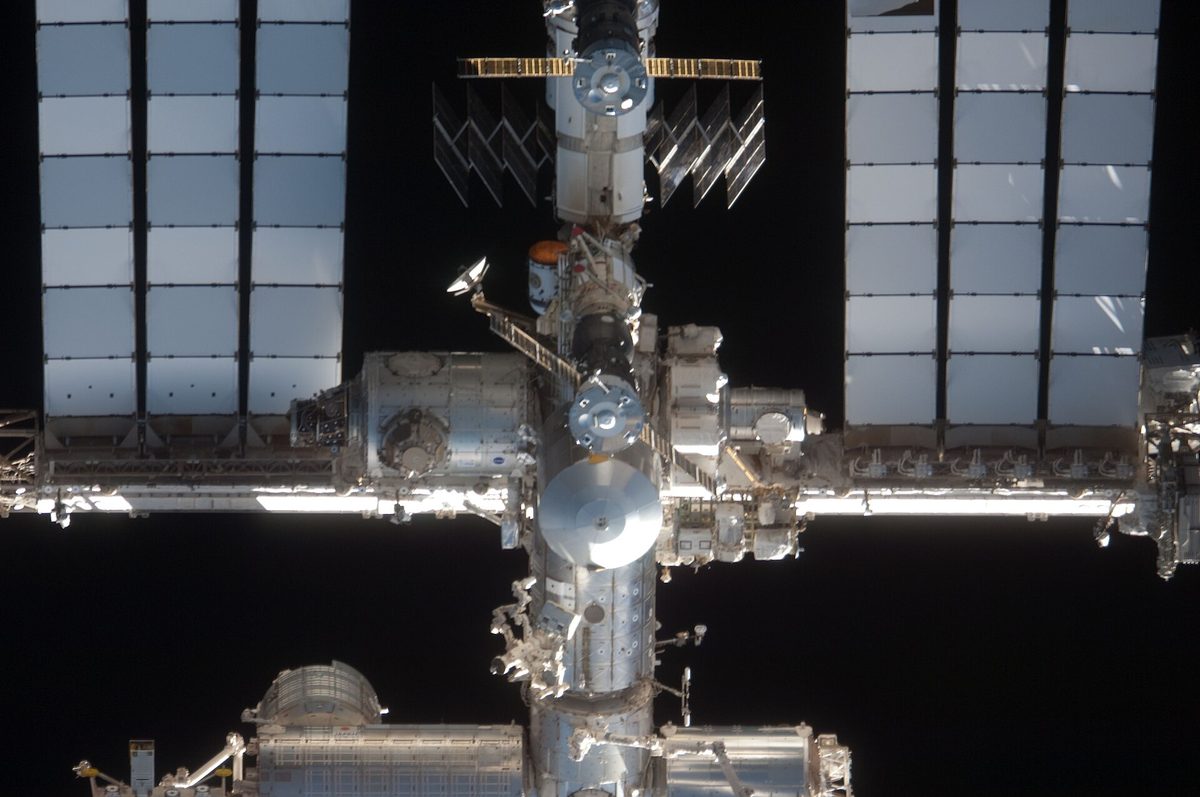
Images: cover, STS-135 ISS seen from Space Shuttle Atlantis (closeup) — NASA (Public domain). In-article, The first rays of an orbital sunrise illuminate Earth’s atmosphere (iss074e0089802) — NASA Johnson Space Center (Public domain).
Source: ISS Tracker ↗