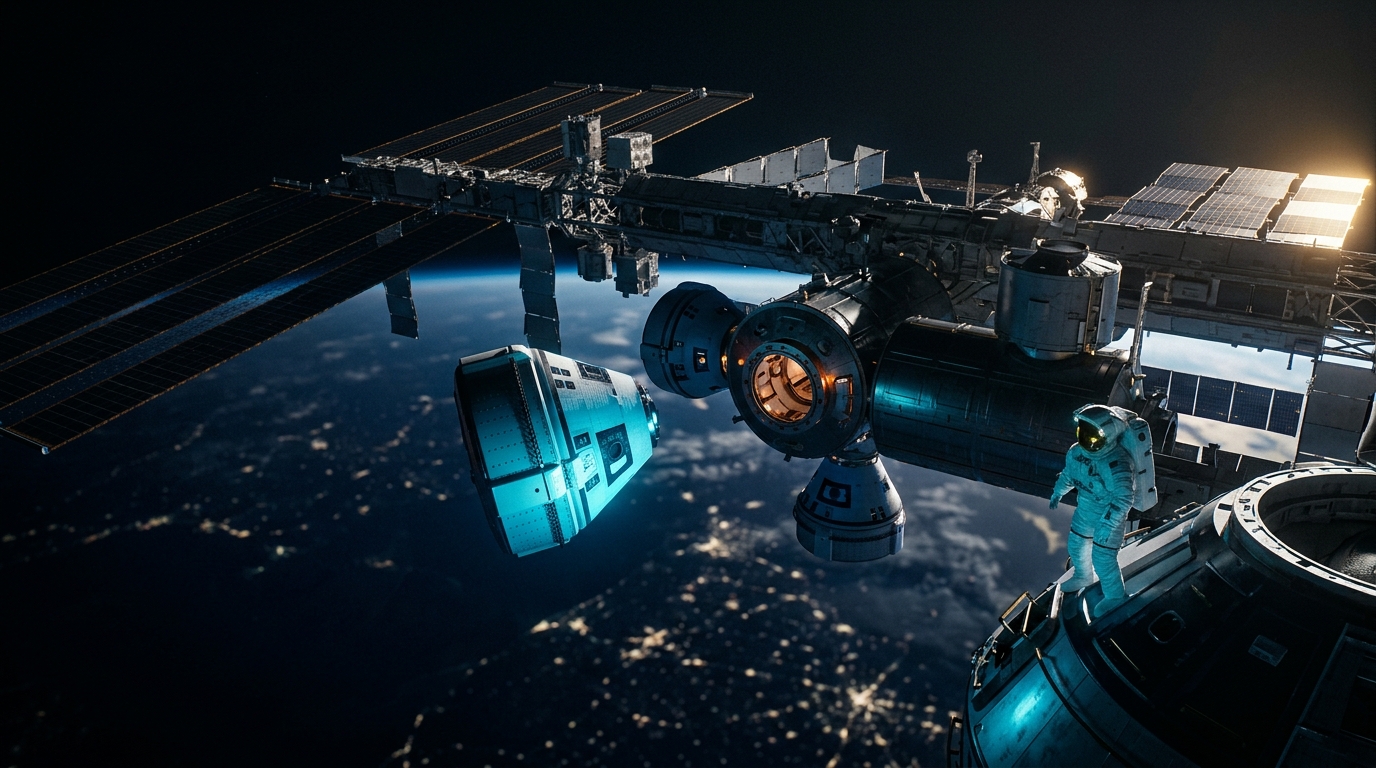
The Future of Starliner: How Boeing's Next Flight Impacts the ISS
Whenever NASA and Boeing adjust the Starliner spacecraft's operational schedule, it is far more than just a technical discussion behind closed doors. For those of us tracking the International Space Station from Earth, understanding these shifts is essential to know which vehicles are docked at any given moment and how the silhouette of the orbital laboratory crossing our night sky evolves.
What Happened
As reported by the specialized outlet SpaceNews, Boeing and NASA are evaluating plans for the next launch of the CST-100 Starliner capsule to the orbital complex. This time, working groups are exploring the possibility of conducting an uncrewed cargo mission.
This approach aims to validate engineering fixes and technical upgrades introduced after analyzing previous missions. During earlier test flights, teams identified performance anomalies in the orbital maneuvering and service module thrusters, prompting thorough reviews using ground simulators and test stands. Flying in cargo mode allows engineers to subject the spacecraft to the real-world stresses of microgravity, acceleration, and orbital thermal shock—gathering critical telemetry on navigation software and autonomous docking without putting human lives at risk.
Setting a final date is no simple task. Approval hinges on syncing capsule readiness at Kennedy Space Center with launch window availability and ongoing operations coordinated from Mission Control in Houston.
Why It Matters
The operational environment aboard the space station is exceptionally dynamic. The Harmony module, which serves as the primary docking port for American and international spacecraft, offers a very limited number of ports. The arrival of any vehicle requires coordinating a crowded manifest shared by SpaceX Dragon capsules, Northrop Grumman Cygnus cargo freighters, and Russian Soyuz and Progress spacecraft.
Compounding this complex scheduling are the fundamental physical constraints of orbital mechanics. One of the most critical factors is the beta angle, which measures the angle between the station's orbital plane and the Sun. This parameter determines how much solar radiation hits the spacecraft's panels and directly impacts the thermal control of onboard subsystems during approach maneuvers. An unfavorable beta angle can cause extreme temperature swings that jeopardize the thrusters of a docking spacecraft.
From NASA’s strategic standpoint, certifying Starliner is the missing piece in securing redundancy for commercial space transportation. The program's goal has always been to maintain two independent vehicles capable of ferrying astronauts and cargo to low Earth orbit. While SpaceX has handled these missions with complete reliability, having a second operational spacecraft ensures that space logistics do not rely on a single fleet should a technical issue temporarily ground one model.
This space traffic management directly affects the daily lives and schedules of those living in space. The station's crew rotates roughly every six months, and every vehicle arrival or departure forces adjustments to those timelines. You can explore the background and roles of those currently on board in our section dedicated to the ISS crew. The case of Butch Wilmore and Sunita Williams—who arrived in 2024 on Starliner’s crew flight test for an intended stay of days and ended up spending over nine months on board—demonstrates how commercial vehicle schedules can alter expedition timelines and orbital science operations.
What to Look For in the Sky
For those of us who love stargazing, changes in the docked vehicle fleet directly shape what we see with the naked eye. Right now, the International Space Station flies at an average altitude of 418 km and travels at a constant speed of 27,606 km/h—live figures you can follow via our real-time ISS tracker.
When a capsule like Starliner enters its rendezvous phase before docking with the station, it creates one of the most mesmerizing sights for skywatchers: two bright points of light chasing each other across the sky. Over several orbits leading up to docking, the capsule trails close to the orbital complex, appearing as two coordinated moving lights against the backdrop of stars.
Furthermore, once the vehicle docks with the main structure, it modifies the complex’s reflective surface. The addition of metallic modules and solar arrays can subtly alter the station's magnitude or brightness during a sunlit night pass. To find out when the best viewing conditions will occur over your city and how to prepare, check out our guide to viewing the ISS and see exact pass times in our space station passes section.
Understanding the technical and scheduling hurdles faced by NASA and Boeing helps us better appreciate what happens above our heads. We invite you to use our tracking tools to be ready the next time the orbital laboratory and its visiting vehicles sweep across your sky.
Source: SpaceNews ↗