Heart Bubbles and Spacewalks: The Medical Challenge NASA Is Reviewing on the ISS
Whenever you look up and see that bright, steady point of light gliding across the night sky, it is easy to forget the extreme hostility of the environment it travels through. The International Space Station flies through the absolute vacuum of space, and keeping a human being alive outside its shielded modules demands physiological engineering just as precise as that of its engines. Yet stepping out into open space still involves invisible hazards unfolding deep within the bloodstream of those on board.
According to NASA's Office of the Chief Health and Medical Officer (OCHMO), a specialized working group has completed a comprehensive review of the latest clinical data on decompression sickness (DCS), venous thromboembolism (VTE) events in microgravity, and the implications of patent foramen ovale (PFO). This reassessment is no mere bureaucratic exercise: it defines how astronauts conducting spacewalks in low Earth orbit today are protected and lays the essential medical groundwork for the Artemis lunar program.
What Happened
The US space agency's medical team has scrutinized three closely interconnected biological phenomena that threaten crew health during extravehicular activities (EVAs):
- Decompression sickness (DCS): Commonly known for affecting deep-sea divers, it occurs when someone moves rapidly from a high-pressure environment to a lower-pressure one, causing nitrogen dissolved in body tissues to form gas bubbles in the bloodstream.
- Patent foramen ovale (PFO): A small natural opening between the heart's right and left atria. Vital for fetal circulation, it typically closes shortly after birth. Roughly 25% of the healthy adult population retains this open passage without experiencing any symptoms on Earth. In space, however, a PFO can allow nitrogen microbubbles to bypass the lungs' natural filtering system and pass directly into arterial circulation, posing a risk of cerebral or neurological embolisms.
- Venous thromboembolism (VTE): The formation of blood clots in deep veins. Microgravity drastically alters fluid distribution in the human body, causing circulation to stagnate in parts of the torso and neck, which increases the risk of unexpected blood clots in orbit.
The OCHMO working group cross-referenced the history of pure-oxygen prebreathe protocols (denitrogenation), subclinical incident logs, and vascular ultrasound studies conducted on the orbital complex. The goal is to update astronaut screening criteria and optimize decompression procedures before crews begin stepping onto the lunar South Pole.
Why It Matters
To understand the scale of this challenge, you have to understand how a spacesuit works. Inside the International Space Station, astronauts live at sea-level atmospheric pressure: 14.7 pounds per square inch (psi), or one standard atmosphere, with a mix of 78% nitrogen and 21% oxygen. However, the American EMU (Extravehicular Mobility Unit) spacesuit operates at just 4.3 psi. If an astronaut stepped straight into the suit without prior preparation, the pressure drop would be so abrupt that nitrogen in their body would literally boil in their blood, causing incapacitating joint pain, asphyxiation, or paralysis.
To prevent this, NASA applies 100% pure oxygen "prebreathe" protocols lasting several hours, sometimes supplemented by light exercise or overnight campouts at reduced pressure inside the Quest airlock. This process flushes nitrogen from tissues before opening the hatch to the vacuum. However, if an astronaut has an asymptomatic patent foramen ovale, the safety margin narrows drastically. Even a tiny number of venous microbubbles that an average person could easily tolerate could cross over to the arterial side of the heart and reach the brain.
Compounding this challenge is the recent discovery that prolonged weightlessness alters blood flow in the internal jugular vein. With no gravity pulling blood toward the feet, fluids pool in the upper body. Blood flow in the neck can become sluggish, stagnant, or even periodically reverse—ideal conditions for blood clot formation. When you combine the risk of venous thrombosis with decompression for a spacewalk, the human body faces a perfect storm that aerospace medicine must manage with mathematical precision.
All of this takes on critical urgency with the Artemis missions. Aboard the station, if an astronaut suffers a severe neurological event or massive thrombosis, a rescue capsule can return them to a terrestrial hospital within hours. On the lunar surface or en route to Mars, immediate evacuation is physically impossible. Next-generation lunar suits will operate under different pressure profiles, and astronauts will conduct far more frequent, physically demanding spacewalks.
Our Take
At the time of writing, our tracker data places the International Space Station flying at an altitude of 416 km and a constant speed of 27,596 km/h. Inside lives a crew rotating in roughly six-month shifts and undergoing regular medical checkups, many featuring ultrasounds astronauts perform on one another guided by teams on the ground.
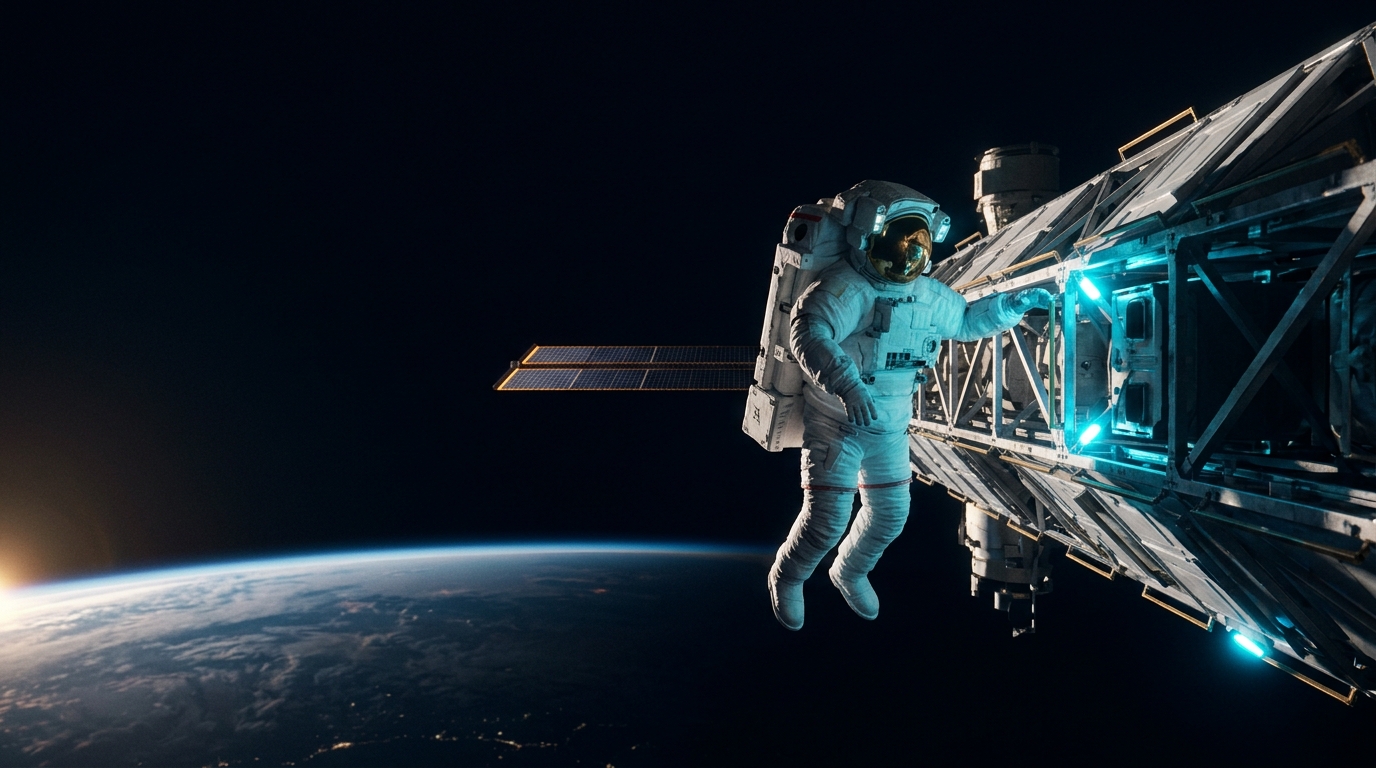
We often watch spacewalks through live streams as slow, peaceful choreographies of white silhouettes suspended above Earth's blue curve. This report reminds us of the reality hidden beneath the layers of Mylar and Kevlar: every excursion outside is an extreme biological stress test. While astronauts float before the camera, their hearts pump under minimal artificial pressures, and their vascular systems fight the formation of microscopic bubbles.
The ISS is not merely a fascinating astronomical vantage point or a materials laboratory; above all, it is the clinical testbed where humanity is learning to survive outside its biological cradle. Every hour astronauts spend breathing oxygen in the station's airlock is an essential step toward ensuring that, within a few years, a crew can descend into a lunar crater without a bubble in the heart jeopardizing their journey home.
The next time you see this orbital laboratory glide across the twilight sky, remember the extraordinary physiological challenge taking place inside, and use our real-time tracker to follow every one of its passes over your city.
Source: NASA ↗