Five Launches in Seven Days: What Orbital Traffic Means for Spotting the ISS
Every time a rocket lifts off into space, low Earth orbit adds new objects to an increasingly crowded space highway. The recent surge of five orbital launches in just seven days, led by SpaceX's Falcon 9 vehicle and China's Chang Zheng 6A rocket, reflects an unprecedented operational pace. For anyone gazing up at the night sky from their hometown, this heightened activity changes how we identify lights crossing overhead and raises important questions about the safety of the inhabited orbital complex.
What Happened
Space news has seen an extraordinary concentration of orbital operations in a very brief window. As reported by specialized outlet NASASpaceflight, international flight manifests coordinated up to five missions in a single week, driven primarily by the planet's two largest spacefaring powers: the United States and China.
On the Asian side, the standout vehicle was the Chang Zheng 6A (Long March 6A). This medium-lift launcher features a hybrid design, combining a liquid-propellant core stage with four solid-fuel boosters strapped to its structure. This configuration provides Chinese space authorities with the power and flexibility required to place heavy payloads into Sun-synchronous orbits. The mission is part of Beijing's strategy to deploy its own megaconstelations of telecommunications and Earth observation satellites, while also supporting orbital logistics for its Tiangong space station.
Meanwhile, in the West, American firm SpaceX continues to set the operational tempo with its reusable Falcon 9 rocket. This vehicle has established itself as the cornerstone of the commercial aerospace industry thanks to its ability to recover and reflown its first stage. The high launch frequency of the Falcon 9 is driven by the massive, ongoing deployment of the Starlink internet network, alongside payload deliveries for commercial customers and government institutions. What years ago would have been an extraordinary milestone—launching multiple rockets in a matter of days—has become standard operational routine in low Earth orbit.
Why It Matters
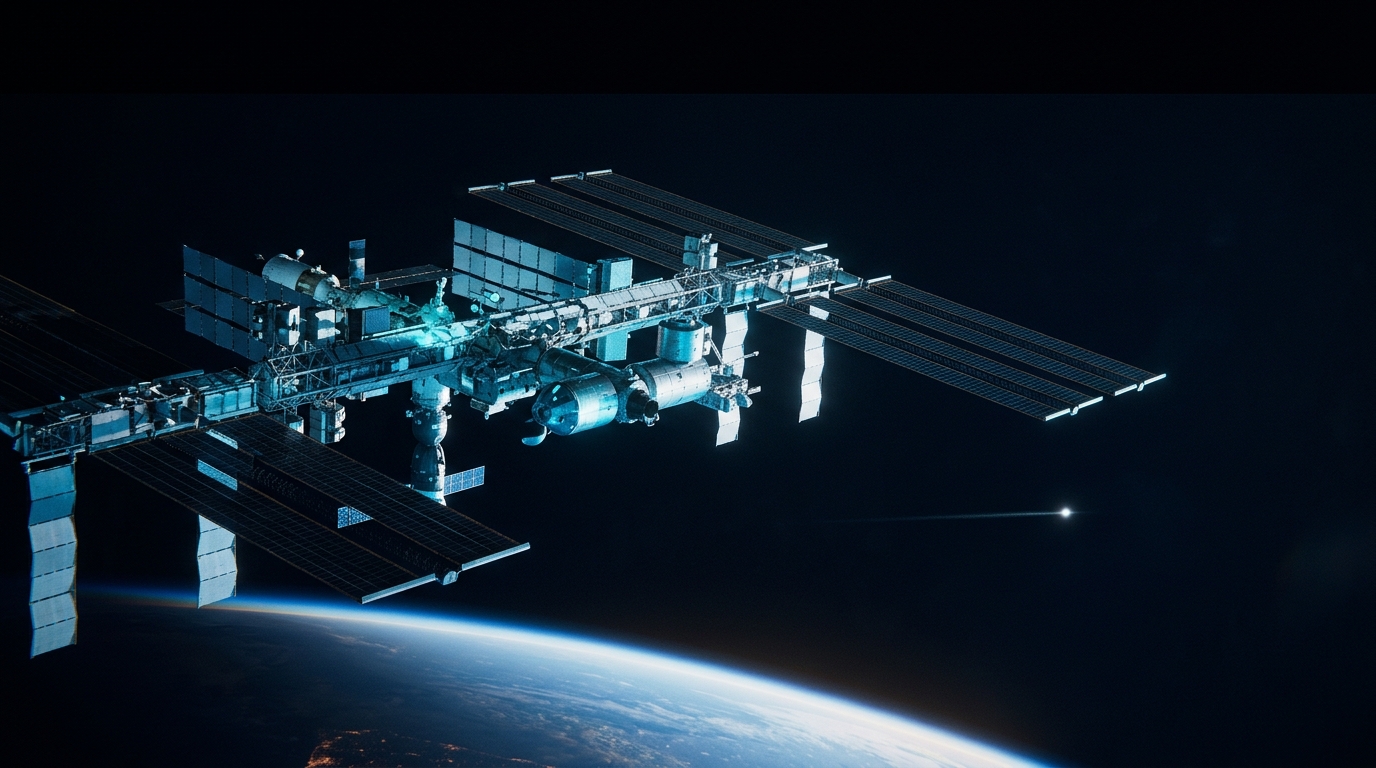
Beyond industry figures, this intense launch cadence directly impacts the dynamic environment of low Earth orbit (LEO), the very region where the International Space Station travels. According to real-time data from our tracker, the ISS currently orbits at an average altitude of 439 km above Earth's surface, cruising at a blistering speed of 27,528 km/h. At this velocity, the station completes an orbit around Earth roughly every 90 minutes.
Adding dozens of new satellites and rocket upper stages to this environment in such short timeframes demands constant coordination and telemetry tracking. The buildup of operational objects and rocket debris heightens the risk of space conjunctions—situations where two orbiting bodies come dangerously close to one another. When a new batch of satellites is deployed, their initial orbits must be cataloged and tracked with pinpoint accuracy to ensure they do not unexpectedly intersect with the path of the international complex.
This orbital traffic management is vital for crew safety. The ISS has been continuously inhabited since November 2000 by international crews rotating every few months. To see who is currently on board and learn about their missions, you can check our detailed profile of the current crew on board. Protecting these astronauts and cosmonauts directly depends on agencies like NASA and their international partners anticipating any close encounters and executing collision avoidance maneuvers whenever necessary.
What to Look for in the Sky
For stargazers on the ground, an increase in rocket launches translates directly into more visible action across the celestial dome, but also potential confusion. After a Starlink Falcon 9 launch, skywatchers frequently spot a straight line of bright dots gliding across the night sky. This phenomenon, known as a "Starlink satellite train," is often mistakenly reported as unidentified flying objects or confused with a pass of the station itself.
Telling the International Space Station apart from these new satellite deployments is simple once you know what to look for during your night sky observations:
- Brightness and magnitude: The ISS is, by far, the brightest artificial object in the night sky. Thanks to its massive solar arrays, it reflects sunlight to reach brilliant magnitudes (often rivaling the brightness of Venus). Newly launched or smaller satellites are noticeably dimmer.
- Trajectory and consistency: The space station glides across the sky as a steady, non-blinking point of white light, taking between 3 and 6 minutes to make its crossing from horizon to horizon. Satellite trains, on the other hand, travel in a tight single file during the first hours or days after launch, gradually spreading out as they boost to their operational orbits.
- A single object vs. multiple lights: Unless a cargo ship or crew capsule is actively maneuvering to dock, the ISS appears as a single, prominent light. If you see a cluster or line of dots moving together, you are looking at the early deployment phase of a satellite constellation.
If you want to plan your stargazing sessions with confidence, we recommend checking out our guide to spotting the ISS, where we cover the basics of visibility, elevation, and visual magnitude. To make sure you never miss a clear pass from your exact location, you can also check what time the ISS passes over your area in the coming days.
Outer space is more crowded than ever, but spotting humanity's largest orbital outpost remains an awe-inspiring experience. We invite you to use our real-time tracker to follow the exact position of the ISS on the global map and know just when to look up at the stars.
Source: NASASpaceflight ↗