When the ISS Passes Over Spain: How to Find the Exact Time for Your City
If you have ever searched for what time the International Space Station passes over your city, you have probably found that almost none of the answers are helpful: they either give you a generic timetable for the entire country or throw a table of coordinates at you without explaining anything. The trouble is that the question does not have a single answer, and it is worth understanding why before looking at any schedule.
There is no "time the ISS passes over Spain"
The ISS orbits the Earth roughly every 92 minutes at an altitude of around 400 kilometers and a speed of 27,600 km/h. That means it flies over the Iberian Peninsula several times a day. But flying overhead is not the same as being visible: most of these passes occur in daylight, or while the station is plunged into Earth's shadow, meaning there is absolutely nothing to see.
For a pass to be visible, three conditions must be met at the same time. First, it must be night where you are: the sky has to be dark. Second, the ISS cannot be in Earth's shadow; it must be illuminated by the Sun from above. And third, its path must take it high enough above your horizon so that buildings or mountains do not block your view.
The combination of these three factors only happens during specific windows: typically between one and two hours after sunset, or between one and two hours before sunrise. In the middle of the night, the station is almost always eclipsed.
Why your city matters more than it seems
The orbit of the ISS is inclined at 51.6 degrees relative to the equator. That figure, which might sound like a technicality, determines where it can fly: the station never passes over points above 51.6 degrees north latitude or below 51.6 degrees south. All of Spain sits comfortably within that range, between 36 degrees in Tarifa and 43.8 degrees at Estaca de Bares, so it gets great visibility.
Yet within that margin, there are substantial differences. Two cities 400 kilometers apart can experience the same pass with very different maximum elevations: in one, the ISS might cross near the zenith, making it impossible to miss, while in the other, it barely creeps 15 degrees above the horizon and hides behind the nearest apartment block. That is why a timetable "for Spain" is useless: you need calculations for your exact coordinates, not the capital's.
There is a second, less obvious factor: your actual horizon. Living on the coast facing the sea gives you a clear 0-degree horizon. Living in an inland valley can rob you of the first 20 degrees of sky. That turns passes that look perfectly valid on paper into ones you will never actually see.
How to calculate it accurately for where you live
The reliable method is always the same: start from your exact position and the station's actual trajectory over the coming hours, not from an average. Our visible pass calculator does just that, and the real-time tracker shows you where the ISS is at this very moment—which is the best way to understand why tonight's pass follows the path it does.
When you check the results, look at three key details rather than just one:
- Start time: when it appears above the horizon. Head outside five minutes early, not right on the dot.
- Maximum elevation: above 40 degrees, it is a great pass; below 20 degrees, be prepared to miss it if there are buildings around you.
- Entry and exit direction: it almost always appears in the west and heads toward the east. Face west before it starts.
What to look for in the sky
The ISS does not flash and has no colored lights: those are airplanes. What you will see is a very bright, steady white dot moving smoothly and silently across the sky, taking between three and six minutes to cross. On a good pass, it outshines Venus and is easily visible even from light-polluted city centers. You do not need a telescope or binoculars; in fact, they get in the way, because at that speed you will lose sight of it the moment you try to focus.
One detail that catches many first-timers off guard: the station often suddenly fades out mid-transit before reaching the horizon. Nothing strange has happened; it has simply slipped into Earth's shadow. If you witness this, you have seen a perfectly normal pass.
If you want to prepare your viewing session in greater detail, our guide to viewing the ISS breaks down brightness, timings, and common mistakes beginners make.
Check your local schedule and head outside: as long as you know where west is and give yourself a five-minute cushion, you will spot the ISS on your very first try.
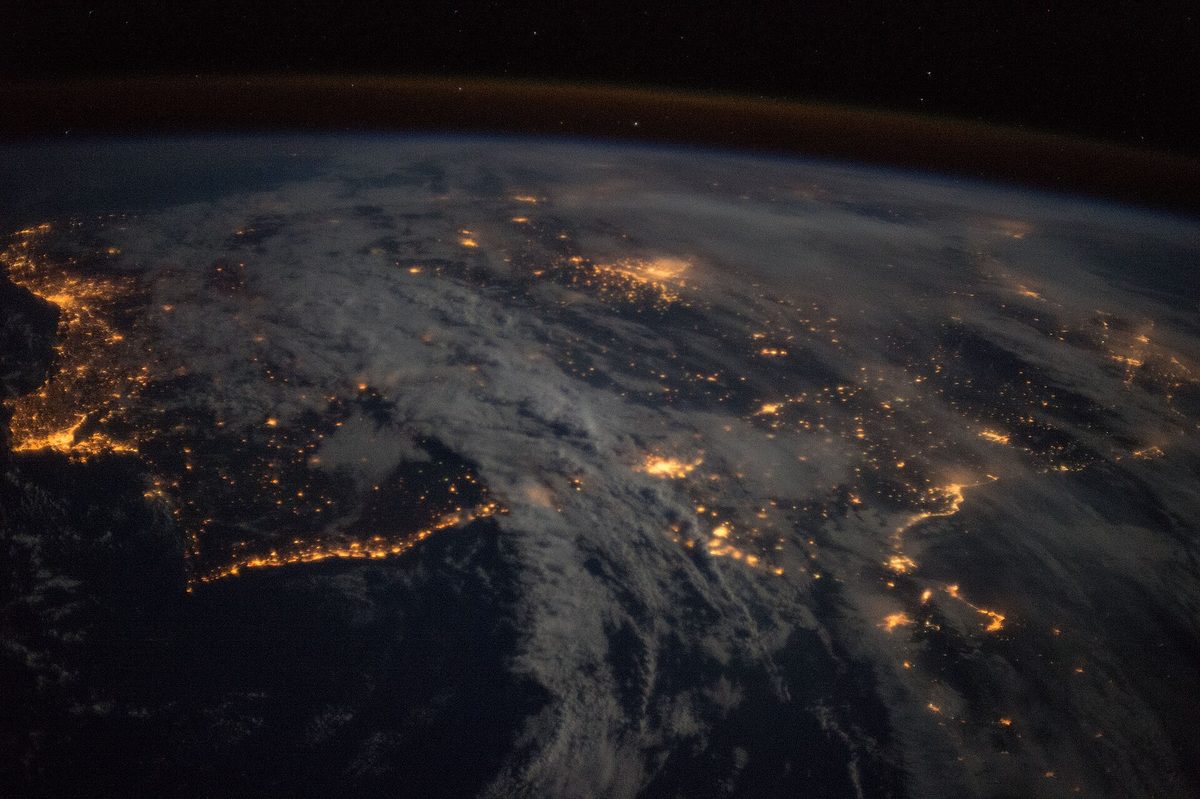
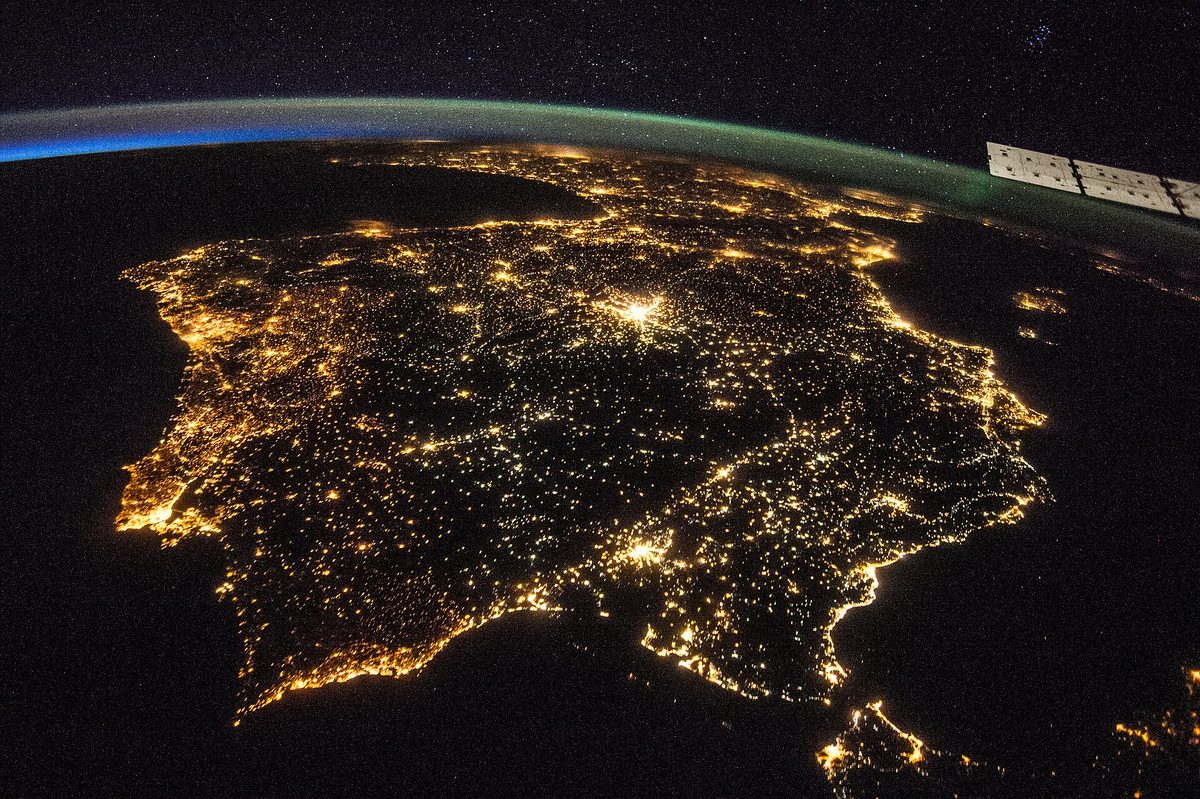
Images: cover, ISS-46 Spain at night — NASA/Tim Kopra (Public domain). Interior, ISS-40 Iberian Peninsula at night — NASA (Public domain).
Source: ISS Tracker ↗