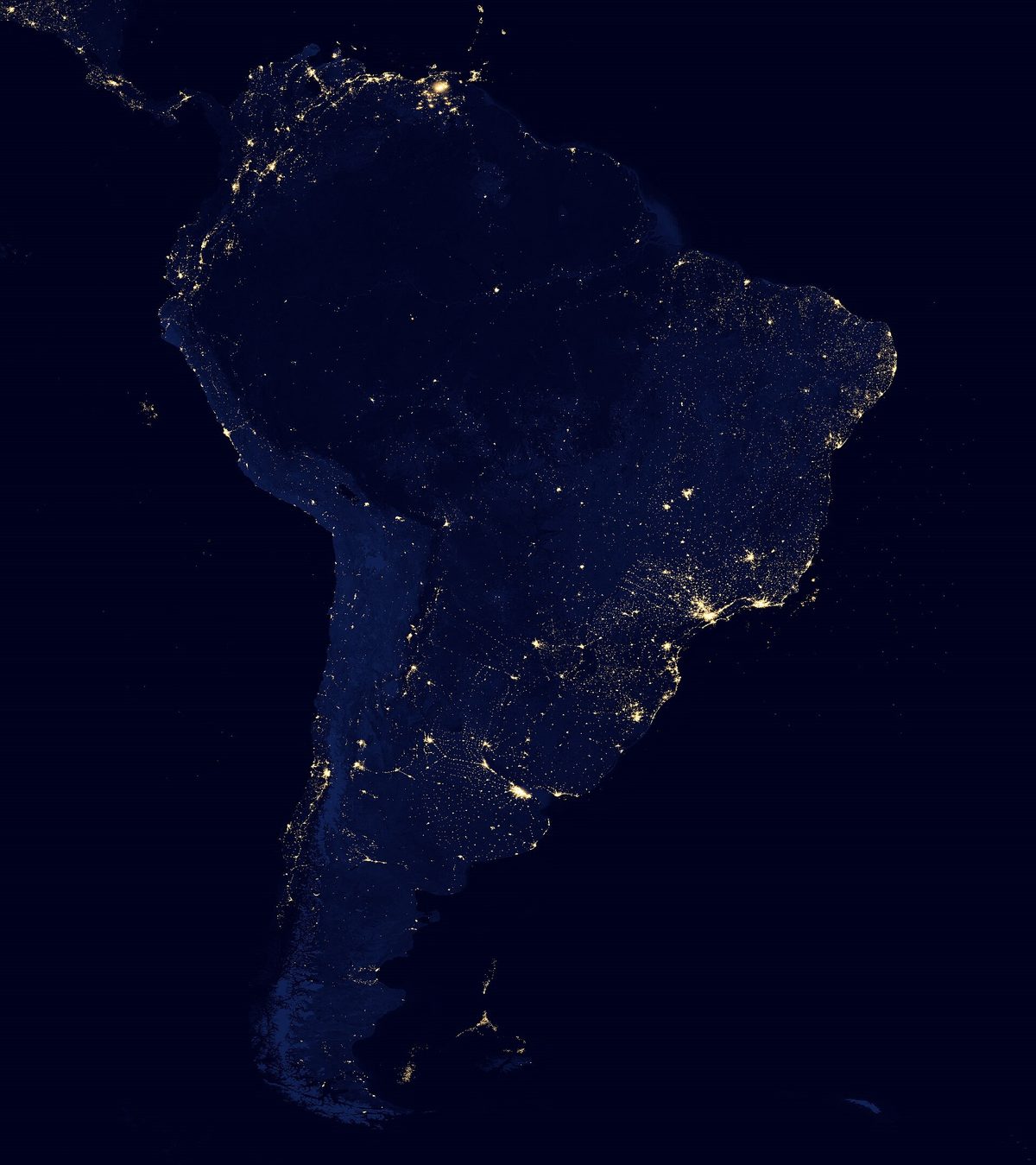
When the ISS Passes Over Latin America: Mexico, Colombia, Peru, Brazil & Southern Cone
The International Space Station can be seen just as clearly from Mexico City as from Madrid, but the rules change enough that copying a European schedule is completely useless. If you live in Latin America and want to watch it cross the sky, here is what you need to know.
All of Latin America Is Within Reach of the ISS
The station's orbit is inclined at 51.6 degrees to the equator, which sets the boundary: it only flies directly over the band between 51.6 degrees north latitude and 51.6 degrees south. Mexico, Guatemala, Colombia, Venezuela, Ecuador, Peru, Brazil, Bolivia, Paraguay, Uruguay, Chile, and almost all of Argentina easily fall within this range.
The only real exception is in the far south: Ushuaia and southern Patagonia, below 52 degrees, lie just outside the ground track. From there, the ISS can still be seen low on the northern horizon during some passes, but never directly overhead.
What Changes Compared to Spain
There are three practical differences worth keeping in mind.
The length of twilight. Near the equator, in Bogotá, Quito, or Panama City, night falls very quickly: the Sun sets almost vertically, and within 45 minutes it is pitch black. That compresses the observation window. In Spain or southern Argentina, twilight lingers much longer in summer, offering more generous windows. If you are in the equatorial zone, the window to catch a good pass is narrower, and you need to be punctual.
Reversed seasons. In the Southern Hemisphere (Chile, Argentina, Uruguay, southern Brazil), the best viewing seasons fall in the opposite months to those in Europe. When the ISS strings together visible passes night after night over Spain in June, it is midwinter in Buenos Aires, and the viewing conditions are completely different.
Time zones. It sounds obvious, but it is the most common mistake: Mexico has several time zones, as does Brazil, and Chile switches daylight saving time on different dates than Europe. Any schedule you check must be calculated for your local time, not roughly converted from UTC in your head.
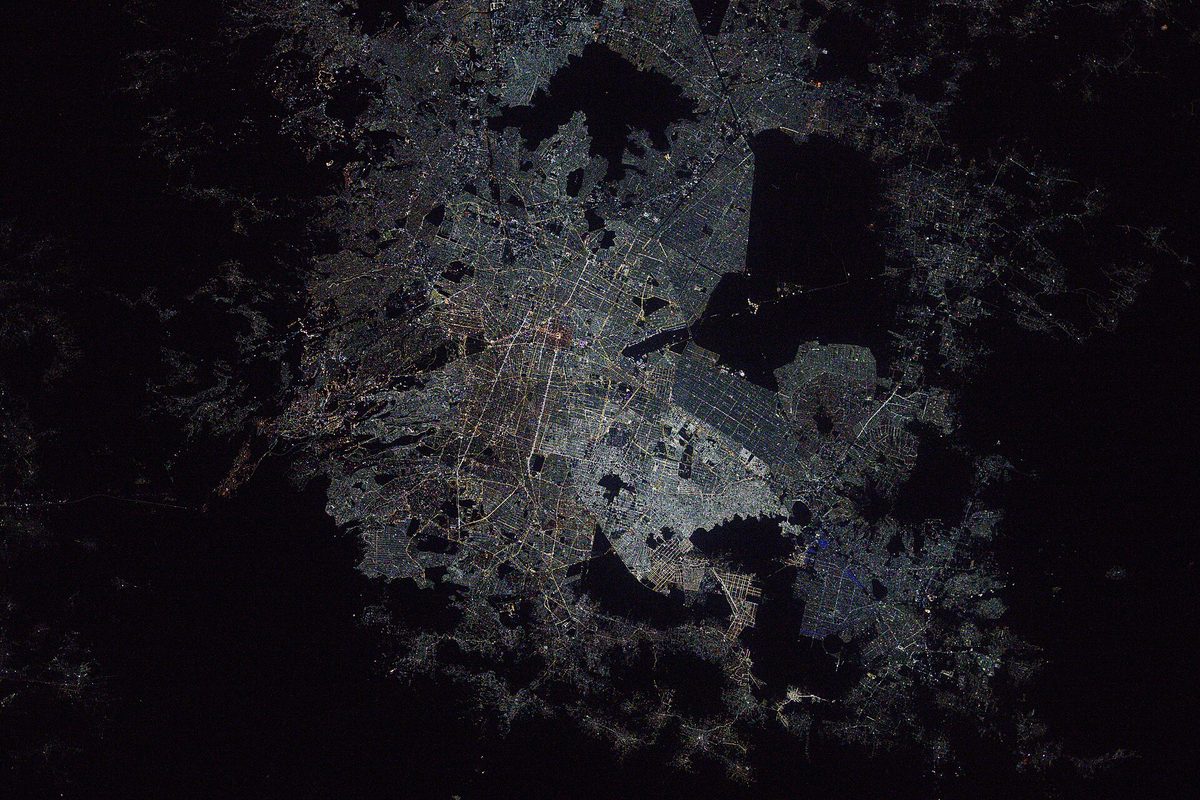
City by City: What to Expect
- Mexico City, Guadalajara, Monterrey: latitudes between 19 and 25 degrees north, great for high-elevation passes. The obstacle here is not the orbit, but light pollution and tall buildings.
- Bogotá, Medellín, Quito, Lima: practically on the equator, featuring frequent passes but short twilight windows. In Bogotá and Quito, mountain cloud cover is an additional factor to consider.
- São Paulo, Rio de Janeiro, Brasília: excellent coverage, with the advantage that the sky clears up at dusk for much of the year.
- Buenos Aires, Montevideo, Santiago: between 33 and 35 degrees south, a very good position. Santiago adds the advantage of having some of the world's best skies just a short distance away.
How to Find Your Exact Pass Time
There is no shortcut: passes must be calculated for your specific coordinates, as a difference of just a couple of degrees in latitude changes the maximum elevation and determines whether you can spot it or not. Our pass calculator works based on your exact location, and the real-time tracker shows you the station's current position on the map, which helps a lot in visualizing where it will appear.
Always check the maximum elevation. Above 40 degrees, you get an easy pass from almost anywhere. Between 20 and 40 degrees, it is visible, but you need a clear horizon in the right direction. Below 20 degrees in a city, consider it a lost cause unless you are on a rooftop.
What You Will See
A very bright, non-blinking, colorless white dot moving steadily in a straight line for three to six minutes. It does not look like an airplane, which flashes, nor like an ordinary satellite, which is much fainter. On a good pass, the ISS outshines any star in the sky.
And yes, it is visible from the center of a major city: it is bright enough to cut through the light pollution of Mexico City or São Paulo. You do not need any kind of equipment. If you want to dial in further, our complete observation guide explains how to interpret brightness and what mistakes to avoid on your first night.
Check your schedule, look toward the west, and head outside a couple of minutes early: that is all it takes to watch it cross the sky.
Images: cover, South America night — NASA Earth Observatory (Public domain). Interior, Mexico City, the capital and most-populous city of the Latin American nation (iss073e0075943) — NASA Johnson Space Center (Public domain).
Source: ISS Tracker ↗