How Many Times a Day Does the ISS Fly Over Your House?
The International Space Station orbits the planet about sixteen times a day. The natural question is how many of those orbits pass directly over your house, and the answer comes down to two very different numbers: how often it flies over, and how often you can actually see it.
How Many Times It Actually Passes Overhead
Counting every pass, visible or not, the ISS flies over your area between two and five times on a typical day from mid-latitudes like those of Spain or Argentina.
The number is not constant because the station does not follow the exact same ground track. It takes about 92 minutes to complete an orbit, during which the Earth rotates roughly 22 degrees beneath it, shifting each successive orbit westward. The overall pattern gradually drifts day by day.
When the ground track aligns near your latitude, you can get four or five flyovers in a single day, often grouped into two clusters separated by several hours. When the pattern shifts away, that drops to one or two.
An important nuance: "passing overhead" does not mean directly above your head. From an altitude of 400 kilometers, the ISS is geometrically visible across a circle over two thousand kilometers wide, meaning most of those passes put it tens or hundreds of kilometers away from you, low on the horizon.
How Often You Can Actually See It
Here, the number drops dramatically: between zero and three visible passes a day, and on many days, none at all.
The reason is that spotting the station requires three conditions to be met simultaneously:
- It must be night where you are. During the day, the sky is too bright, no matter how luminous the ISS is.
- The station must be illuminated by the Sun. Because it is 400 kilometers up, it continues to catch sunlight long after sunset on the ground. But once it enters Earth’s shadow, it disappears.
- It must climb high enough above your horizon. A pass that does not exceed ten degrees in elevation will be hidden behind buildings, trees, or mountains.
The overlap of all three conditions leaves a narrow window: the two to three hours after dusk and before dawn. Anything passing at midday or in the middle of the night does not count.
The Viewing Cycle
If you start checking sighting forecasts daily, you will quickly notice a pattern repeating roughly every nine weeks.
For seven to ten consecutive days, there are great visible passes—sometimes two or three a night—with each pass occurring about twenty minutes earlier than the previous one. Then the streak fades: flyovers continue, but they all happen while the station is in Earth's shadow. For a couple of weeks, there is nothing to see. Then the cycle starts all over again.
So if no decent passes show up today, your tool is not broken: you are simply in a trough of the cycle. A good rule of thumb is to check every few days and make the most of active streaks.
The Best Pass of the Week
Not all visible passes are created equal. The two deciding factors are maximum elevation and brightness magnitude.
A pass exceeding sixty degrees of elevation crosses almost directly overhead, lasts longer, and shines brighter: this is the one worth stepping outside for or setting up a tripod. A pass that tops out at fifteen degrees is technically visible, but in an urban area, it will likely be obstructed.
The most efficient approach is to check the next seven days all at once in the pass timetable calculator and pick the pass with the highest elevation of the entire week. That is the one to put on your calendar.
Keep in mind that within a viewing streak, passes shift earlier each night, so never rely on yesterday's timetable.
What to Expect When You Head Outside
A visible pass lasts between three and six minutes. The ISS appears in the west as a white point of light that gradually brightens, crosses the sky in a straight line without blinking or making a sound, and fades toward the east.
It is very common for it not to reach the opposite horizon: during many passes, it fades mid-sky as it enters Earth's shadow. This is not a forecast error, and if you are taking long-exposure photographs, the truncated light trail looks even more striking.
Practical tips, from where to stand to how to distinguish it from an airplane, can be found in our spotting guide. And to see where it will be coming from, it helps to check its current ground track on the map via the real-time tracker.
It passes several times a day, every single day. Seeing it is just a matter of picking the right night.
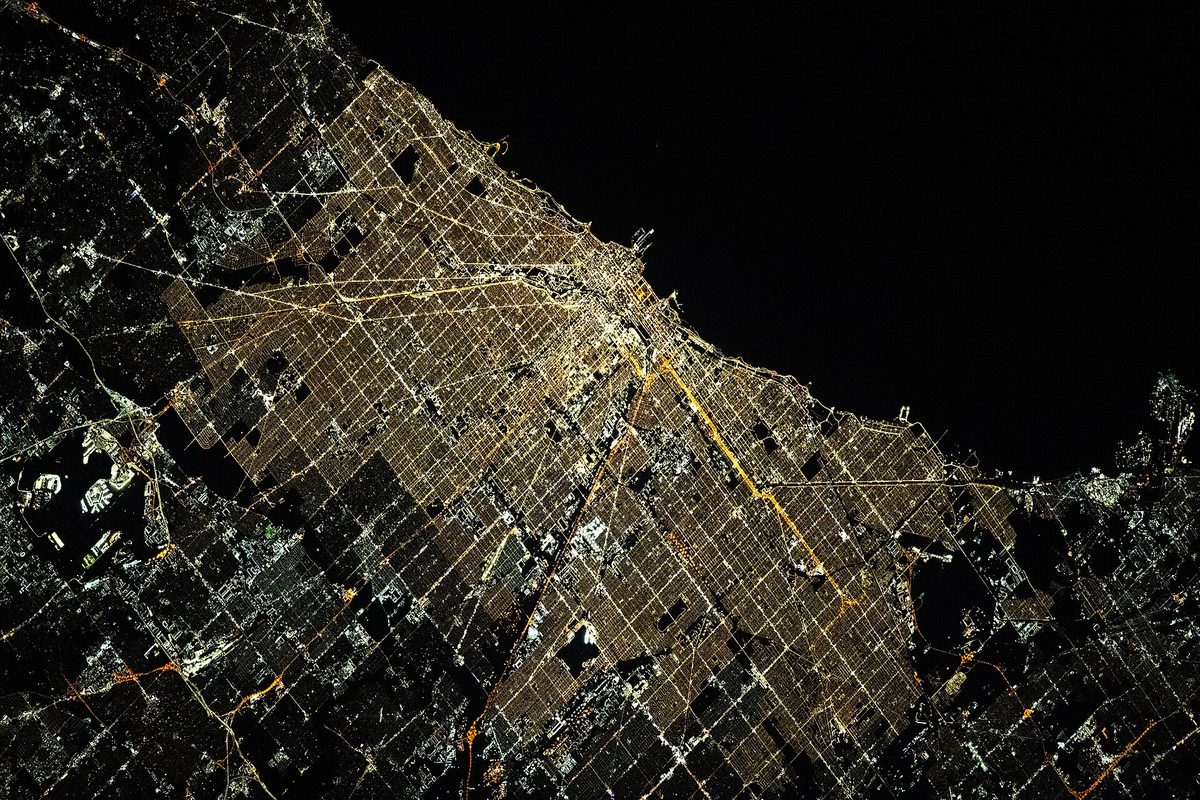
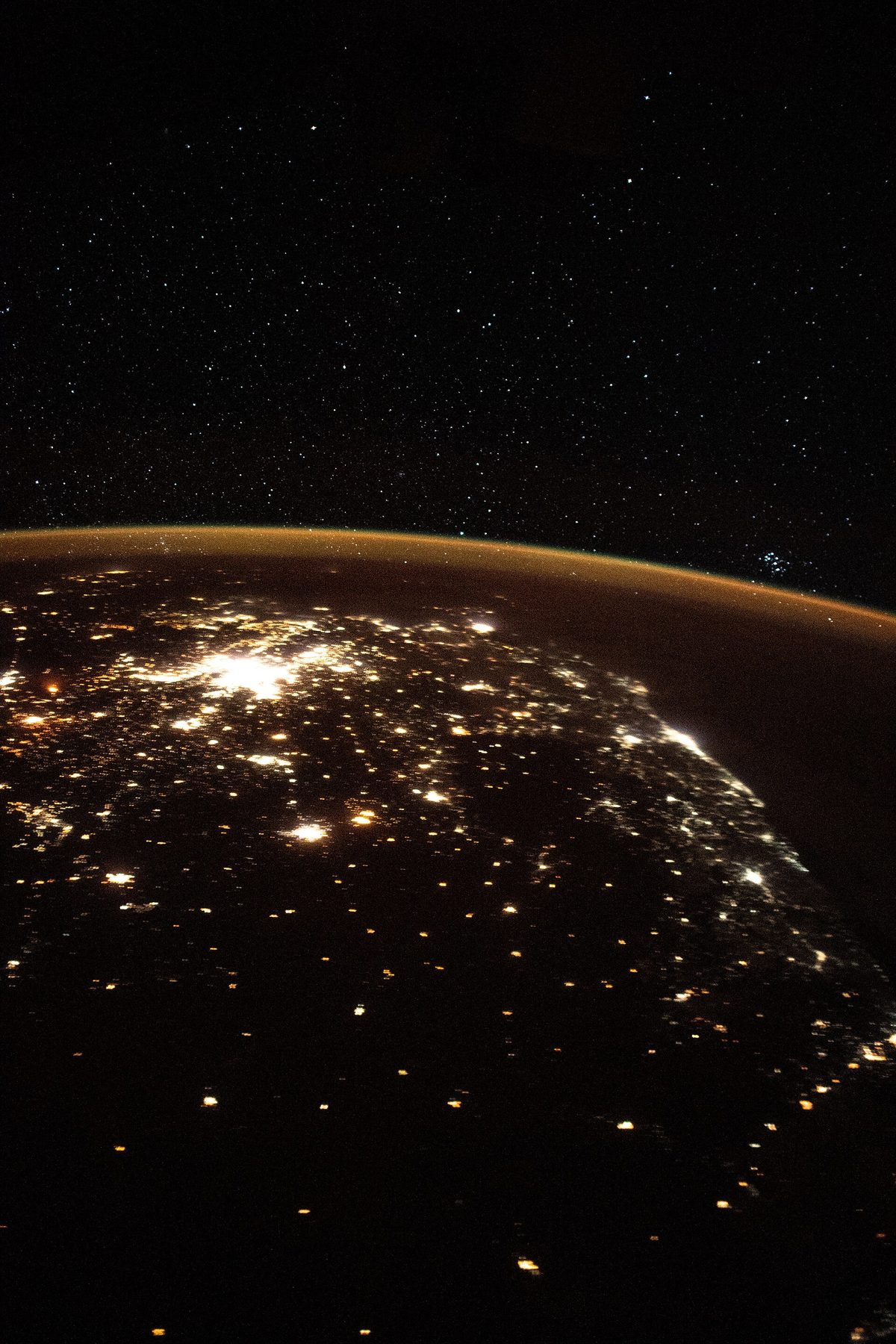
Images: cover, Windy City of Lights (153622) — Astronaut photograph ISS070-E-105097 was acquired on March 1, 2024, with a Nikon D5 digital camera using a focal length of 400 millimeters. It is provided by the ISS Crew Earth Observations Facility and the Earth Science and Remote Sensing Unit, Johnson Space Center. The image was taken by a member of the Expedition 70 crew. The image has been cropped and enhanced to improve contrast, and lens artifacts have been removed. The International Space Station Program supports the laboratory as part of the ISS National Lab to help astronauts take pictures of Earth that will be of the greatest value to scientists and the public, and to make those images freely available on the Internet. Additional images taken by astronauts and cosmonauts can be viewed at the NASA/JSC Gateway to Astronaut Photography of Earth. Caption by Sara Schmidt, GeoControl Systems, JETS II Contract at NASA-JSC. (Public domain). In-text, ISS-65 Night lights of South Africa — NASA (Public domain).
Source: ISS Tracker ↗