How Long Does the ISS Take to Orbit the Earth?
Ninety-two minutes. That is how long it takes the International Space Station to make one complete orbit around Earth. Less than the running time of a movie, and in that span it has crossed oceans and continents, witnessing one sunrise and one sunset.
The exact number and why it varies
The orbital period of the ISS ranges between 92 and 93 minutes, depending on its altitude at any given moment. That works out to 15.5 orbits per day, which is usually rounded to sixteen.
This figure is neither an arbitrary design choice nor something that can be adjusted at will. For any given orbital altitude, there is only one possible period: altitude dictates orbital time. At 400 kilometers, it takes 92 minutes; if the station were higher, it would take longer, and if it were lower, less.
Because the ISS continuously loses altitude due to friction with the residual atmosphere and regains it through periodic reboosts, its orbital period fluctuates slightly over the months. It is only a matter of seconds, but it is real.
Sixteen sunrises a day
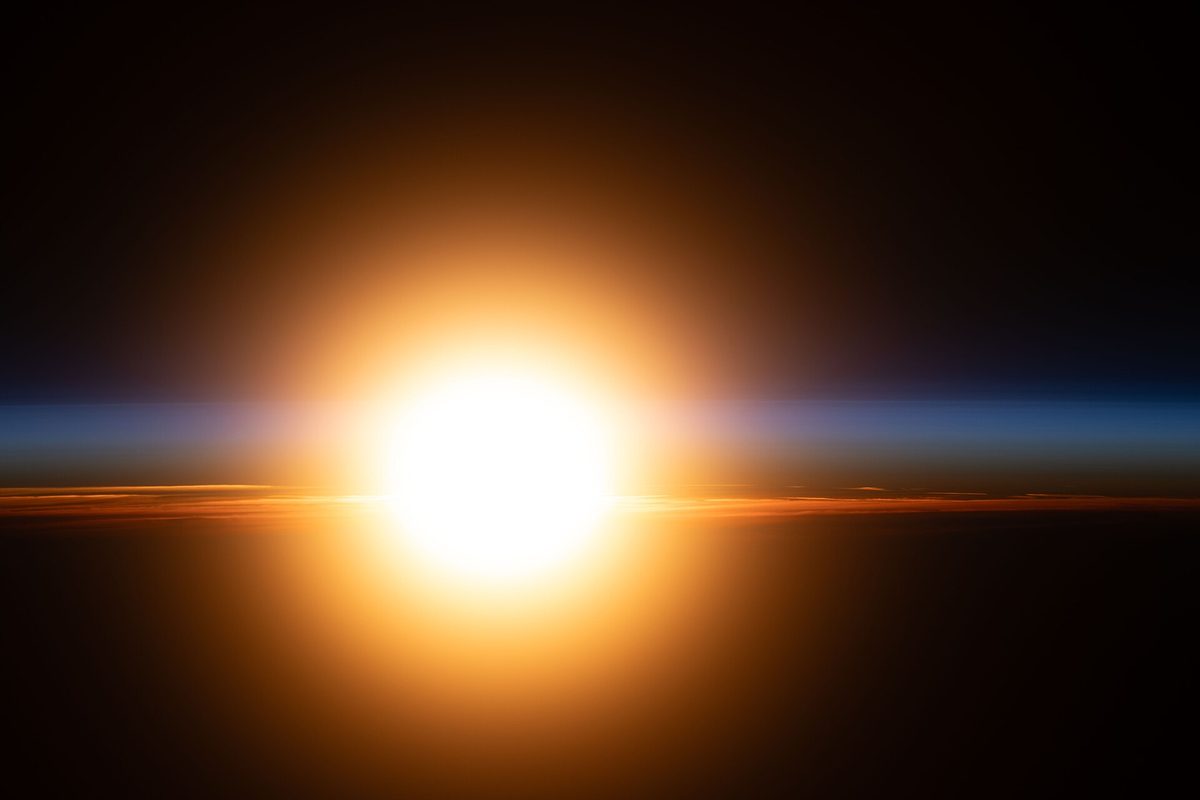
The most striking consequence of this pace is what the crew sees. On each orbit, the station spends about 45 minutes in full sunlight and another 45 in Earth's shadow. Multiply that by sixteen orbits: sixteen sunrises and sixteen sunsets every twenty-four hours.
This creates a practical challenge that must be managed on board. The human body regulates its internal clock through light, and alternating day and night every 45 minutes completely disrupts it. To solve this, the station operates on a shared reference time—Coordinated Universal Time (UTC)—using window blinds and scheduled lighting to simulate a standard 24-hour cycle. We cover how sleep and the rest of the daily routine are organized in life on the ISS.
Why it never takes the same path
Here is the detail that explains almost everything else. While the ISS completes its 92-minute orbit, Earth keeps rotating beneath it. During that time, the planet turns about 22 degrees.
As a result, each orbit crosses the equator roughly 2,400 kilometers further west than the previous one. On a map, this is clearly visible: the ground track forms a series of waves steadily shifting to the left.
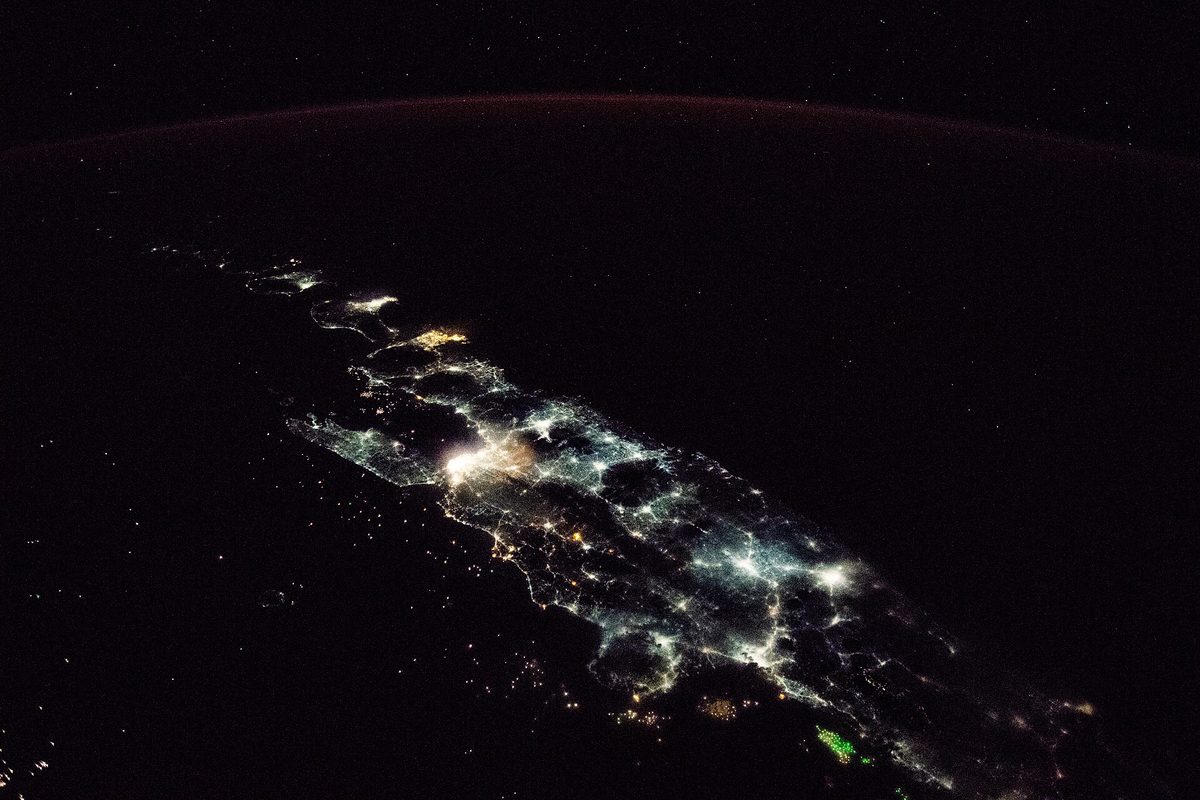
This leads to two interesting outcomes. First, the ISS ends up flying over virtually all inhabited parts of the planet between 51.6 degrees north and south latitude, which marks the limit of its orbital inclination. Second, it never passes over the exact same spot twice in a row: the track shifts day by day and only roughly repeats after quite a few days.
You can find the full orbital mechanics in how the ISS orbits.
What this means for spotting it from the ground
The 92-minute cycle has a very specific effect during good viewing periods. When you are in a visibility window, you can watch the station pass overhead, wait an hour and a half, and spot it again on the next orbit—this time shifted west and usually lower in the sky.
Two or even three passes in a single night are entirely possible. The best ones occur at the start of the viewing window, when the station flies high overhead and is fully illuminated.
That alternating 45 minutes of light and 45 minutes of shadow also explains the phenomenon that most confuses first-time observers: seeing the ISS suddenly disappear in the middle of the sky without reaching the horizon. Nothing broke and the prediction did not fail: it simply entered Earth's shadow and stopped reflecting sunlight.
Watch it live
All of this makes much more sense when you see it in real time rather than reading about it. On the live tracker, you can follow its path and watch the ground track shift from one orbit to the next across the map.
The next step is to head outside and look up: check the next visible pass for your location with the pass predictor, and if it is your first time, take a look at the spotting guide beforehand to know what to expect.
Ninety-two minutes per orbit. By the time you finish reading this, the ISS will have covered a good chunk of its own.
Images: cover, A bright orange sunburst illuminates Earth's atmosphere during an orbital sunrise (iss074e0779393) — NASA Johnson Space Center (Public domain). Interior, Lights of Java — NASA (Public domain).
Source: ISS Tracker ↗