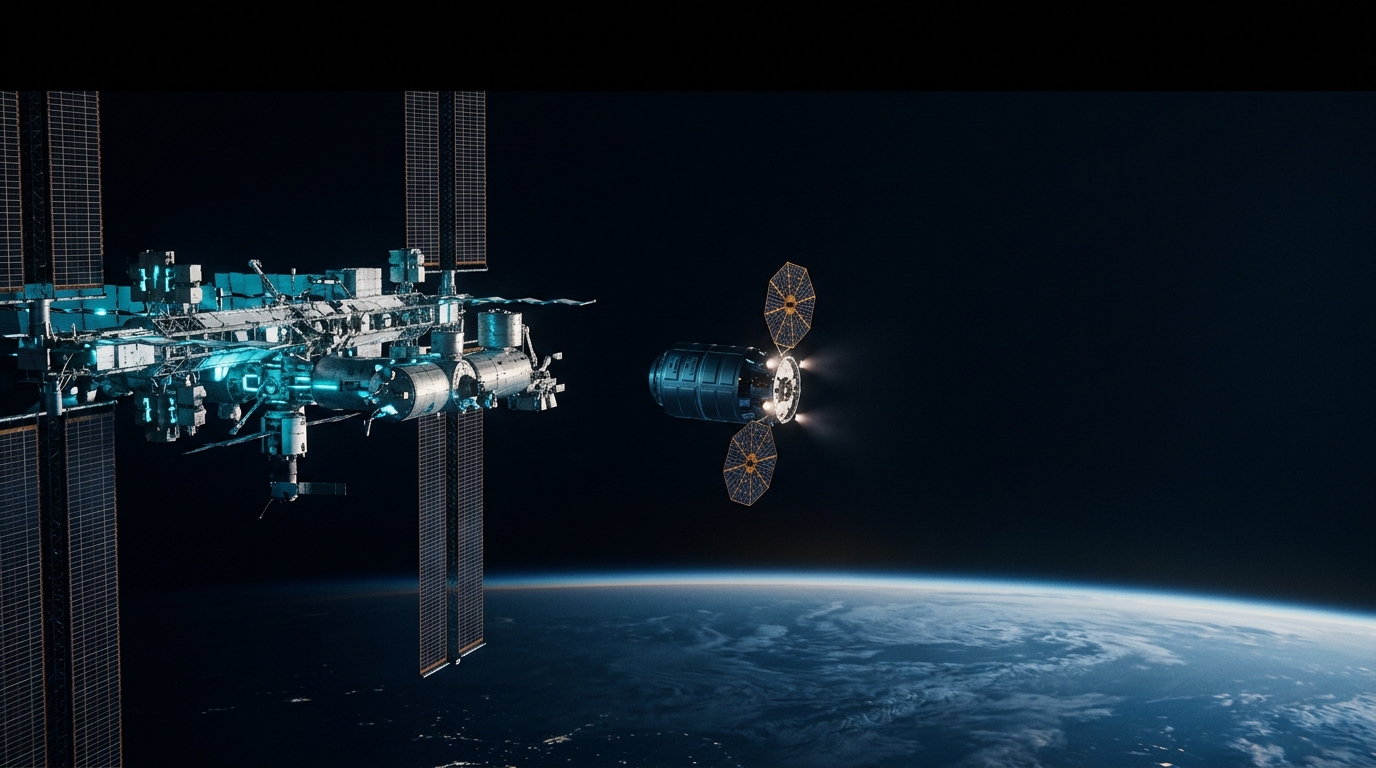
Cygnus CRS-24 Departs the ISS: Orbital Manoeuvre and What to See in the Sky
One of the largest cargo ships serving the International Space Station is preparing to cast off and begin its journey home. The departure of the Cygnus XL spacecraft for the CRS-24 mission concludes a vital logistics and scientific resupply stay in low Earth orbit. For those of us tracking the orbital complex from our towns and cities, this type of manoeuvre does not just alter the space laboratory's mass—it adds a unique dynamic to night skywatching.
Below, we break down the technical details of this farewell, the role it plays in station routine, and what you can look for when glancing up during its upcoming passes across your horizon.
What happened
The Cygnus XL resupply craft, operated by Northrop Grumman under contract with the US space agency, is scheduled for orbital release this Friday. The mission, commercially designated Northrop Grumman CRS-24, brings an end to its berthed stay at the outpost after delivering more than 11,000 pounds (approximately 5,000 kilograms) of vital supplies, mechanical hardware, and cutting-edge science investigations, according to NASA's official operations schedule.
Unlike crewed capsules or other cargo freighters that dock autonomously via hard-docking mechanisms, Cygnus operates under assisted berthing procedures. This means departure is not simply an undocking with mechanical push-off springs: ground flight controllers remotely operate the station's Canadarm2 robotic arm to unbolt and unberth the spacecraft from the Unity module, manoeuvre it to a safe distance below the complex, and gently release it into the void. The entire release and departure manoeuvre is also covered on official live streams before the capsule fires its thrusters to fly away for good.
Why it matters
The steady cadence of visiting cargo vehicles is the true lifeblood of the station. Without this continuous pipeline, maintaining an inhabited environment more than four hundred kilometres above the ground would be impossible. This particular mission holds special significance for several structural and human reasons:
- Waste management and freeing up space: Lacking a heat shield designed to survive re-entry, Cygnus serves a secondary yet indispensable role: acting as the outpost's giant incinerator. Over recent weeks, astronauts have packed tons of disposable items, retired suits, packing materials, and biological waste inside it. As it plunges into Earth's dense atmosphere over an unpopulated stretch of the South Pacific Ocean, the spacecraft and its contents will safely and completely burn up.
- Berthing port turnover: The departure of CRS-24 vacates the Earth-facing (nadir) port of the Unity module. Keeping these ports available is critical to ensure a seamless turnaround for future cargo runs and commercial spacecraft already queuing on launch pads back on Earth.
- Supporting a full crew: Keeping the orbital outpost functioning demands massive quantities of water, fresh food, atmospheric gases, and spare parts. Right now, the current crew on board numbers eleven: Jessica Meir, Jessica Watkins, Joshua Kutryk, Anna Kikina, Pyotr Dubrov, Luke Delaney, Jack Hathaway, Anil Menon, Andrei Fedyaev, Sophie Adenot, and Sergey Teteryatnikov. Managing the day-to-day life, research, and safety of eleven astronauts and cosmonauts at once requires clockwork logistics that freighters like Cygnus XL make possible.
As orbital science presses ahead and grand next-generation observatories take shape—such as NASA's long-term astrophysics concepts designed to probe the far infrared—the Space Station remains the living testbed where we learn how to sustain humanity off the Earth day in and day out.
What to look for in the sky
Whenever a cargo freighter departs the station, skywatchers always ask the same question: can you spot anything unusual in the night sky? The answer comes down to pure orbital mechanics.
According to live data from our tracker, the International Space Station is currently flying at an altitude of 430 kilometres, orbiting at a steady speed of 27,568 km/h. After release by the robotic arm, the Cygnus spacecraft does not immediately plunge toward Earth: it initially shares a nearly identical coplanar orbit with the ISS while performing small departure burns with its thrusters to open up distance gradually.
If the weather and the departure schedule line up with a visible pass over your area, you may witness a captivating sight: two points of light travelling along the same orbital track just minutes apart. The Space Station will be unmistakable as a brilliant, steady beacon of negative magnitude, outshining almost every star in the sky, while the Cygnus capsule will appear as a much fainter point of light trailing or leading along a similar path.
To make the most of this sighting, keep in mind the basic tips from our guide to spotting the ISS: you don't need a telescope or binoculars, as its swift motion makes manual optical tracking tricky; your own eyes, adjusted to the dark about ten minutes beforehand, are the best tool. Notice that the main station doesn't flash or blink red or green—ruling out conventional aircraft—shining instead with a steady white or slightly golden hue as sunlight glints off its enormous solar arrays.
Even if unberthing takes place outside your local twilight viewing window, watching the complex pass 430 kilometres overhead—knowing it just bid farewell to its visitor while eleven people work inside at nearly eight kilometres per second—completely transforms the experience of looking up.
Check our tracker to find out exactly when the complex will cross your sky, and don't miss the next pass.
Source: NASA ↗