The Future of the ISS Runs Through Europe: How Startups Shape Life in Orbit
Every time you look up at the night sky and see a bright speck crossing the heavens at over 27,000 kilometers per hour, you are gazing at the greatest feat of public scientific cooperation in history. Yet, the future of human presence in low Earth orbit is taking shape right now in private offices and laboratories. The European Space Agency is bringing together the continent's most innovative companies to redefine Europe's role in the New Space era, ensuring that once the International Space Station ends its mission, the European mark continues to shine above our heads.
What Happened
The European Space Agency's ESTEC technical centre in Noordwijk, the Netherlands, is hosting a new edition of Industry Space Days (ISD). According to ESA, this biennial event brings together hundreds of small and medium-sized enterprises, startups, and established aerospace prime contractors to exchange technical proposals, forge partnership agreements, and accelerate the arrival of new technologies into the orbital supply chain.
Historically, taking part in European space missions was a privilege almost exclusively reserved for major legacy corporations due to astronomical development costs, steep regulatory barriers to entry, and stringent technical qualification processes. Industry Space Days was created with the explicit goal of tearing down these institutional hurdles. Throughout the working sessions, emerging companies pitch disruptive solutions in critical areas such as modular hardware development, orbital logistics, advanced telecommunications, and real-time data processing.
The event format emphasizes dynamic bilateral meetings between innovators and system integrators. In doing so, ESA aims to ensure that high-potential concepts pioneered by small startups are swiftly adopted by major industry players and incorporated into larger-scale institutional or commercial missions, boosting the global competitiveness and technological sovereignty of Europe's industrial base.
Why It Matters
To grasp the true significance of this shift, one must look beyond the institutional schedule and examine the changing era of space exploration. The International Space Station (ISS) will not last forever. With its retirement planned for the end of this decade, agencies like NASA and ESA are fundamentally transforming their operating model: rather than funding, building, and operating complex government-owned stations, they will transition to buying services aboard privately owned commercial space stations.
This paradigm shift toward commercializing low Earth orbit demands a pace of innovation that traditional public procurement models cannot deliver on their own. This is where the New Space concept truly comes into its own. Startups offer extraordinary agility, substantially lower development costs, and a high appetite for calculated engineering risks. Without a vibrant network of young companies capable of manufacturing habitable modules, resupply systems, or automated experiments, Europe risked being relegated to a secondary role, completely reliant on American or Asian infrastructure.
Furthermore, commercial space exploitation is no longer limited to conventional telecommunications. Fields such as medicine, biotechnology, and advanced materials science are finding that manufacturing in microgravity yields purer protein crystals, complex cellular tissues, and ultra-precise semiconductors impossible to replicate on Earth. Accelerating partnerships between large corporations and private innovators ensures Europe maintains its strategic independence and technical capability in tomorrow's orbital markets.
Our Take
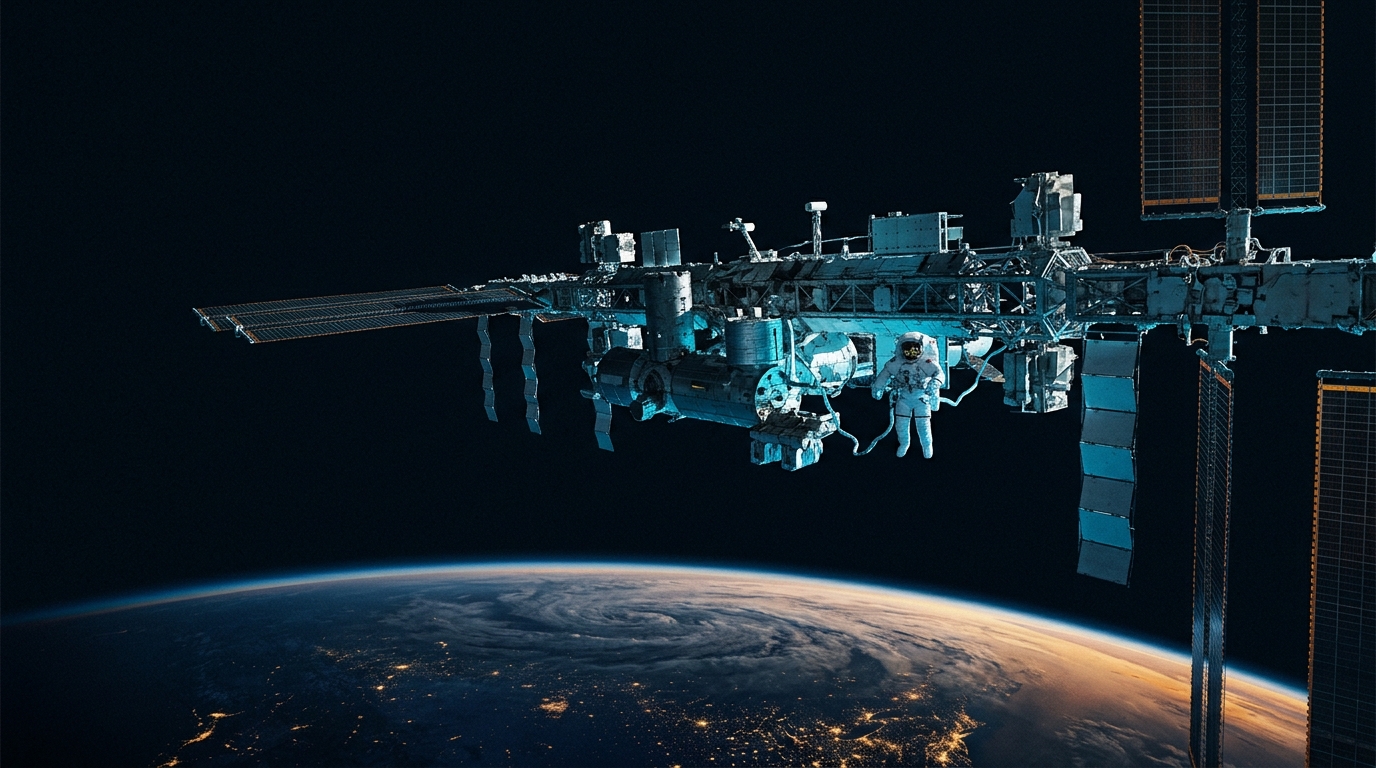
At the time of publishing this analysis, data from our real-time tracker shows that the International Space Station is flying above us at exactly 439 km in altitude and traveling at 27,528 km/h. Aboard this complex, an international crew rotated every few months conducts dozens of scientific experiments that serve as the proving ground for this new private economy.
For anyone who enjoys spotting the ISS from Earth, this New Space ecosystem isn't a distant economic abstraction, but the driving force that will reshape what we see in the night sky in the coming years. Today, when you use our tool to check ISS pass times and step outside to watch it, you behold a single dazzling point of light powered by its massive solar arrays and habitable modules, including the European Columbus laboratory. The latter already hosts private European commercial platforms like Bartolomeo, designed to host private-sector payloads outside the station.
Over the next decade, the momentum built at events like Industry Space Days will diversify that nightly show. We will no longer be tracking just a single government-run space lab, but a constellation of smaller commercial stations, private cargo spacecraft resupplying orbit, and servicing satellites maneuvering in real time. Understanding the industrial alliances being forged today at ESTEC is the best way to know which spacecraft we will be watching tomorrow.
If you want to see the largest space complex ever built with your own eyes before it gives way to the new private era, check our tracking map to find out when the ISS will pass over your city.
Source: ESA ↗