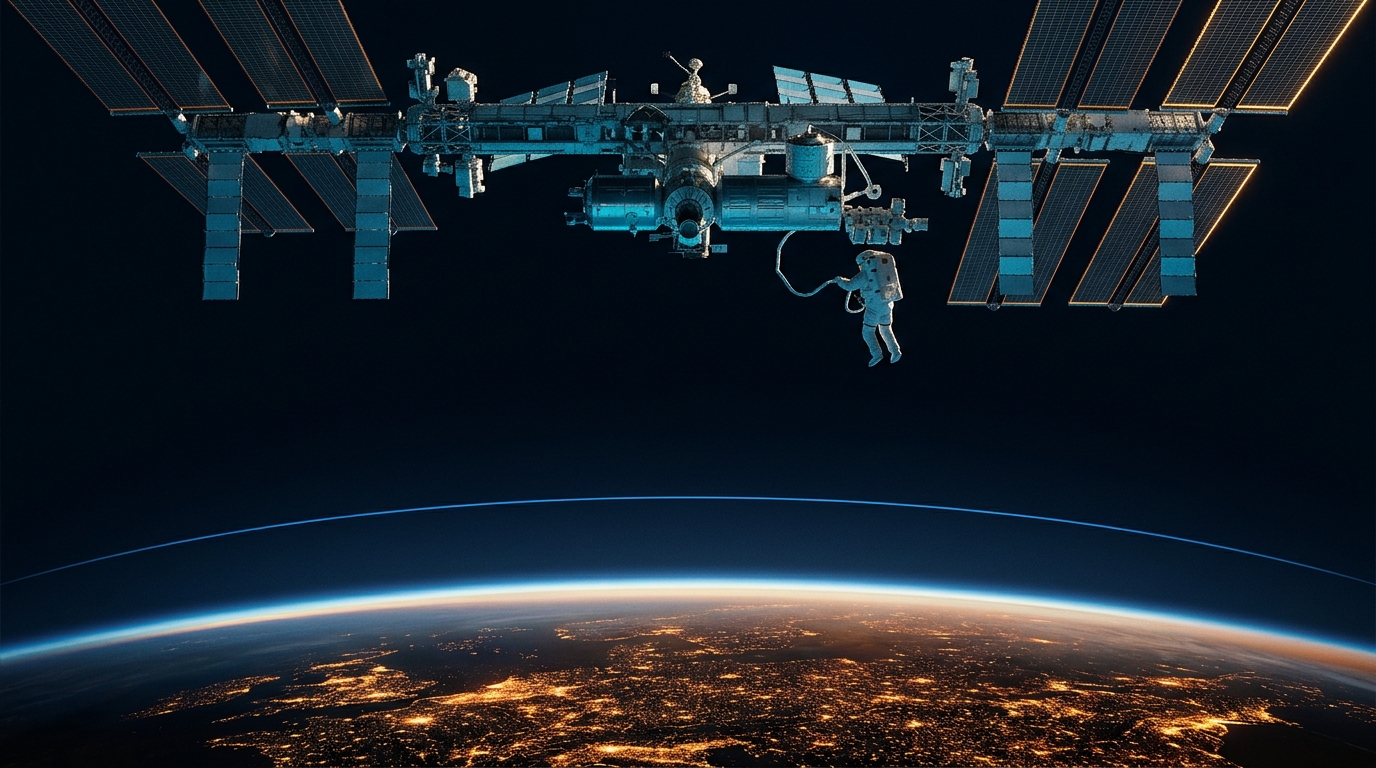
The Space Station's Future at Stake: Earthbound Budgets and Life in Orbit
Every time you step out onto your balcony or into your garden and watch a bright star silently glide across the sky, you are witnessing the direct result of budgetary and legislative decisions signed in offices down on Earth. The International Space Station does not fly powered solely by the laws of orbital physics; it is sustained by political consensus and continuous funding from its partner nations. Understanding what is being debated in legislative committees is key to knowing how many astronauts live aboard, what science is conducted there, and how many years of life remain for this wonder visible to the naked eye.
What happened
With the resumption of the congressional committee schedule in the United States, in both the House of Representatives and the Senate, civil space policy is entering a period of critical budgetary determinations, as reported by specialized outlet SpacePolicyOnline.com. Over these weeks, congressional committees overseeing NASA and federal agencies are reviewing the allocation of public funds for low Earth orbit missions, space science research, and the transition toward future commercial space stations.
Priority items on the legislative agenda include the operational maintenance costs of the station, the funding timeline for commercial crew and cargo transportation, and the development of the dedicated vehicle for safely deorbiting the orbital infrastructure at the end of its operational life. Although these debates take place behind closed doors or in formal hearings steeped in bureaucratic language, the decisions that emerge dictate the cadence of launches, the continuity of crew rotations, and the life support of those living aboard the orbital complex.
Why it matters
For those of us who regularly watch the space station, these debates are not detached budgetary discussions: they are the clock that will determine how much longer we can continue enjoying ISS passes across our night skies. Officially, NASA and its Western partners envision operating the orbital laboratory until 2030, but keeping a complex weighing more than 400 tons running after more than two decades of exposure to the thermal vacuum and space radiation requires a continuous annual investment of billions of dollars.
The context that does not always emerge from official press releases includes three crucial factors:
- The commercial handover: NASA needs private companies to have operational stations before retiring the ISS to avoid a gap in human presence in low Earth orbit. If Congress cuts funding for this transition program, the agency could be forced to accelerate retirement without a replacement ready, or stretch the ISS budget under complex technical conditions.
- Structural maintenance: The oldest modules suffer from material fatigue and micro-leaks requiring constant repairs, driving up operating costs in contrast to exploration missions like the Artemis program.
- Mission stability: Approved budgets directly determine how frequently commercial spacecraft such as Crew Dragon launch from Cape Canaveral, affecting the volume of cargo supplies and regular science crew rotations.
Ultimately, every dollar debated in Congress directly affects the viability of keeping the Cupola’s windows open and ensuring the station remains the brightest, most visible artificial object in the night sky.
Our take
There is a fascinating contrast between the sluggish pace of political committees on the ground and the relentless speed of orbital reality. While lawmakers debate files in Washington, real-time data from our tracker shows a tangible, active scene: the International Space Station is flying right now at an altitude of 435 km, traveling at an exact speed of 27,541 km/h above our planet. At that dizzying pace, the station completes an orbit every ninety minutes, completely detached from partisan bickering and terrestrial borders.
Inside that pressurized structure travels a crew of astronauts and cosmonauts who rotate in shifts of about six months. You can find out in detail who is currently on board and what their roles are by checking the active crew section on our platform. For them, budget agreements represent far more than numbers: they mean the technical support of their oxygen systems, the timely arrival of supplies, and the guarantee of a safe return to Earth.
Astronomical benchmark imagery captured by NASA missions—whether spectacular views of comets streaking through the atmosphere or distant galaxies like the Southern Pinwheel—often reminds us of the sheer vastness of the cosmos. Yet the ISS offers a distinct experience: it is not an unreachable natural phenomenon, but a human community floating in the void. Knowing that current political decisions are paving the way for its eventual retirement in the coming years turns every sighting into an unrepeatable moment. Checking visibility conditions in advance with our guide to spotting the ISS will help you make the most of every clear night while this engineering giant remains active.
Check our real-time tracker to find out the exact time the station will pass over your home tonight, and witness this magnificent human endeavor with your own eyes.
Source: SpacePolicyOnline.com ↗