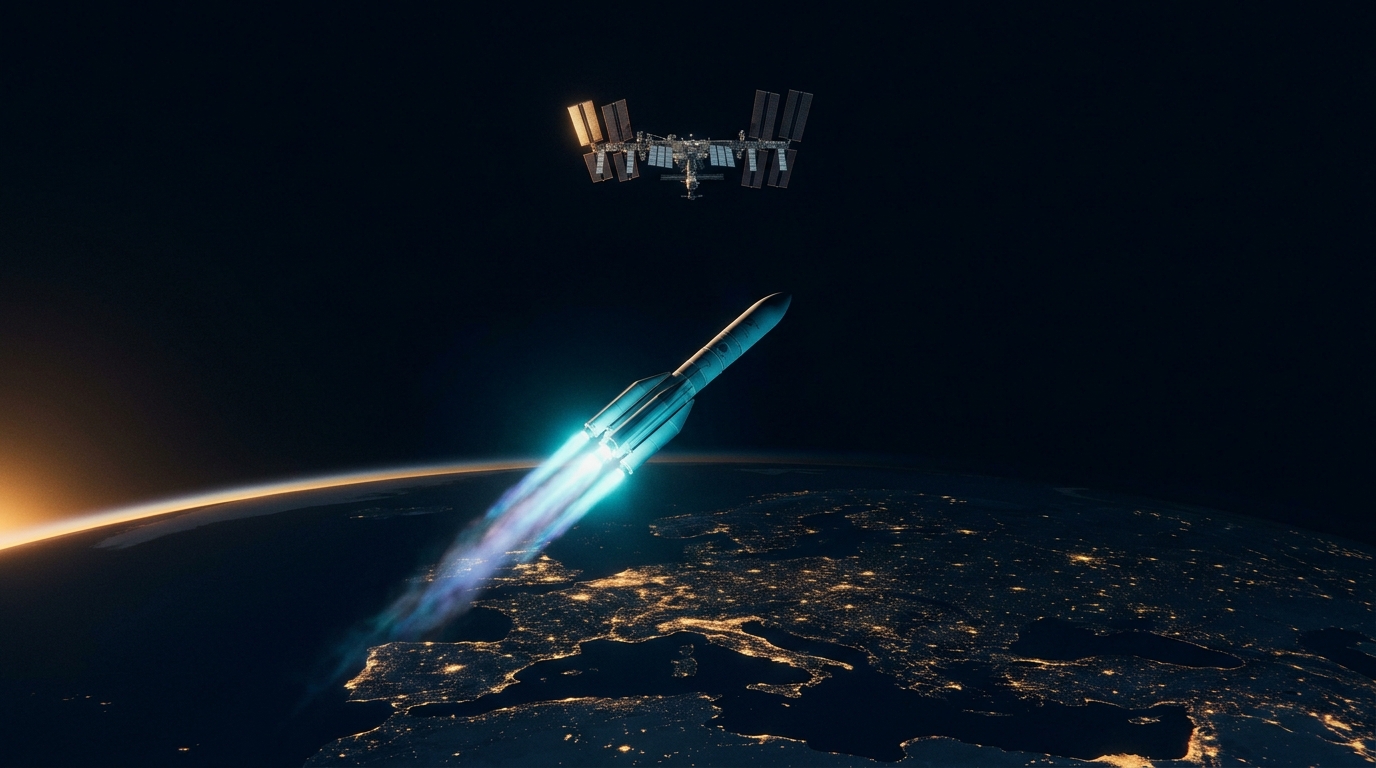
Ariane 6 Lifts Off: What Europe's New Rocket Means for the ISS and Space
When you look up at the night sky to catch the brilliant streak of the International Space Station, you are witnessing the result of a delicate global logistical and geopolitical balance. The successful maiden flight of Europe's Ariane 6 rocket not only restores Europe's independent access to orbit for heavy payloads, but it also reshapes the alliances that sustain orbital laboratories like the one you track daily on our platform. Here is what actually changes in space following this historic launch and how it affects the orbital ecosystem.
What happened
The European Space Agency's (ESA) new heavy-lift launch vehicle has successfully completed its first vertical liftoff from Europe's Spaceport in French Guiana. With this milestone, as ESA reported, the continent's space program kicks off the operational phase of Ariane 6, the successor designed to replace the iconic Ariane 5, which was retired from active service after nearly three decades of success and flagship missions.
This first test flight was far from a mere spectacle; its primary goal was to test and validate the rocket's architecture under real launch conditions. Along its trajectory, technical teams closely evaluated structural response during liftoff, acceleration through dense atmospheric layers, and stage separation.
Ariane 6 is designed as a versatile, modular system available in two main variants depending on payload mass:
- Ariane 62, equipped with two solid rocket boosters, tailored for institutional missions and medium-sized satellites.
- Ariane 64, which uses four solid boosters to deliver the maximum thrust needed for heavy payloads and large commercial satellites.
One of the major technical innovations put to the test is the upper stage, powered by the Vinci engine. Unlike previous-generation engines, this propulsion unit has the critical ability to reignite multiple times in space. This technical flexibility makes it possible to release different payloads into different orbits during a single flight and—crucially for orbital sustainability—perform a final braking burn to deorbit the upper stage in a controlled manner, mitigating space debris.
Why it matters
To understand why this launch echoes inside the International Space Station's Cupola, one must examine the geopolitical landscape of space transportation. Following the retirement of Ariane 5 and the disruption of cooperation with other international heavy-launch providers, Europe found itself in an unprecedented logistical bind: it lacked an independent, sovereign way to place its large satellites and infrastructure into orbit.
Although Ariane 6 is not designed in this initial phase to carry astronauts directly—crews traveling to the ISS still fly aboard international partner spacecraft—autonomy in heavy transport is the backbone of all European scientific research. Without a reliable heavy-lift rocket, ESA's leverage to negotiate cooperative agreements, launch major science modules, or contribute logistical support to the orbital complex was severely constrained.
Securing sovereign access to space means Earth observation projects, weather satellites, and the Galileo navigation network will not depend on third-country schedules or decisions. Economically, Ariane 6 has been optimized to significantly reduce manufacturing and operational costs, allowing European industry to compete in an increasingly demanding commercial space market.
Furthermore, the upper stage's versatility opens the door to future cargo resupply missions, support satellites, and scientific payloads destined for the same orbital realm as the ISS. The continuity of low-Earth orbit science depends on space agencies having predictable, sustainable access to outer space.
Our take
From the perspective of satellite-spotting and orbital-tracking enthusiasts, the debut of a new heavy-lift rocket is always great news because it strengthens the foundation of the missions we follow night after night from Earth. While engineers review Ariane 6 telemetry to clear the way for upcoming commercial launches, human activity overhead never stops.
Right now, according to data from our live tracker, the International Space Station is flying at an altitude of 439 km and traveling at a speed of 27,528 km/h. Aboard is an international crew of astronauts and cosmonauts—including ESA astronauts—who rotate in roughly six-month increments.
Europe regaining sovereign launch capability ensures that European laboratory modules aboard the ISS receive technical support, upgrades, and instruments without disruption. Every time you watch that bright dot traverse the sky, you are seeing the culmination of a global network of launch vehicles and ground stations working in harmony.
If you want to know when to catch the orbital complex's next bright pass over your location, make sure to check out our guide to spotting the ISS. Watching the flying laboratory pass overhead is the best reminder that developing rockets like Ariane 6 is not just distant engineering—it is the very bedrock keeping human space exploration alive.
Use our real-time tracker to follow the station's exact path and plan your upcoming night-sky observations.
Source: ESA ↗