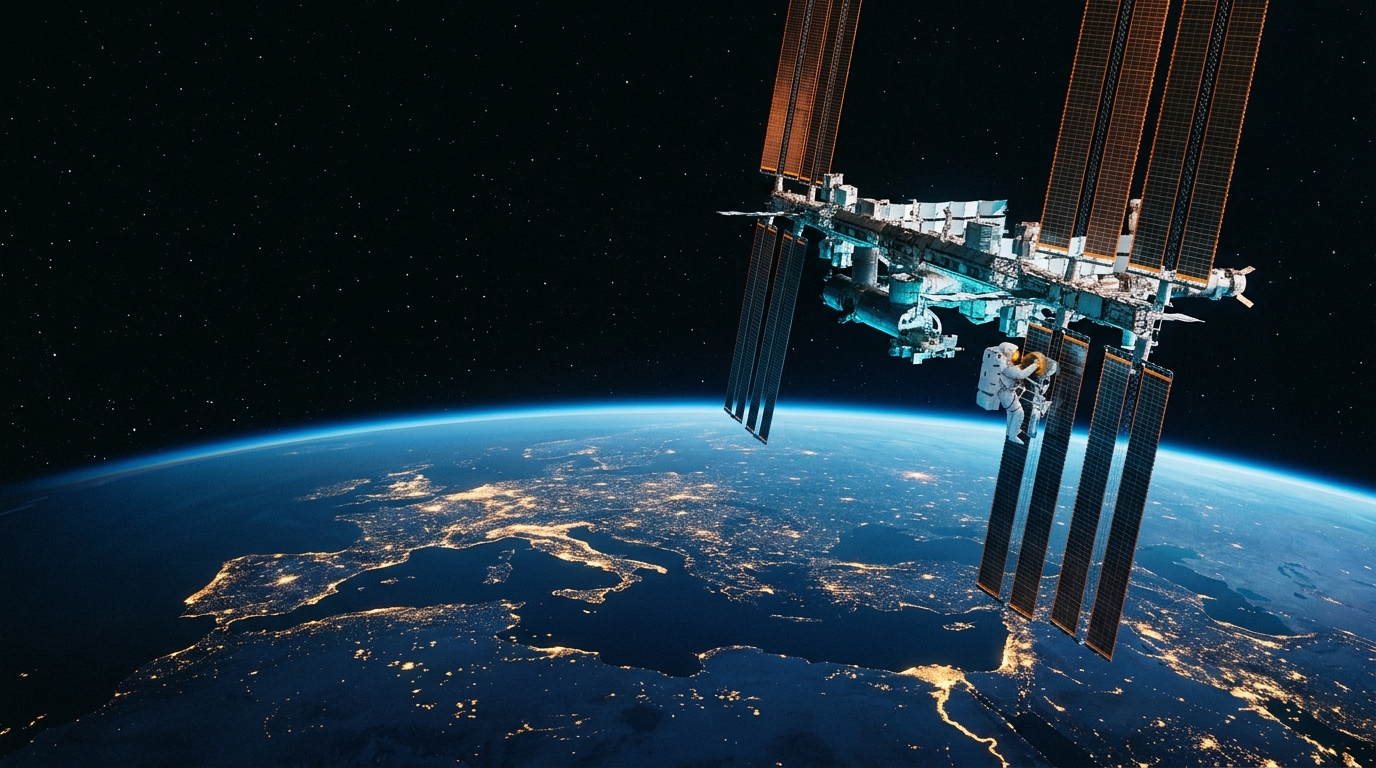
NASA Funding Secured: What It Means for the ISS Flying Over You
Every time you look up and see that unmistakable streak of light glide across the night sky, you are witnessing the result of extraordinarily complex technical, scientific, and political machinery. Behind every visible pass of the International Space Station lie thousands of hours of ground engineering and, above all, a constant budget battle to keep mission control centers humming and orbital missions safe. Understanding what happens in the halls of power helps us better grasp the future of humanity's greatest floating laboratory.
In recent days, legislative progress in Washington and high-level political attention on space programs have once again put the spotlight on the stability of orbital operations. For those of us tracking the station from home, these developments are not mere bureaucratic formalities: they guarantee that the orbital complex will remain inhabited, resupplied, and fully operational right above our heads.
What Happened
The United States Congress has cleared a continuing resolution (known as a CR) to prevent any shutdown of federal government operations before the new fiscal year begins, as reported by specialized outlet SpacePolicyOnline.com. The measure, passed by the House of Representatives following prior approval in the Senate, now heads to the president's desk for signature.
This legislative mechanism enables federal agencies, including NASA, to continue receiving funding at current levels while lawmakers finalize full-year budget packages. Meanwhile, direct political interest in the agency's work—highlighted recently by top-tier national figures attending NASA scientific press conferences, as detailed by Ars Technica—underscores the strategic importance that space exploration and low Earth orbit operations continue to hold on the US agenda.
Why It Matters
For stargazers watching for the station from a backyard or balcony, budget debates might seem distant, but their consequences directly and immediately impact daily life aboard the orbital outpost. The ISS is not an automated satellite that can simply drift without constant oversight: it requires a workforce of hundreds of flight controllers, communications specialists, and medical personnel working round-the-clock, 24/7 shifts from Houston, Huntsville, Munich, and Tsukuba.
A government shutdown or indefinite funding lapse creates severe operational friction that impacts:
- The precise scheduling of commercial cargo resupply missions, vital for delivering food, water, critical spare parts, and scientific experiments to the crew.
- The maintenance of astronaut rotation contracts, coordinated across international partner agencies and commercial providers to ensure an uninterrupted human presence.
- Smooth ground support and public broadcasts that allow the public to track the outpost's daily operations.
- Certainty for investments in extending the orbital structure's operational lifespan, planned to run safely through the end of the decade.
Passing this stopgap measure clears the near-term horizon, removing the immediate risk of logistical disruptions. This ensures that international cooperation proceeds without administrative hurdles, keeping supply lines open and scientific research operating at peak capacity.
What to Look For in the Sky
While these agreements secure continuity on Earth, activity overhead never pauses for a single second. According to real-time data from our tracking platform, the International Space Station is currently traveling at an altitude of 419 km, racing through the vacuum of space at a blistering 27,584 km/h.
Inside that pressurized outpost lives a crew that depends directly on this operational stability. If you check the current crew aboard the ISS, you will see astronauts and cosmonauts representing multiple space agencies. That multinational crew makes every sighting a living testament to humanity's greatest collaborative achievement.
When weather permits and you check when the ISS passes over your city, what you see crossing the night sky is neither a shooting star nor an airliner. It is a 400-ton laboratory reflecting sunlight off its vast solar arrays, shining with a brightness that rivals Venus. Knowing that inside that bright dot, human beings are conducting cutting-edge research made possible by ongoing worldwide technical support completely transforms the experience of looking up.
To make the most of these sightings, all you need is the exact minute it will rise above the horizon and the right constellation to look toward—no telescope or binoculars required.
The next time your skies clear, take a moment to watch science march forward in low Earth orbit. Check our real-time ISS tracker and do not miss the next visible pass over your area.
Source: SpacePolicyOnline.com ↗