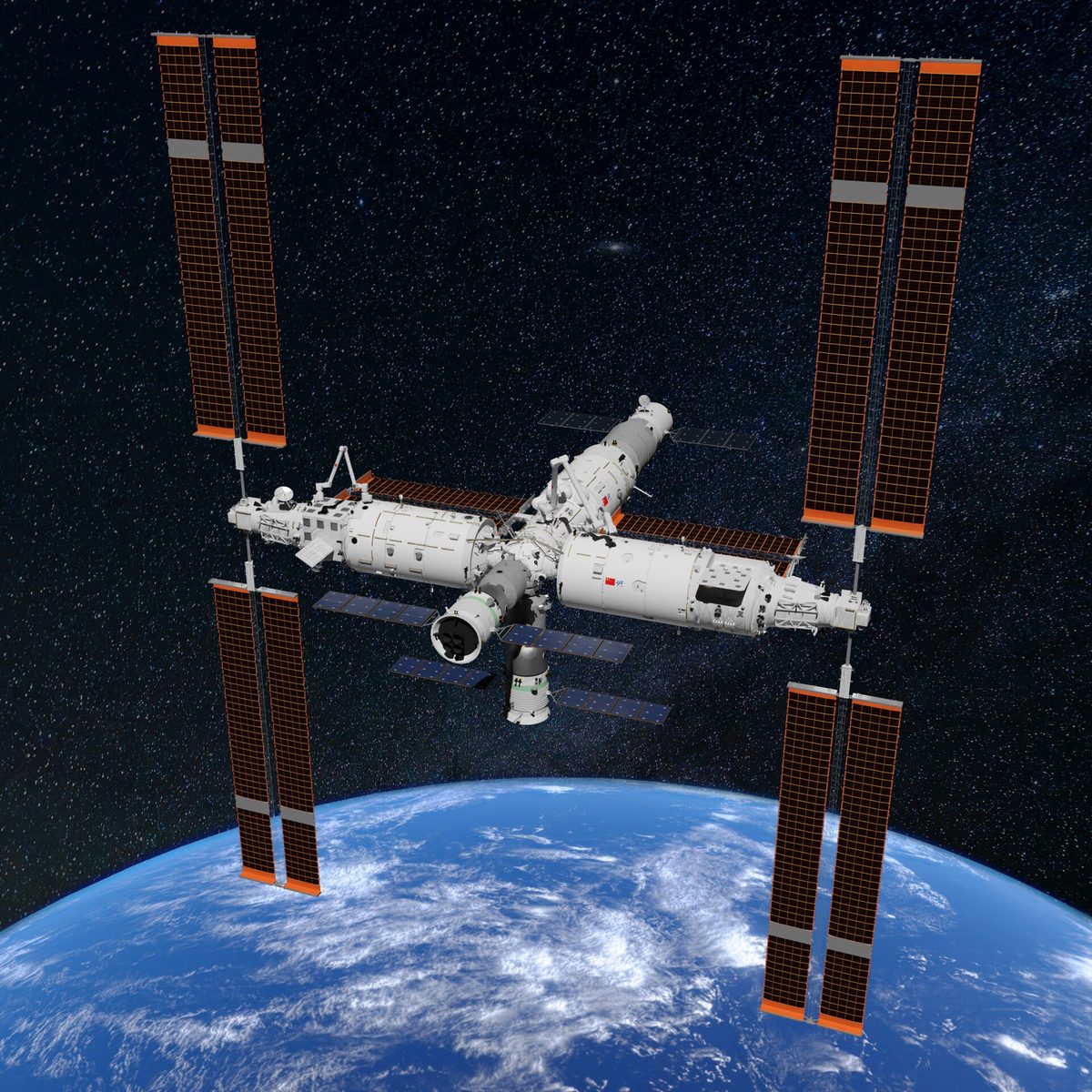
ISS or Tiangong: How to Tell the Two Space Stations Apart in the Sky
For several years now, two crewed space stations have been orbiting Earth, and both are visible to the naked eye. If you spot a bright dot gliding across the sky, it is worth remembering that it is not always the ISS: it could be China's Tiangong. Telling them apart is easier than it might seem.
Two stations, two sizes
The International Space Station has been continuously inhabited since the year 2000. It weighs around 420 tonnes, spans just over 100 meters from end to end including its solar arrays, and is by far the largest artificial object in orbit.
Tiangong, operated by China, was completed in 2022. It is significantly smaller: roughly 100 tonnes, three main modules, and a regular crew of three astronauts compared to the six or seven aboard the ISS.
That difference in size is precisely what allows you to tell them apart in the sky. What you see from both is reflected sunlight, and the reflective surface area of the ISS is far larger.
How to tell them apart just by looking
By brightness. This is the most straightforward clue. On a good pass, the ISS reaches magnitude -3 or -4, rivaling Venus. Tiangong usually stays between magnitude 0 and -1: clearly visible and comparable to the brightest stars, but without that commanding brilliance that makes the ISS stand out instantly. If the dot unquestionably dominates the sky, it is the ISS.
By orbital altitude. The ISS flies at around 400 kilometers (250 miles), while Tiangong orbits slightly lower, at about 380 kilometers (235 miles). It is a minor difference that you will not notice with the naked eye, but it explains why Tiangong passes tend to be slightly faster.
By inclination. Here you have a genuinely useful hint. The ISS orbits at an inclination of 51.6 degrees; Tiangong orbits at around 41.5 degrees. In practice, this means that from high latitudes (such as northern Europe), Tiangong is harder to see and appears lower on the horizon, whereas from mid and low latitudes (such as Spain or the southern US and Latin America), both are clearly visible. At mid-latitudes, Tiangong tends to cross through the southern half of the sky more often than the ISS.
By timing. Both follow the exact same rule: they are only visible when it is dark on the ground while they remain illuminated by the Sun—that is, during the hours just after sunset or right before sunrise. Their passes do not coincide, so checking the schedule is the ultimate tiebreaker.
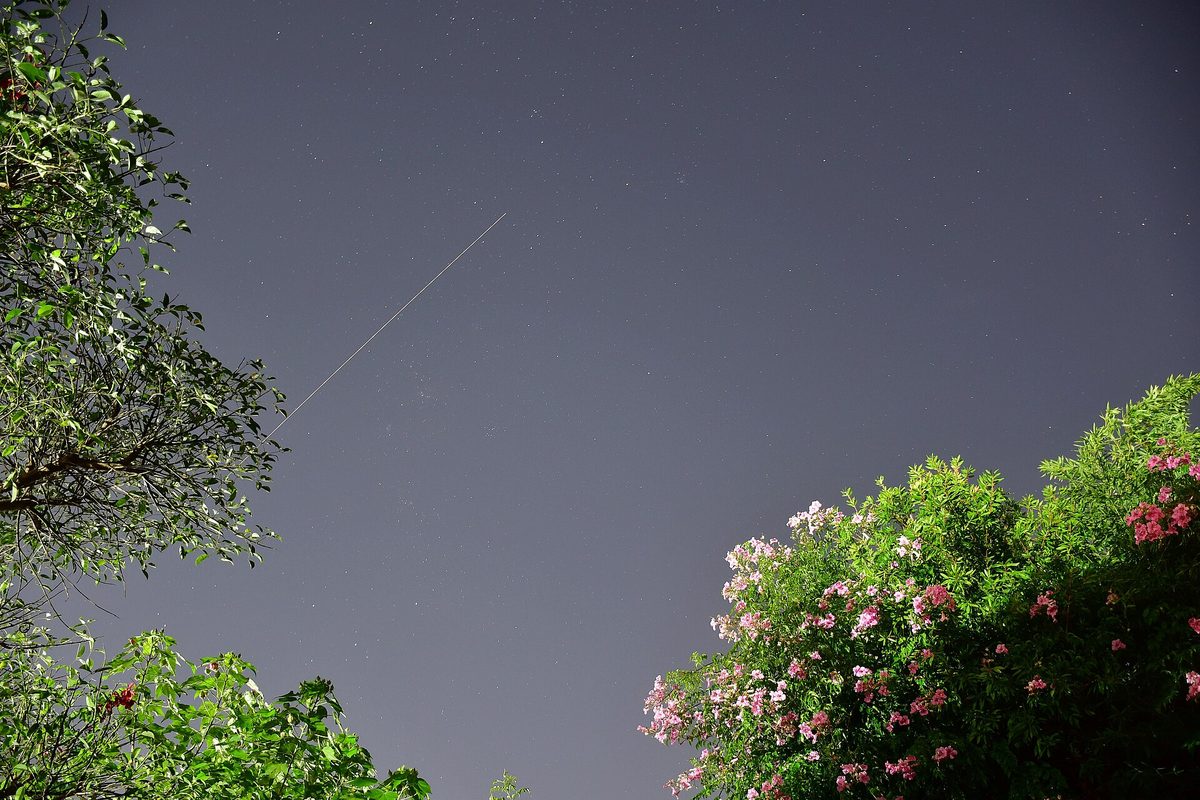
What neither of them is
Before deciding which one you have spotted, rule out other common sights:
- Airplanes: blinking red and green lights, plus engine noise if they are low. Neither the ISS nor Tiangong ever blinks or makes a sound.
- Starlink satellite trains: multiple dots moving in a tight single file. Unmistakable once you have seen one, and very common in the days following a launch. We explain this in detail in how to tell Starlink apart from the ISS.
- Standard satellites: much fainter, often tumbling and flashing irregularly as they rotate.
- Drones: they hover, change direction, or descend. No object in orbit ever does that: their trajectory is always steady and straight.
The foolproof method
Visual identification is a fun guessing game, but the foolproof way to know what you saw is to cross-check it with pass predictions. Before heading outside, look up ISS passes for your location using the pass times calculator: if an object appears right on time, from the expected direction, and at the predicted elevation, it is the ISS—end of story. If it crosses at a time with no scheduled pass, you likely have a candidate for Tiangong or another satellite.
Checking the station's current position on the real-time tracker also helps you understand the geometry: if the ISS is over the Pacific at that exact moment, whatever just flew past your window was definitely not it.
Why both are worth watching
There is something awe-inspiring about knowing that both bright points of light are inhabited laboratories. The ISS has hosted international crews for over two decades; Tiangong carries three people working within an entirely independent program. Catching both in the same week from your own backyard offers a striking perspective on what low Earth orbit looks like today.
If this is your first time station spotting, start with the ISS: it is brighter, more frequent, and easier to catch. You can find all the practical details in our spotting guide.
Once you have mastered the ISS, Tiangong is the natural next target—and you will know exactly what to look for.
Images: cover, Chinese Tiangong Space Station — Shujianyang (CC BY-SA 4.0). Inside, Tiangong space station as seen from M.B Gonnet in March 2024 - BugWarp — BugWarp (CC BY 4.0).
Source: ISS Tracker ↗