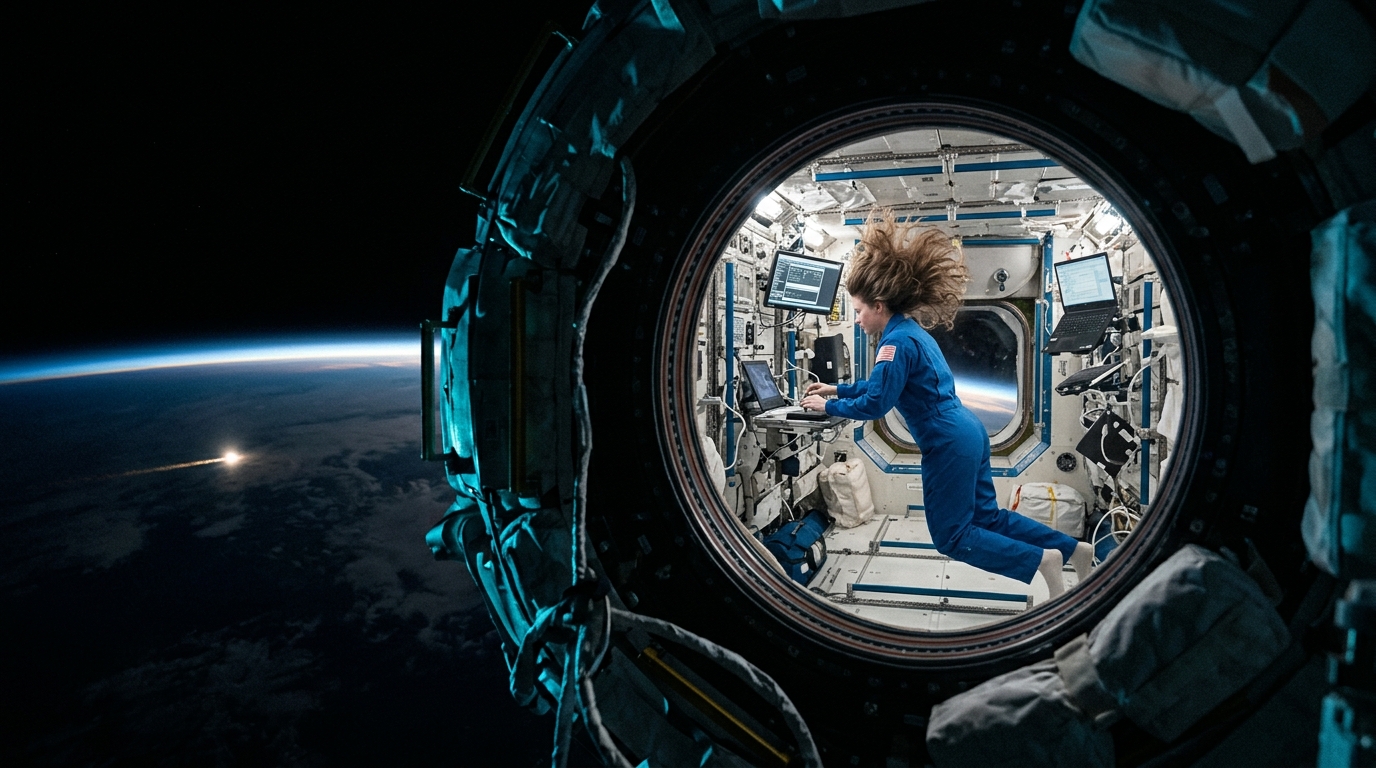
Daily Life at 400 km: What Zero-G Hair Teaches Us About the ISS
When you look up on a clear night and watch that steady, bright point of light glide across the sky, it is easy to forget the mundane, human details of living up there. Managing everyday routines like curly hair care in microgravity proves that the orbital outpost is not just a marvel of aerospace engineering, but a home suspended in the vacuum of space, where real people live and tackle unexpected challenges every day.
What happened
NASA astronaut Jessica Meir recently shared practical insights into managing and styling curly hair in weightlessness aboard the International Space Station, as reported by Space.com. Through visual demonstrations, Meir described the challenges faced by crew members with voluminous hair when gravity no longer pulls each strand downward, causing hair to float freely in all directions and form an unruly mass during technical workdays.
These personal accounts tie directly into the growing diversity and female presence in low Earth orbit. Recently, the space community marked the anniversary of Mae Jemison's historic flight on September 12, 1992, when she became the first African American woman in space aboard Space Shuttle Endeavour. That groundbreaking mission paved the way for what is now routine on the space station, where professionals from diverse backgrounds live together for months, developing solutions tailored to a wide range of biological and hygiene needs.
Personal hygiene aboard the station does not involve running tap water or traditional showers. Instead, astronauts rely on warm water squeeze pouches, no-rinse shampoos originally developed for hospital care, and combs, all paired with careful towel maneuvers to keep water droplets from floating away. Loose hair is not just an annoying distraction during precision experiments; shed strands turn into floating debris that can clog ventilation filters or interfere with sensitive instruments if not promptly captured with dedicated vacuum systems.
Why it matters
Far from a superficial concern, hair hygiene and personal grooming in weightlessness test the core principles of fluid physics and life-support engineering. On Earth, gravity pulls water downward, washing away dirt. In orbit, surface tension causes liquids to cling to the skin and scalp like a viscous, gelatinous film. To wash their hair, astronauts must carefully massage this liquid layer to prevent it from breaking apart into tiny floating spheres that drift throughout the living quarters.
This is further complicated by the orbital outpost's closed-loop water recovery system. The ISS relies on the Environmental Control and Life Support System (ECLSS), an infrastructure that recovers up to 98% of ambient humidity generated by sweat, breath, and hygiene runoff. The water Meir or any of her crewmates uses to wash their hair evaporates into the cabin air, gets captured by the module's condensing heat exchangers, and undergoes purification to become drinking water again in a matter of days. Every drop used for grooming is part of an essential closed loop that ensures human survival far from Earth.
There is also a critical ergonomic and safety factor. Extravehicular Activity suits (the white spacesuits used for spacewalks) and communications headgear—colloquially known as "Snoopy caps"—demand a precise fit against the head. Any bulky, uncontained hair can displace earphones, block microphones at critical moments, or impair visibility inside the helmet's pressure bubble. Experience gained from early trailblazers like Mae Jemison to modern expeditions has helped refine suiting and grooming protocols, ensuring that individual bodily differences never interfere with mission operations.
What to look for in the sky
Understanding these domestic details completely transforms the experience of stepping outside to watch the night sky. When you check pass times to see when the ISS flies over your location, what you watch racing overhead is not a lifeless, robotic satellite, but a living habitat where real human and scientific routines are unfolding at that very second.
According to our real-time tracker, the orbital complex is currently cruising at an altitude of 423 kilometers above Earth, traveling at an astonishing speed of 27,594 kilometers per hour. At that speed, the station orbits the globe every 90 minutes, treating its occupants to 16 sunrises and 16 sunsets every 24 hours.
That gleaming structure is home to an astronaut crew that rotates roughly every six months, which you can follow in our section dedicated to the current crew. Those on board carry out these same daily routines of personal care and community life in microgravity, all while conducting complex scientific research and exterior maintenance.
To spot it with the naked eye, keep the following tips in mind:
- The station appears as a brilliant white or slightly golden star, shining with a steady, intense brightness that often far outshines any visible star or planet, including Jupiter or Venus.
- Unlike commercial airliners cruising through the lower atmosphere, the ISS does not blink or flash red and green lights; its glow comes entirely from sunlight reflecting off its massive solar array wings.
- Its flight path is smooth, steady, and silent, taking between three and six minutes to cross the sky from one horizon to the other before gracefully fading into Earth's shadow.
The next time you spot that streak of light gliding across the night sky, you will know that 423 kilometers above, someone is wrapping up a workday, floating in a sleeping bag tethered to a bulkhead, or styling their weightless hair in front of a hygiene module mirror.
Check our real-time tracker to find out exactly when this orbiting laboratory will cross the horizon over your city, and step outside to see it with a whole new perspective.
Source: Space.com ↗