A New Cargo Ship Docks at the ISS: What Changes When You Spot It Passing By
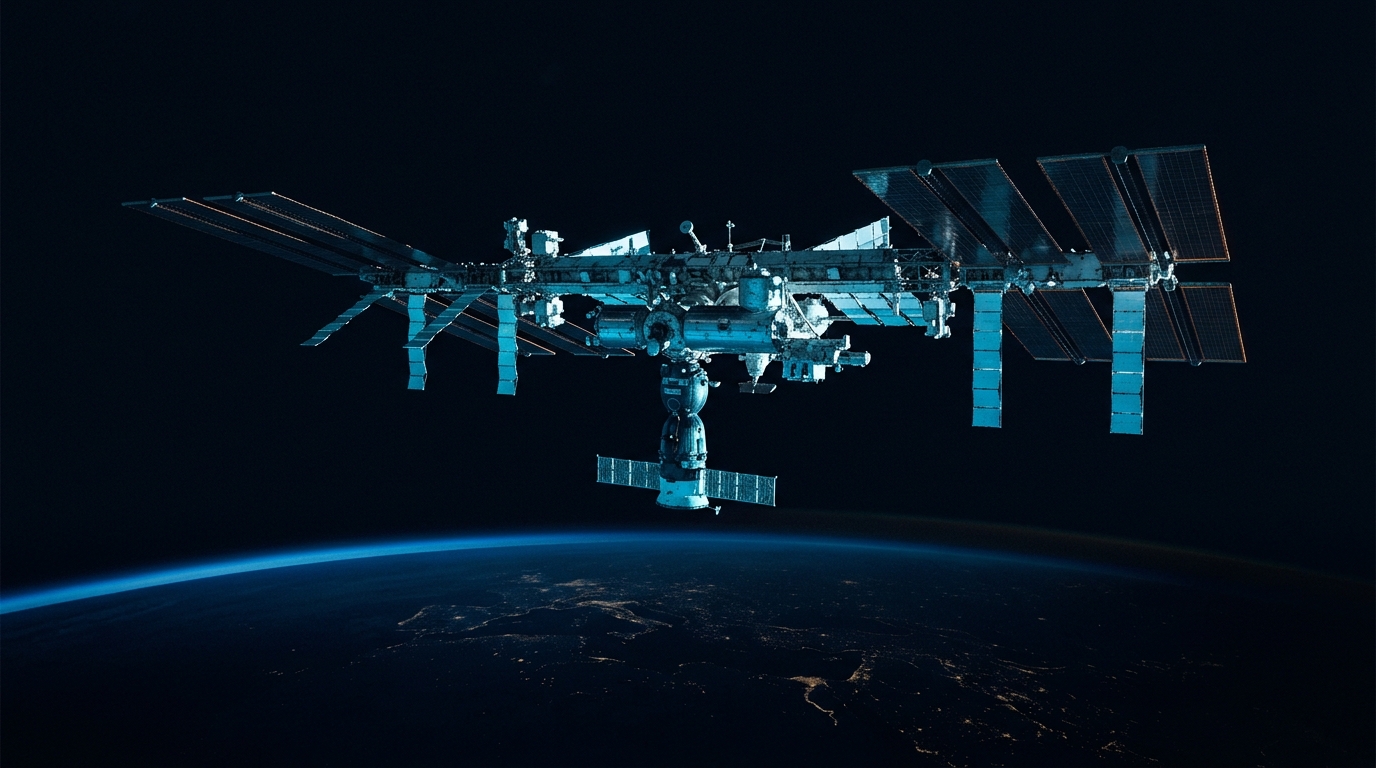
If you look up at the sky tonight and catch sight of that characteristic bright white dot gliding across the celestial dome, you will be gazing at an orbital complex that weighs several tons more than it did just a few hours ago. The International Space Station has just added a new vehicle to its floating silhouette following the successful docking of a vital resupply ship. For those of us tracking this orbiting laboratory from the ground, every arrival transforms the complex into an even more active and self-sustaining piece of infrastructure above our heads.
Below, we break down the technical details of this docking, what it means for daily life aboard the station, and what you should keep in mind the next time you step out onto your patio or balcony to watch for its shining trail.
What Happened
The Russian Progress cargo spacecraft successfully docked with the space port of the Poisk module, located on the space-facing section of the orbital complex's Russian segment. Contact and subsequent mechanical capture occurred at 13:44 UTC (9:44 EDT), concluding an approach that had been delayed by a week compared to its original schedule, according to space news outlet Spaceflight Now.
This automated cargo freighter completed the critical rendezvous phases autonomously using the Kurs telemetry and guidance system, monitored throughout by Roscosmos Flight Control Center specialists in Korolyov and by the crew inside the station. Although the initial delay required rescheduling intermediate orbital maneuvers to synchronize its trajectory with the station, the final approach sequence concluded without notable incidents, locking the cargo craft's probe into the docking cone of the Poisk module more than four hundred kilometers above Earth's surface.
Inside, the vehicle carries routine yet vital cargo: roughly three tons of supplies divided between propellant for orbital maintenance thrusters, potable water tanks, compressed oxygen to replenish the internal atmosphere, spare parts for life support systems, scientific gear, and personal care packages for crew members spending months in microgravity.
Why It Matters
Far from the romance of crewed launches, resupply logistics are the true backbone supporting a continuous human presence in space. Keeping the crew on board alive and working as they rotate in roughly six-month shifts requires a finely tuned supply chain that cannot afford prolonged interruptions.
When a cargo flight's schedule slips, as happened with this one-week delay, ground teams must recalculate essential resource consumption down to the gram. Water, for instance, is more than ninety percent recycled aboard the complex, but fresh reserves are indispensable to make up for unavoidable losses in the loop. Similarly, carbon dioxide scrubbers and particulate filters undergo continuous wear, demanding periodic replacement.
However, the most strategic asset aboard a Progress spacecraft is not found in the food bags, but in its aft tanks. The freighter's thrusters routinely act as an external engine for the entire space station. The ISS experiences continuous atmospheric drag caused by faint traces of gas in Earth's thermosphere; this friction gradually degrades its altitude by dozens or hundreds of meters every day. Progress freighters attached to the Russian segment are regularly tasked with firing their engines to perform "reboosts" or altitude correction burns, accelerating the complex to raise it back into a safe orbit and dodge potential space debris when necessary.
This ongoing logistical support contrasts with the broader international exploration landscape advancing in parallel. While agencies like ESA strive to engage younger audiences through cultural initiatives and global outreach ahead of World Space Week, powers like China are stepping up their lunar programs and robotic missions to Mars and asteroids. Yet the ISS remains the only outpost where a multinational logistical effort sustains real human life uninterrupted around the clock.
What to Look for in the Sky
When watching the station with the naked eye from the ground, distinguishing the docked cargo craft individually is impossible: to the unaided eye, the ISS appears as a solitary, exceptionally bright star gliding smoothly across the sky without blinking or flashing. However, according to our tracker data, the ISS is currently flying at an altitude of 426 km and a staggering speed of 27,556 km/h. Knowing these numbers completely transforms the experience of stepping outside to watch it.
How does the arrival of this vehicle affect what you will see on your horizon? Mainly in three key ways that every skywatcher should keep in mind:
- Pass frequency and altitude: Thanks to the newly delivered fuel, flight controllers will schedule several propulsion burns over the coming weeks to regain altitude. At an altitude of 426 km, a shift of just ten kilometers up or down can change the exact second the station rises above your local horizon. Regularly checking what time the ISS passes over your area is essential so these orbital adjustments don't cause you to miss a brilliant pass.
- Total reflectivity of the complex: Even if you cannot resolve the Progress spacecraft itself, its metallic hull and deployed solar arrays become part of the station's total reflective surface area. The ISS shines solely by reflecting sunlight back down to Earth's night side; every docked module and vehicle subtly contributes to that overall albedo, allowing visual magnitude on favorable overhead passes to rival the planet Venus.
- Human perspective in orbit: Knowing that inside that bright speck of light, people are unpacking fresh boxes just arrived from Earth adds a unique dimension to your stargazing. You can check our guide to spotting the ISS to learn how to catch the best twilight passes and enjoy its clean transit across the sky.
To make sure you don't miss the next pass of the fully resupplied station over your home, check our real-time tracker and plan your viewing right as it crosses your coordinates.
Source: Spaceflight Now ↗