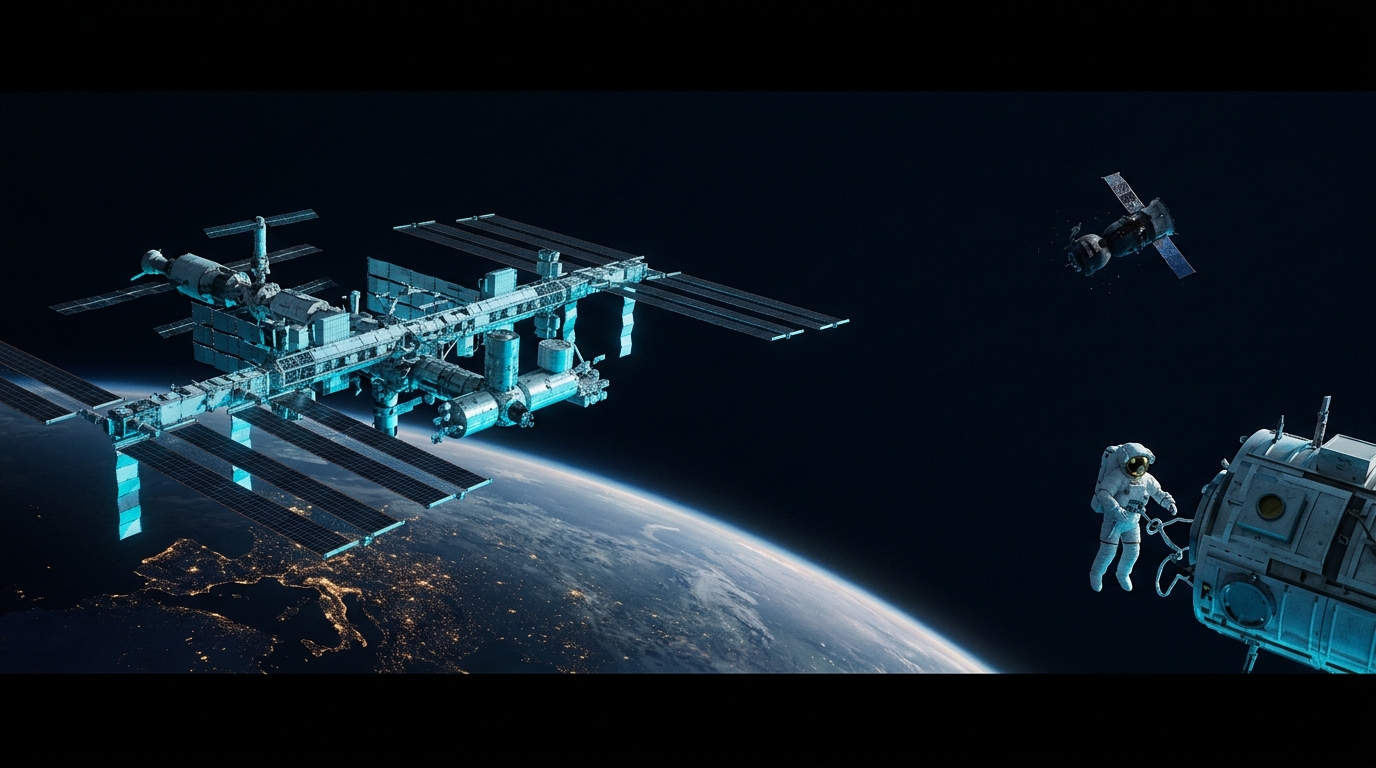
From the Mir Disaster to the ISS: The Crisis That Changed How You Look at the Sky
Every time you look up and see a bright point of light crossing the night sky in total silence, you are looking at the pinnacle of human engineering in space. However, the extraordinary safety enjoyed by the International Space Station is not an accidental miracle, but the result of bitter lessons learned in the past. For any skywatcher who enjoys tracking the orbit of our space laboratory, understanding how life works up there requires looking back at the dramatic crisis that nearly destroyed its Soviet predecessor, the Mir space station, in the summer of 1997.
What happened
On June 25, 1997, space exploration faced one of its most critical moments when an uncrewed Progress M-34 cargo spacecraft collided directly with the Mir space station. During a manual test of the teleoperated rendezvous docking system, known as TORU, the cosmonauts lost visual contact with the spacecraft due to lighting issues and poor control displays. The multi-ton inert mass of the Progress slammed into the Spektr science module, puncturing its outer hull and destroying part of the solar arrays that powered the entire orbital complex.
The collision triggered an immediate, top-priority emergency: a massive loss of atmospheric pressure as air leaked into the vacuum of space. Three crew members were on board: Russian commander Vasily Tsibliyev, flight engineer Aleksandr Lazutkin, and dual British-American NASA astronaut Michael Foale. As alarms blared and atmospheric pressure plunged rapidly, the crew's survival hinged on a single maneuver: isolating the Spektr module before the station's entire supply of breathable air ran out completely.
In a dramatic race against the clock, the astronauts had to hastily disconnect the thick bundle of power and data cables running through the Spektr hatch threshold in order to seal it. Poor visibility, pressure dropping in their ears, and disconnecting cables blindly turned the intervention into an act of extreme improvisation and bravery. After managing to close the hatch and cut off airflow to the damaged module, the station's depressurization stopped, saving the crew's lives and preventing a hasty evacuation of Mir in the Soyuz lifeboat.
As Michael Foale himself recently recalled in comments to the specialized outlet Space.com, the ordeal did not end with containing the leak. On Earth, a media and political firestorm erupted, seeking someone to blame immediately. Commander Tsibliyev publicly bore the brunt of the blame for the docking failure, even though technical shortcomings in the system and a lack of proper sensors were decisive factors in the accident. Yet in space, mutual cooperation and trust between Russians and Americans outweighed politics, allowing the crew to stabilize a severely damaged station.
Why it matters
For those watching the sky from Earth, the 1997 collision may seem like a distant chapter in the history of spaceflight, but its direct consequences are what allow the International Space Station to remain continuously and safely operational today. The Mir crisis served as the true real-world testbed under actual depressurization conditions to draft modern space exploration contingency protocols.
The first major lesson involved modular architecture and power isolation. The Spektr module hosted more than 40 percent of Mir's solar arrays. By sealing the hatch to prevent air loss, the station not only isolated the hull puncture, but also abruptly cut off nearly half of its electrical power. The spacecraft began losing its solar orientation, developing an uncontrollable spin that nearly depleted its thruster propellant reserves. To address this in the design of the ISS, engineers built a fully redundant networked electrical system and hatches equipped with quick-disconnect connectors that can be decoupled in seconds without having to sever cables manually.
The second fundamental legacy was standardized multinational emergency management. The Mir crisis proved that during an in-orbit disaster, there is no time for language barriers, cultural differences, or national bureaucracies. Emergency escape procedures, universal codes for pressure and fire alarms, and cross-training enabling any astronaut to operate systems in the other space segment are strict rules drafted in the wake of what Foale, Lazutkin, and Tsibliyev endured. Without the sacrifice and composure demonstrated in the Spektr module, the ISS would lack the safety assurances that have enabled it to house humans continuously since the year 2000.
What to look for in the sky
When you use orbital tracking tools to step out onto your balcony or backyard to spot an ISS pass, what you are actually seeing is an impressive structure of solar arrays and habitable modules reflecting sunlight from the darkness of space. Currently, according to data from our real-time tracker, the International Space Station flies at an average altitude of 439 km above Earth's surface, traveling at an impressive speed of 27,528 km/h. At that speed, the orbital laboratory completes an entire trip around the planet every 90 minutes.
Aboard that bright flare crossing your horizon, a crew continues to work today that still pairs Russian cosmonauts with American astronauts and those from other agencies. That partnership is the direct heir to the mixed crew that saved Mir in 1997. You can check the up-to-date list of who is currently orbiting the planet in our section on the onboard crew.
The next time you prepare for a night of skywatching, keep in mind what makes the ISS so dazzling from Earth. The station's exceptional visibility is mainly due to the vast surface area of its solar arrays, designed specifically with the lessons learned from Mir to ensure that even if a module had to be isolated or disconnected during an emergency, the electrical capacity and reflective brightness of the main structure would remain intact. To plan your sightings and find out exactly when it will pass over your location, check out our guide to spotting the ISS.
Watching the ISS streak across the sky is not only a fascinating sight to share with your family; it is live proof that humanity has learned to live and survive in the most hostile environment known to us, thanks to the courage of those who came before us in low Earth orbit.
If you want to know exactly what time and where this orbital laboratory will appear over your city, use our real-time tracker and witness firsthand the greatest triumph of human cooperation in space.
Source: Space.com ↗