The US Space Academy Is Born: Who Takes the Baton in Low Earth Orbit
When we look up to watch that steady white dot gliding across the constellations, we rarely pause to consider the colossal civil and educational machinery that makes it possible for humans to live beyond Earth. The decision to create a Space Academy in the United States formally kicks off the race to train the generation that will succeed today's orbital crews, just as human exploration redefines its boundaries between low Earth orbit and returning to the Moon.
For those of us who follow the day-to-day life of the orbital complex from our backyards and balconies, this institutional announcement is no mere administrative formality: it represents the shaping of the human talent pipeline that will sustain humanity's permanent presence in space for decades to come.
What Happened
NASA has formally issued a Request for Information (RFI) to the governors of US states, inviting them to submit proposals and sponsorship bids to host the future United States Space Academy, as reported by SpacePolicyOnline.com. This step puts into motion a recent presidential executive order aimed at establishing a dedicated national institution to develop the technical and operational leadership of the aerospace sector.
The institutional response has been swift. Just two weeks after the mandate was signed, NASA Administrator Jared Isaacman chaired the inaugural session of the Presidential Commission tasked with structuring and building the academy. According to official releases from the US space agency, the primary objective is to urgently address the shortage of skilled labor and establish an educational ecosystem capable of training future orbital operators, engineers, and flight directors alike.
Alongside this reinforcement of domestic educational capacity, space diplomacy continues to expand internationally: the Republic of Djibouti has formally signed the Artemis Accords, becoming the 72nd signatory nation. The signing, held at NASA Headquarters in Washington with Deputy Administrator Matt Anderson and Ambassador Mohamed Siad Douale in attendance, highlights the growing interest of nations of all sizes to join the framework governing lunar exploration and the peaceful use of outer space.
Why It Matters
For more than six decades, the traditional path to reaching space or commanding orbital missions has relied on two primary tracks: military training through established service academies (such as West Point, Annapolis, or the Air Force Academy) complemented by elite civilian technical careers. However, Earth orbit is no longer the exclusive domain of a few superpowers, nor is it confined to scientific research aboard government stations.
Creating a Space Academy addresses an unavoidable paradigm shift. The sector is undergoing three simultaneous transitions that demand a volume of professionals conventional university and military programs simply cannot supply fast enough:
- Replacing the International Space Station: The scheduled retirement of the ISS toward the end of this decade will pave the way for private commercial stations operated by multiple consortia, multiplying the demand for orbital specialists and mission control technicians.
- The Artemis cislunar leap: Unlike the temporary missions of the Apollo program, the Artemis architecture calls for a sustained presence, industrial-scale logistics at the lunar South Pole, and deep operational expertise that extends far beyond the traditional test pilot profile.
- Space democratization and governance: The fact that 72 countries have already signed the Artemis Accords demonstrates that diplomacy, aerospace law, and global interoperability will require professionals trained under a cohesive, technical, and civilian doctrine.
In this sense, the competition among governors to secure the academy's headquarters is not merely a contest for multimillion-dollar investments and academic infrastructure; it is an effort to position their states at the epicenter of the talent that will define interplanetary navigation throughout the second half of this century.
Our Take
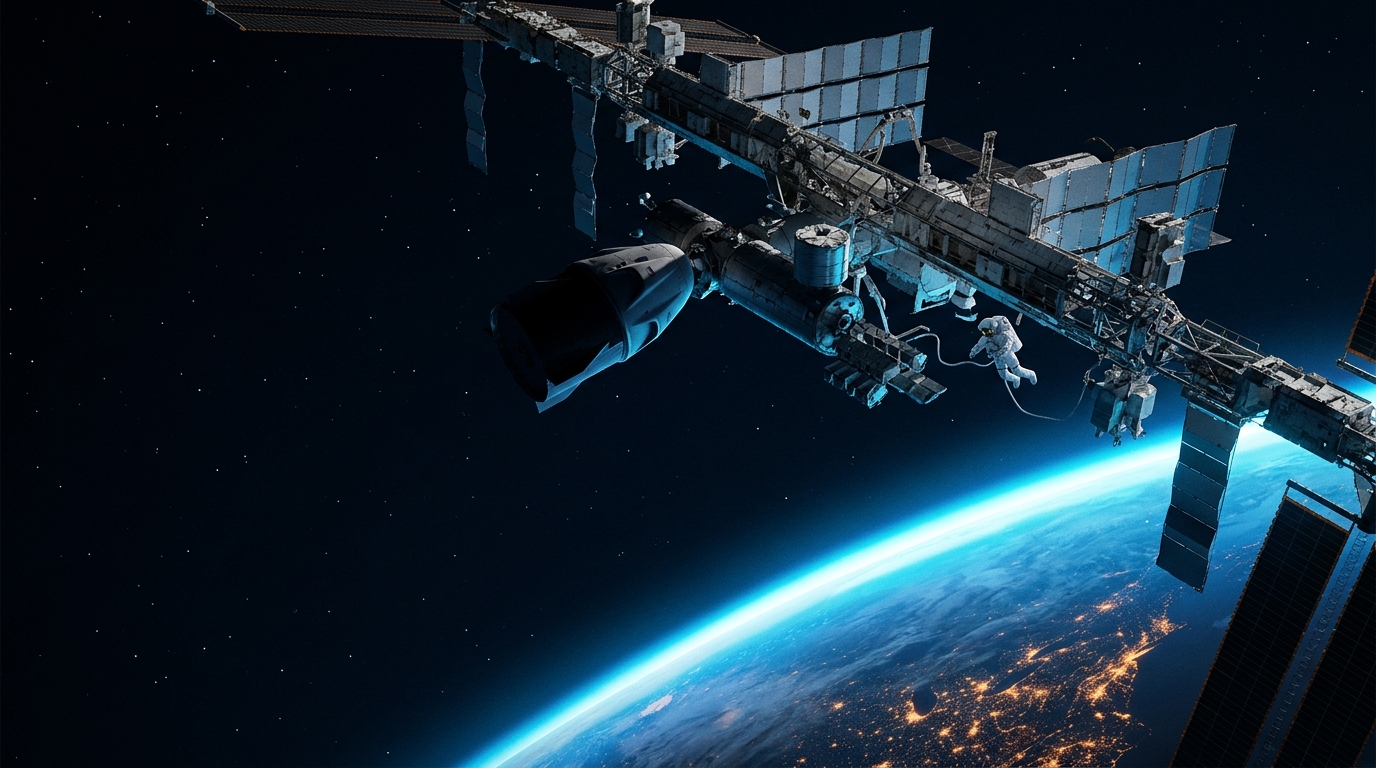
From the perspective of satellite trackers, all this flurry of commissions and academies makes sense when you look up and witness the physical reality of what is already operating overhead. Right now, the International Space Station is cutting through the ionosphere at an altitude of 421 km and cruising at a blistering speed of 27,585 km/h, according to telemetry data from our real-time tracker.
Inside that pressurized structure lives an international crew working under extreme conditions and rotating on roughly six-month shifts. Every maneuver, biomedical experiment, and spacewalk they carry out is the product of decades of hands-on knowledge passed down like a craft guild. If you want to learn more about the backgrounds and journeys of the people currently living aboard the complex, check out our detailed section on the ISS crew.
The future Space Academy will aim to codify, accelerate, and scale the very experience embodied today by the astronauts and cosmonauts on board. For those of us who love stargazing and space outreach, tracking passes of the ISS isn't an exercise in nostalgia; it is the firsthand observation of the proving ground where the operational doctrines taught to future space cadets are being forged. Watching the station glide across a clear night sky—using the practical tips in our guide to spotting the ISS in the sky—means witnessing the physical bridge connecting the pioneer era to this educational future now taking root on Earth.
The next time you glance up at the night sky, remember that the bright speck streaking across the stars in just a few minutes isn't just carrying cutting-edge science: it's carrying the baton that the next generation of spacefarers will soon inherit.
Check the station's exact position and predicted ground track at any time on our real-time ISS tracker so you never miss its next pass over your city.
Source: SpacePolicyOnline.com ↗