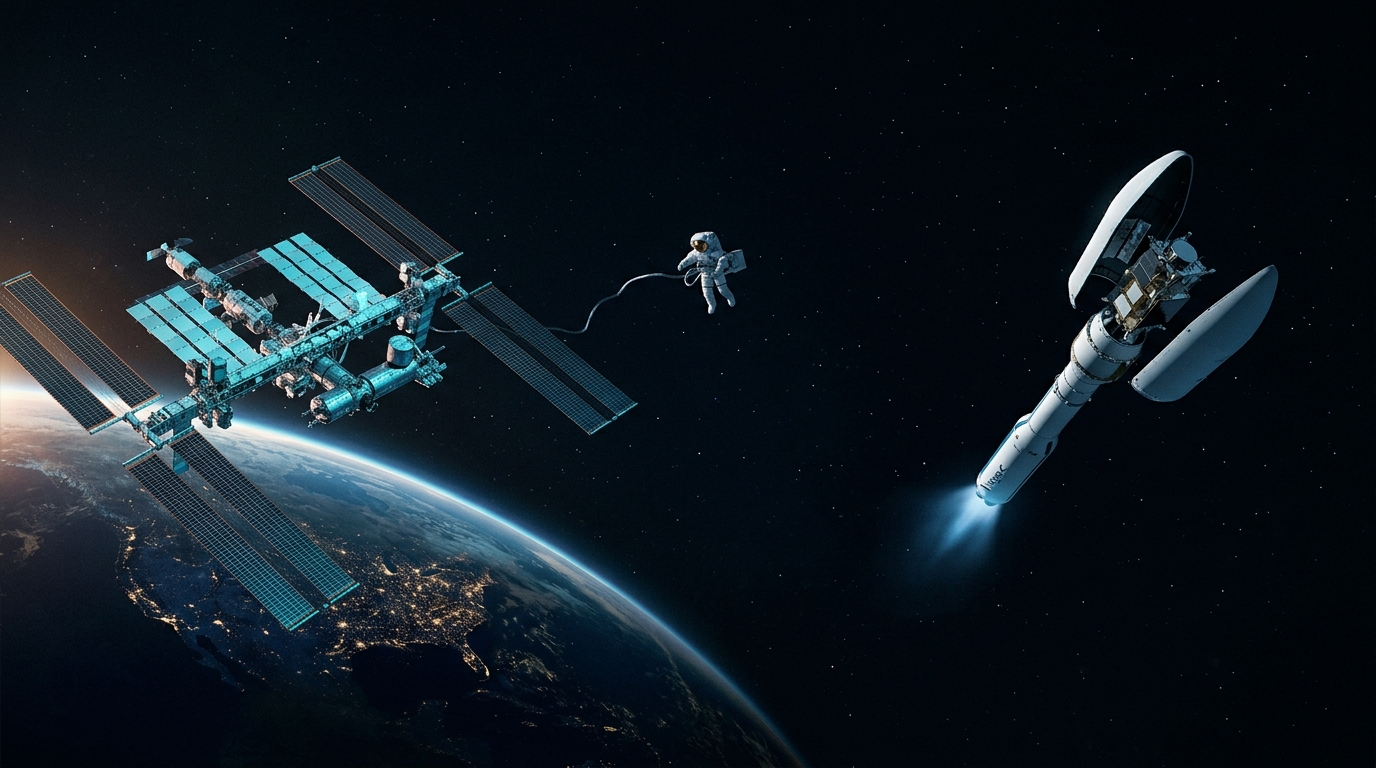
New Eyes on Earth: Vega C’s Return and Orbital Monitoring from the ISS
As commercial rockets break launch frequency records and European programs reshape their launch schedules, traffic above our heads continues to transform. Every new satellite reaching low Earth orbit shares a neighborhood with the brightest and most fascinating object in the night sky: the International Space Station. Understanding what launches into space helps us put into perspective what we see when we look up as the station crosses the sky above our homes.
What happened
The European Space Agency (ESA) and Italian prime contractor Avio are finalizing preparations to launch two key Earth observation payloads aboard the Vega C rocket from the Kourou spaceport in French Guiana. According to the specialized outlet NASASpaceflight, the European light launcher is tasked with placing the Sentinel-3C and FLEX (Fluorescence Explorer) missions into orbit—two instruments designed to monitor planetary plant health and ocean dynamics in unprecedented detail.
Sentinel-3C will ensure operational continuity for the Copernicus program, succeeding or complementing its predecessors in measuring sea surface temperature, ice topography, and the color of inland and ocean waters. Meanwhile, the FLEX mission carries a high-resolution spectrometer designed for a fascinating scientific goal: measuring the fluorescence naturally emitted by plants during photosynthesis—a direct indicator of water stress and plant productivity that conventional cameras cannot detect.
This announcement comes amid a dizzying global launch cadence. As technical media report, SpaceX has just notched the 700th launch of its Falcon rocket family after placing three O3b mPOWER communications satellites into orbit for SES. In addition, orbital history reminds us of the technological evolution we have witnessed: on September 13, 2007, Japan launched the Kaguya (SELENE) probe into space, a pioneer in capturing the Moon in high definition. In barely two decades, remote sensing has shifted from isolated milestones to a continuous, automated, and ubiquitous network of scientific platforms circling the globe.
Why it matters
Vega C's scheduled flight is not just another routine launch; it represents a strategic and industrial turning point for Europe. Following the technical setbacks and mechanical failures that grounded this solid-fuel rocket, regaining autonomous access to low Earth orbit is critical for European institutions. Without an operational domestic launcher in this class, flagship scientific missions would be forced to seek slots with external providers like SpaceX or delay their climate research timelines.
Furthermore, integrating FLEX and Sentinel-3C illustrates a radical shift in Earth science: the transition from simple orbital photography to real-time biological diagnostics of our planet. Once these platforms reach their Sun-synchronous polar orbit, they will make it possible to correlate the vigor of forests and crops with thermal and moisture anomalies, providing vital data to tackle extreme droughts and food crises. Space is no longer just a distant frontier of exploration, but the primary tool for managing daily resources on solid ground.
This boom in uncrewed satellites also raises the question of orbital coexistence. The low Earth orbits where these scientific fleets operate lie just a few hundred kilometers from the flight path of crewed complexes. With thousands of active payloads transmitting data and constantly adjusting their positions, trajectory coordination and space traffic management have become tasks as complex and critical as approach control at any major international airport.
Our take
Compared to sophisticated automated cameras like Sentinel-3C's or FLEX's fluorescence sensors, the International Space Station retains an unmatched distinct advantage: the human factor. Real-time data from our platform show that the station is currently traveling at an altitude of 435 kilometers and at a blistering speed of 27,541 km/h. Inside that orbiting laboratory, a crew works with the ability to choose what to photograph and react to the unexpected—something no automated sensor can do.
You can learn all about each member's background and mission tasks in our section on the ISS crew. While automated satellites sweep Earth in fixed, pre-programmed swaths, these astronauts combine microgravity experiments with direct visual observation through the station’s panoramic Cupola. Their ability to spot auroras, unexpected storms, volcanic eruptions, or smoke plumes and quickly point telephoto lenses complements the continuous scans of ESA satellites perfectly.
For anyone who loves skywatching, this news is a reminder that the space above us is not a static void, but a frontier bustling with craft in constant motion. Many communications or Earth observation satellites are not visible to the naked eye due to their small size or higher altitude, but the space station is. Measuring roughly the size of a football field and sporting massive reflective solar arrays, the orbital complex outshines almost any star as it glides through twilight. If you haven't yet had the chance to witness one of its passes, we recommend checking out our guide to spotting the ISS to learn how to identify its steady, silent streak across the constellations.
To find out when it will cross the horizon over your city and follow its flight second by second with pinpoint precision, head over to our real-time tracker and discover your next viewing opportunity.
Source: NASASpaceflight ↗