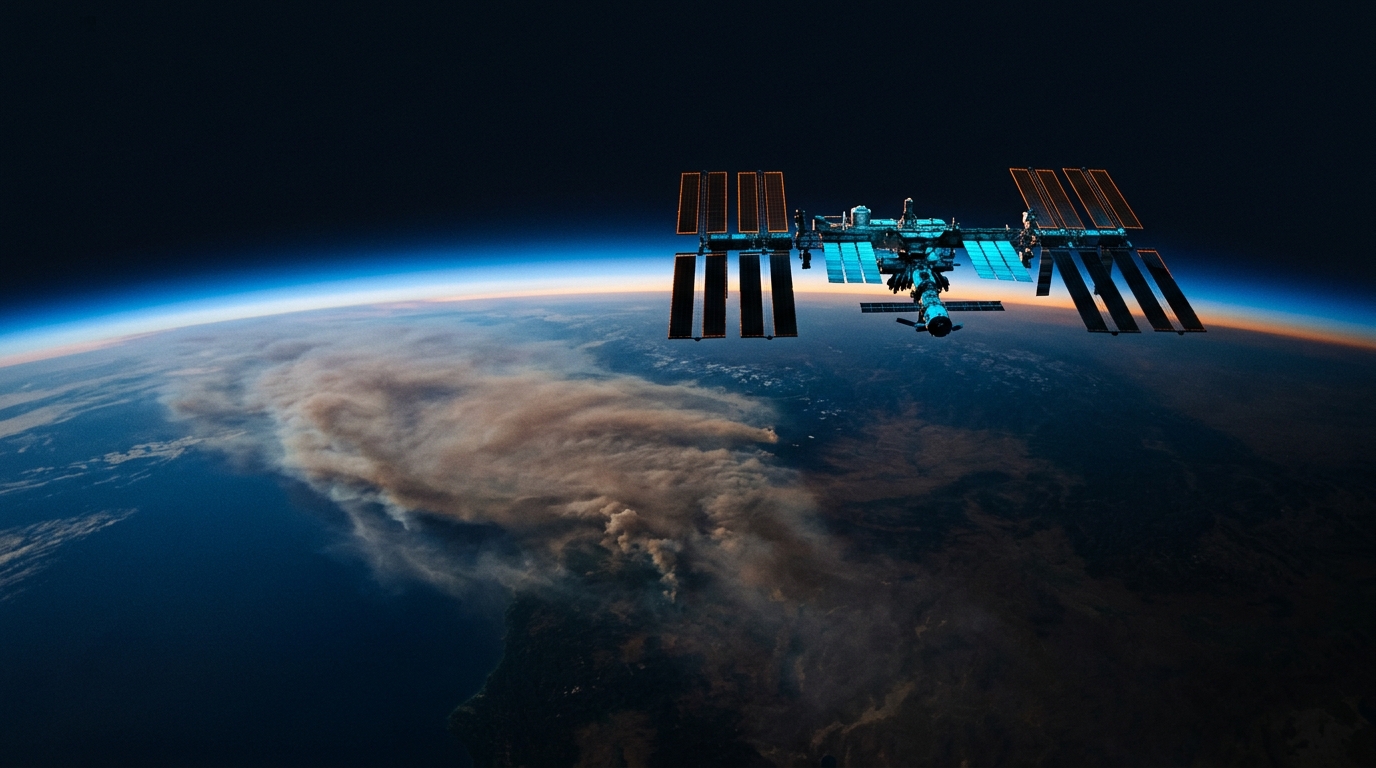
Smoke Over Oregon: How Wildfires Affect Your ISS Sightings
When you look up at the night sky hoping to catch a pass of the International Space Station, you usually assume the atmosphere overhead is a transparent window. However, massive natural events on the surface can drastically alter that perception. A wave of wildfires triggered by thunderstorms has blanketed the state of Oregon in thick smoke—an extreme event being closely tracked from Earth orbit that transforms both the astronauts' view from space and sighting conditions for observers on the ground.
What Happened
The Pacific Northwest in the United States has once again become the stage for a severe environmental crisis. Over the past few weeks, cumulative summer drought conditions reduced vegetation moisture to critical lows, turning forests across central and eastern Oregon into extremely flammable fuel. The spark that ignited the disaster came in the form of dry thunderstorms—weather systems that produce intense lightning activity but whose rainfall almost completely evaporates before reaching the ground due to low relative humidity in the lower atmospheric layers.
As a direct result, dozens of lightning strikes ignited multiple simultaneous fires across rugged, hard-to-reach terrain. The rapid spread of the flames overwhelmed initial containment efforts, generating massive smoke plumes that have released thousands of tons of particulate matter, ash, and gases into the atmosphere.
According to NASA's natural disaster tracking programs, the smoke plumes from Oregon have merged into a colossal grayish blanket drifting across hundreds of kilometers. This vast airborne mass has not only darkened the skies over cities and rural areas across the American Northwest, but has also been captured in sharp detail by multispectral sensors aboard environmental satellite fleets and remote sensing systems on the International Space Station.
Why It Matters
The impact of an event of this scale goes far beyond the tragic loss of forest cover and local ecosystem destruction. From the standpoint of atmospheric physics and orbital science, the massive injection of aerosols into the troposphere triggers a chain reaction that alters regional climate in complex ways rarely detailed in standard reports.
First, dense layers of smoke modify Earth's radiation budget through what is known as a regional global dimming effect. Soot and ash particles suspended in the atmosphere directly reflect a significant fraction of incoming solar radiation back into space, potentially leading to temporary surface cooling. However, at mid-altitudes, these same particles absorb radiative heat, warming the atmospheric layer they inhabit. This creates a pronounced thermal inversion that traps cold, stagnant air near the ground, preventing natural ventilation and driving pollutant concentrations to hazardous levels for human health.
Second, when fires burn with sufficient intensity, extreme thermal energy drives violent updrafts that form pyrocumulonimbus clouds. These fire-generated storms act as giant chimneys capable of injecting smoke directly into the lower stratosphere, more than 10 or 12 kilometers up. Once there, the smoke is not washed out by normal rainfall and can circle the globe for months, affecting atmospheric transparency worldwide.
This is where space-based observation becomes irreplaceable. While ground-based thermal sensors have a line of sight restricted by terrain, infrared remote sensing from low Earth orbit detects thermal anomalies in real time. This makes it possible to map the advancing fire line through dense smoke, provide precise guidance to firefighting crews on the ground, and feed computer models that forecast where the toxic plume will drift over the coming hours.
What to Look for in the Sky
For those of us tracking the International Space Station from the ground, these kinds of atmospheric and meteorological events directly impact the night sky viewing experience. Right now, according to data from our orbital tracker, the ISS is cruising at an altitude of 439 km at a blistering 27,528 km/h. At that speed and altitude, the station takes just 90 minutes to complete a full orbit around Earth.
For the crew aboard the station, flying over a region gripped by massive wildfires provides an awe-inspiring perspective. Looking out through the orbital outpost's cupola, astronauts not only capture high-resolution photos to assist ground agencies, but also witness in real time how the shroud of smoke drapes across the curvature of the Earth.
But how does this affect you as an observer on the ground? When a massive smoke plume drifts through the upper atmosphere driven by prevailing winds, its impact on the optical clarity of the night sky can be felt thousands of kilometers away from the fire. Aerosol particles cause a phenomenon known as Mie scattering, which alters how light travels through the atmosphere.
If you check when the ISS passes over your city during a high-altitude smoke event, you will notice two main effects on the orbital laboratory's brightness:
- Optical extinction and dimming: Smoke absorbs and scatters the sunlight reflected by the ISS solar arrays, making the bright pinpoint of light appear dimmer than standard astronomical passes predict.
- Color shift: Much like what happens during a sunset, ash particles scatter shorter wavelengths (blue) more effectively while allowing longer wavelengths (red and orange) to pass through. As a result, when crossing a region affected by high-altitude smoke, the ISS can take on a distinct warm or golden hue instead of its typical brilliant white shine.
Watching the International Space Station cross a sky altered by our own planet's dynamics is a fascinating reminder of the link between the atmosphere and space. To never miss a sighting and check live when the station will fly near you, check out our real-time tracker and plan your next viewing session.
Source: NASA ↗