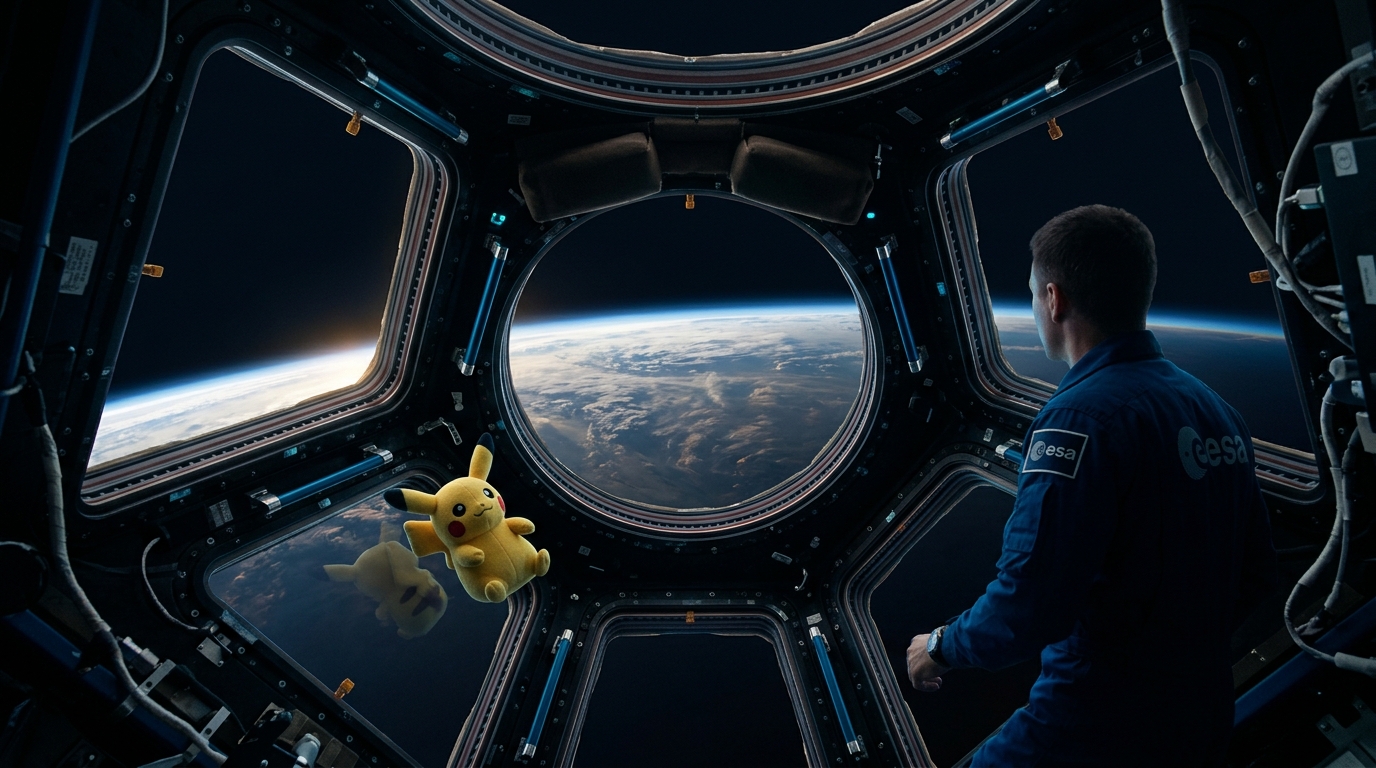
Pikachu in the ISS Cupola: Science, Pop Culture, and the Window to Earth
When you look up at the night sky and watch that bright, steady point glide across, you rarely imagine the small moments unfolding on the other side of the glass. One of human exploration's most coveted vantage points, the International Space Station's Cupola, has just welcomed a very special symbolic crew member courtesy of the European Space Agency. For those of us tracking the orbital complex from our neighborhoods and towns, this striking image is far more than just a novelty: it bridges popular culture with the fascinating pursuit of naked-eye stargazing.
What Happened
The European Space Agency (ESA) and The Pokémon Company International have formed an official partnership to celebrate World Space Week, an annual event held from October 4 to 10. The centerpiece of this announcement is a unique image featuring Pikachu dressed as an astronaut inside the International Space Station's Cupola, as reported by ESA across its outreach channels.
The project extends beyond social media buzz. The agreement includes a series of traveling exhibitions and educational experiences across several European countries. The primary goal is to harness the immense, multigenerational appeal of a decades-old franchise to introduce students and families to space navigation, microgravity research, and Earth observation. Seeing a global cultural icon gazing out of the planet's most famous window aims to spark that same sense of wonder that skywatchers feel whenever they look up at a clear night sky.
Why It Matters
To understand the significance of this news, it helps to know exactly what the Cupola is and Europe's role in it. Designed and built by the European aerospace industry, this seven-window armored glass observatory was delivered to NASA in 2010. Since then, it has served as the operational hub for visually monitoring arriving cargo spacecraft, operating the Canadarm2 robotic arm, and, above all, conducting meteorological and geographic observations of our home planet.
Space agencies face a major challenge: the normalization of human spaceflight. We live in an era where continuous human presence in low Earth orbit spans more than two decades. While this continuity is a resounding engineering triumph, it paradoxically leads the general public to forget that people are permanently living and working hundreds of kilometers above us. Initiatives like this help break through that wall of indifference. By placing a character recognized by millions of young people into a cutting-edge scientific environment, it accomplishes what technical press releases rarely do: reminding new generations that the station exists, is real, and is inhabited.
In addition, the Cupola has a nadir orientation: its windows look directly and constantly down toward Earth's surface. While astronauts capture images of hurricanes, auroras, and moonlit mountain ranges, we watch for them from the ground below. This collaboration between ESA and Pokémon adds fresh meaning to that two-way perspective between those looking down and those looking up.
What to Look for in the Sky
Right now, the sensors on our real-time ISS tracker show the station cruising at an altitude of 426 km, moving across the planet at a staggering 27,556 km/h. At that speed, the complex circles the globe roughly every ninety minutes, experiencing sixteen sunrises and sunsets every Earth day.
Inside the complex lives a crew of astronauts and cosmonauts rotating on shifts of about six months. If you want to learn more about the background and missions of those currently on board, check out our guide to the station's current crew. They are the ones floating daily before the very windows where Pikachu's experience was set, gazing down at the same continents and oceans you walk upon.
When planning your next viewing session, keep in mind what the station looks like from solid ground:
- A steady beacon: The ISS does not blink or flash colored lights. It appears as a bright white point of light, comparable in brightness to Venus or Jupiter, gliding smoothly and steadily across the constellations.
- The Cupola's orientation: Since the observation module faces straight down toward Earth, when you see that flash overhead, you are looking directly at the belly of the spacecraft and the base of the Cupola itself, where scientific instruments and these creative educational initiatives come together.
- Timing is everything: The station is only visible during the early hours after sunset or just before sunrise, when the ground is dark but its massive solar arrays still reflect sunlight. To plan your sighting with pinpoint accuracy, check out our guide to spotting the ISS in the sky before heading outside.
Knowing what happens on board—what experiments are underway or what educational campaigns are dreamed up within its corridors—transforms a fleeting streak of light into a living experience rich with human meaning.
Don't miss the next opportunity to spot it over your city: check coordinates and live passes with our tracker, and enjoy the spectacle of an orbital flyover right from your own window.
Source: ESA ↗