Why the ISS Suddenly Disappears in the Middle of the Sky
You are tracking the bright dot of the International Space Station crossing the sky, everything looks perfect, and suddenly it goes out. It doesn't dip toward the horizon, nor does it hide behind a cloud: it vanishes into thin air in a matter of seconds. It is one of the most baffling sights the first time you watch the ISS, and it has a very straightforward explanation.
The ISS does not emit its own light
That is the starting point, and one that almost no one considers. The station isn't a lightbulb: what you see is sunlight reflected off its radiators and, above all, its massive solar arrays, which total more than 2,500 square meters of surface area. In that respect, the ISS works exactly like the Moon. If it stops receiving sunlight, it ceases to exist for your eyes.
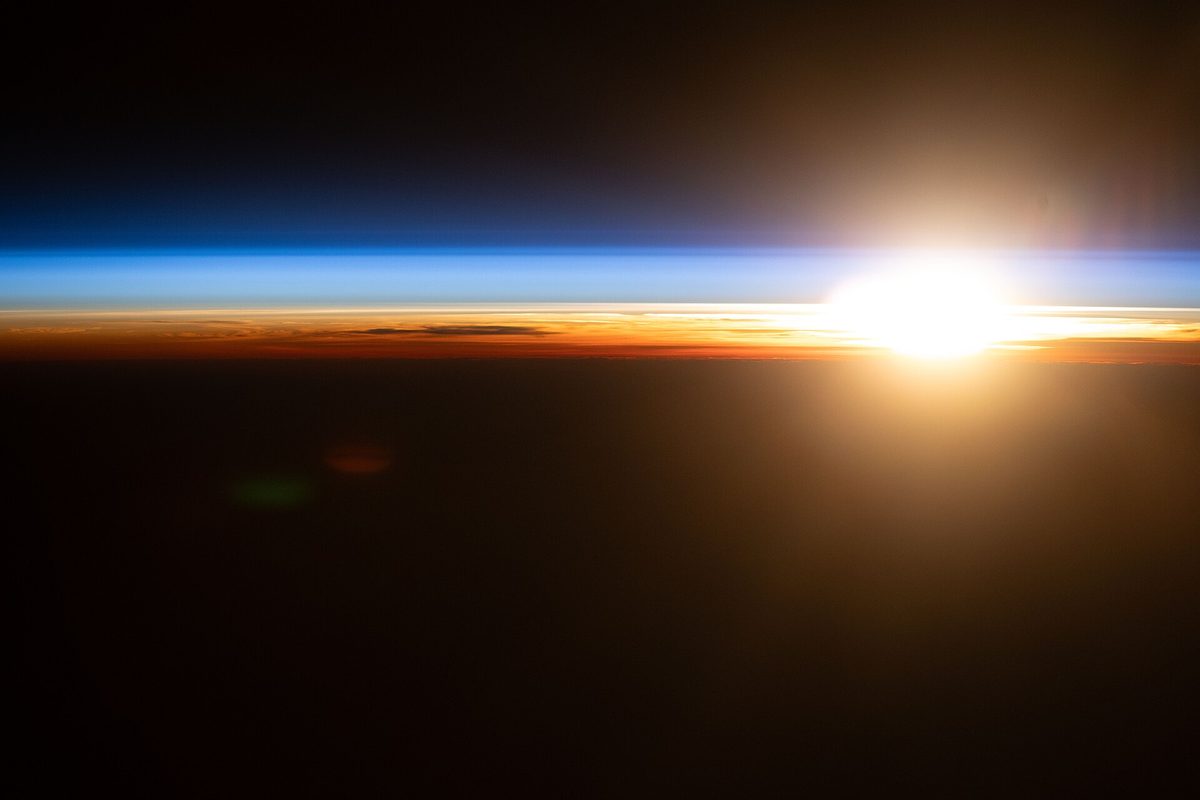
And at an altitude of 400 kilometers, the ISS loses sunlight very frequently: it circles the Earth every 92 minutes, meaning its crew witnesses about 16 sunrises and 16 sunsets every 24 hours.
What an orbital eclipse actually is
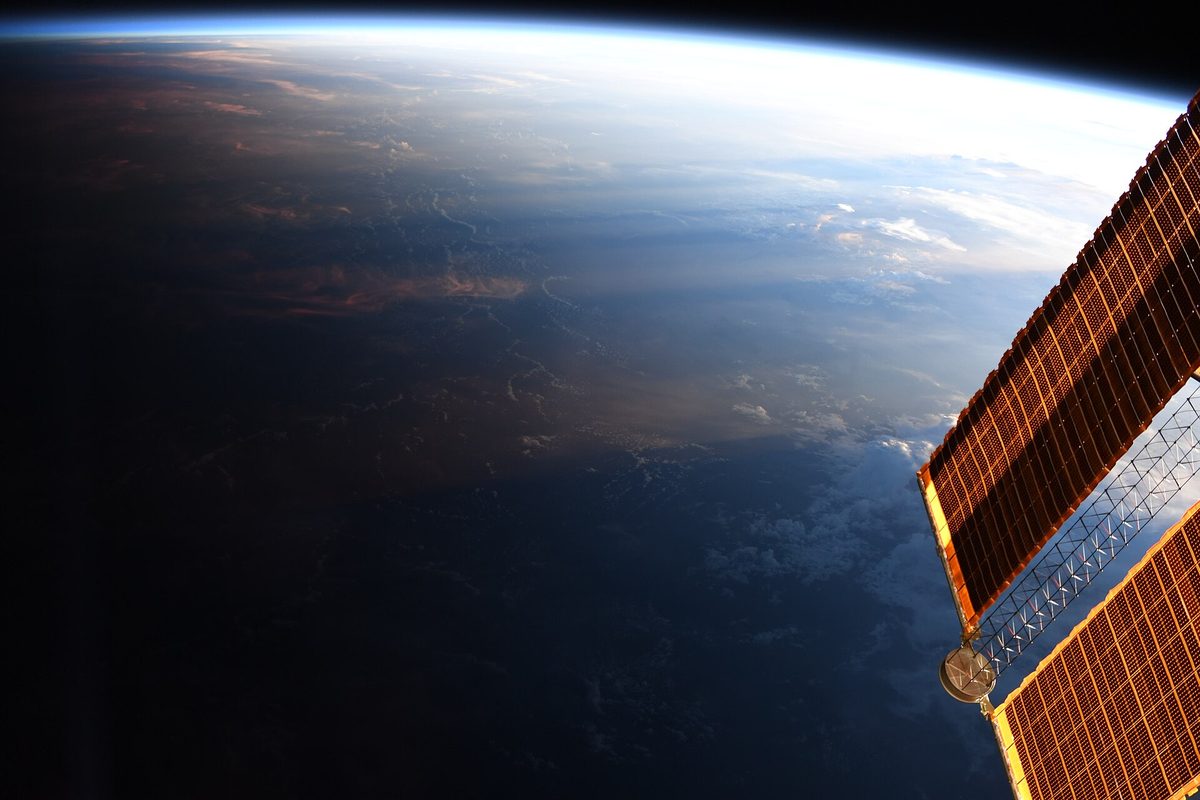
Earth casts a gigantic cone of shadow pointing away from the Sun. When the station enters that cone, it is still there—at the same altitude, moving at the same speed—but completely in the dark. From the ground, the effect is what you have just seen: the bright dot dims over two or three seconds, turns briefly orange, and vanishes.
That reddish tint right before it disappears, when visible, is fascinating to understand: you are seeing the ISS illuminated by sunlight filtering through Earth's atmosphere at the limb of the planet. It is literally Earth's sunset projected onto the station. At that very moment, the astronauts are crossing the terminator, watching the shadow line advance beneath them.
The reverse also happens, and it is harder to catch: on some passes, the ISS doesn't rise from the horizon, but suddenly flares into view mid-sky. It is the exact same phenomenon in reverse—the station emerging from the shadow.
Why this dictates when you can see it
Here is the practical part. The fact that the ISS must be illuminated while you are in the dark is what narrows observation opportunities to just a few windows a day, explaining why you can't step outside and spot it at 3:00 a.m.
The geometry required is this: you must be in darkness, with the Sun below your horizon, while the station is still high enough to catch sunlight above Earth's shadow. This happens mainly during the two hours after sunset and the two hours before sunrise. In the middle of the night, Earth's shadow extends across the ISS orbit as well, leaving nearly all passes eclipsed.
There is one great exception: around the summer solstice at mid-to-high latitudes, Earth's shadow is tilted so steeply that the station can remain illuminated all night long. These are the weeks when you can catch multiple visible passes in a single night, some sweeping across the entire sky from horizon to horizon.
How to make the most of it when observing
- Don't expect it to reach the horizon. A pass that cuts off midway isn't a failed pass: it is completely normal for most evening sightings.
- Dawn passes work in reverse. They usually begin with the ISS appearing out of nowhere in the sky and end with it descending toward the eastern horizon.
- Watch the color at the end. If you manage to catch that brief orange glow right before blackout, you are watching an orbital sunset. It is well worth the effort.
On our real-time tracker, you can see where the station is right now and where it is headed, which is the quickest way to understand why tonight's pass cuts short where it does. And with our pass calculator, you get the exact times for your location.
Don't mistake it for something else
A receding airplane might also seem to vanish, but first you'll see flashing red and green lights, and it gradually descends toward the horizon. A small satellite can tumble, producing irregular flashes. The ISS is different: steady, intense brightness, smooth motion, complete silence, and an abrupt cutoff mid-sky. That sudden blackout is, in fact, one of the best ways to confirm that what you saw was truly the space station.
If you want to know the differences before heading out, we cover them in our guide to spotting the ISS.
The next time it goes dark halfway across, you'll know what you are witnessing: not a forecast glitch, but the shadow of your own planet.
Images: cover, An orbital sunrise above the Pacific Ocean illuminates Earths atmosphere (iss074e0796544) — NASA Johnson Space Center (Public domain). Interior, From Day Into Night — کریستیانا هاموک ناسا (Public domain).
Source: ISS Tracker ↗