Back to Earth After 8 Months on the ISS: How It Affects Your Views
Each time you look up at the night sky and see that dazzling point of light gliding across the heavens, you are watching a human habitat in constant transformation. After an intensive eight-month stay in low Earth orbit, NASA astronaut Chris Williams and Roscosmos cosmonauts Sergey Kud-Sverchkov and Sergei Mikaev have safely touched down in the Kazakh steppe. For those of us who enjoy watching the International Space Station from our backyard or balcony, this crew handover not only renews life aboard the complex, but also invites us to better understand the remarkable physical and logistical feats unfolding more than 400 kilometers above our heads.
What happened
The return of a space crew is never a sudden event; rather, it is a high-precision maneuver blending orbital mechanics, atmospheric reentry engineering, and flawless ground logistics. The return sequence formally kicked off in the early morning hours when the spacecraft undocked from its designated port on the orbital complex at 2:03 a.m. US Central Time. At that moment, with a gentle pulse from its maneuvering thrusters, the capsule began to drift away from the space station to reach a safe distance before executing the critical deceleration burn.
Once the required separation was achieved, the vehicle fired its engines against its direction of travel for the exact duration needed to slow its orbital speed. This braking maneuver lowered the orbit's perigee, sending the capsule plunging into the denser layers of Earth's atmosphere. During atmospheric descent, friction with the air generates scorching temperatures across the heat shield, causing a plasma blackout period where radio communications are temporarily cut off. After enduring this trial of fire and gravitational deceleration, the parachute system deployed in multiple stages to stabilize and slow the spacecraft.
Final touchdown occurred at 5:27 a.m. CDT (3:27 p.m. local time in Kazakhstan) on a flat expanse of the steppe southeast of the town of Zhezkazgan. According to NASA's official release, search and recovery teams—made up of medical personnel, ground support specialists, and a fleet of helicopters—reached the landing site almost immediately. After securing the capsule and checking for toxic propellant leaks, flight surgeons assisted Chris Williams, Sergey Kud-Sverchkov, and Sergei Mikaev out of the spacecraft.
Following strict medical protocols established for long-duration missions, the three crew members underwent initial checkups inside a medical tent set up right at the landing zone. Once their physical stability was confirmed, the split repatriation process began: American astronaut Chris Williams boarded a flight bound for NASA's Johnson Space Center in Houston, Texas, while cosmonauts Kud-Sverchkov and Mikaev headed to the Gagarin Cosmonaut Training Center in Star City, near Moscow, to begin their physical rehabilitation.
Why it matters
Understanding the true scope of an eight-month mission requires looking past the dramatic landing imagery. Keeping human beings living and working in weightlessness for nearly 240 days is far from routine: it is a vital biological and technological endurance test essential for the future of space exploration. The human body evolved under Earth's constant gravitational pull; when gravity disappears, bodily fluids shift toward the torso and head, muscle mass rapidly atrophies, and bone density drops unless rigorous daily exercise countermeasures are applied.
The medical and biological tests performed on Williams and his crewmates throughout these eight months provide invaluable data for tackling humanity's next giant leaps beyond Earth. Missions under the Artemis program—aimed at establishing a sustainable human presence on the Moon—as well as future crewed voyages to Mars, which will require six to nine months of transit each way, depend directly on the insights gathered aboard the space station. The orbital laboratory serves as humanity's only long-duration microgravity proving ground.
On a scientific and operational level, during this rotation the departing crew carried out dozens of experiments across diverse fields such as cellular biology, biotechnology, complex fluid dynamics, and space-based environmental and weather monitoring. In addition, routine station maintenance demanded hundreds of hours of hands-on work to repair life support systems, swap out batteries, and upgrade vital electronics. This ongoing effort ensures the complex remains safe and fully functional after more than two decades of continuous human occupancy.
Following the departure of Williams, Kud-Sverchkov, and Mikaev, life aboard the station carries on without skipping a beat. The complex remains fully operational thanks to the astronauts and cosmonauts who remain on duty, whom you can explore in our section on the current crew. They will carry forward the ongoing science and keep the engine of international space exploration running strong.
What to look for in the sky
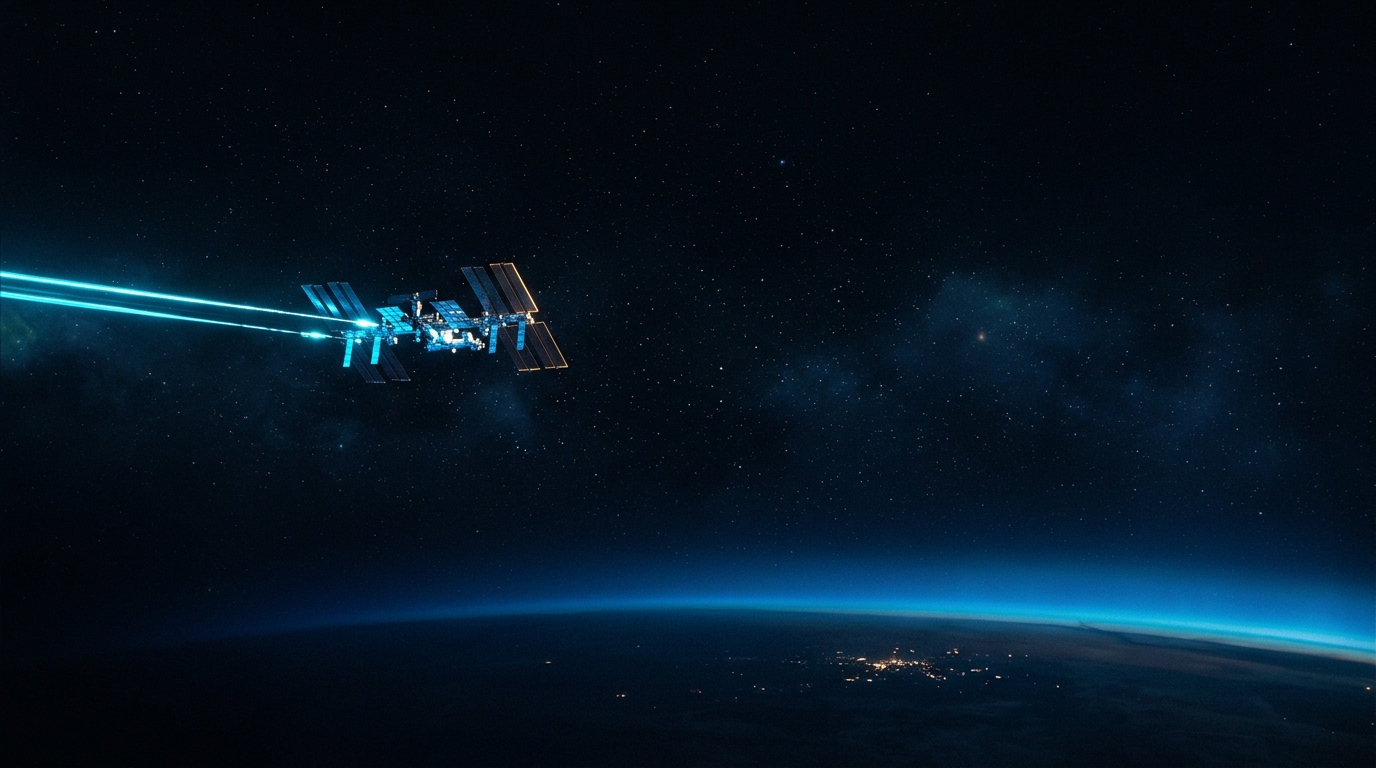
For those of us tracking satellites from the ground, milestones like a crew's homecoming add a deeply human layer to that bright dot arcing overhead. Right now, according to our real-time tracker, the International Space Station orbits at an average altitude of 439 km above Earth, traveling at an astonishing 27,528 km/h. At that speed, the complex circles the globe roughly every 90 minutes, meaning the crew witnesses 16 sunrises and 16 sunsets every 24 hours.
Despite the departure of three residents, the station's physical appearance and visibility from your location remain completely unchanged. The orbital complex spans an area roughly the size of an American football field, and its massive solar arrays reflect sunlight with such brilliance that it ranks as the third-brightest object in the night sky, outshone only by the Moon and Venus. When the station glides over your city shortly after sunset or before dawn, you will spot it as a brilliant, steady golden light cruising smoothly without twinkling, crossing the sky from west to east in two to six minutes.
If you want to know exactly when and where to look tonight, be sure to check our ISS pass times tailored to your location. To get the most out of your viewing session, read our guide to spotting the ISS with the naked eye, where we break down visual magnitude, elevation angle above the horizon, and the ideal weather conditions so you never miss a pass. Plus, if you want to follow upcoming dockings or live spacewalks by the current crew, head over to our space live streams.
The next time you see that bright light streak across the stars, remember that people are living and working inside it at nearly 28,000 km/h. To calculate the station's next pass over your neighborhood with pinpoint accuracy, check out our real-time tracker and stay connected to low Earth orbit.
Source: NASA ↗