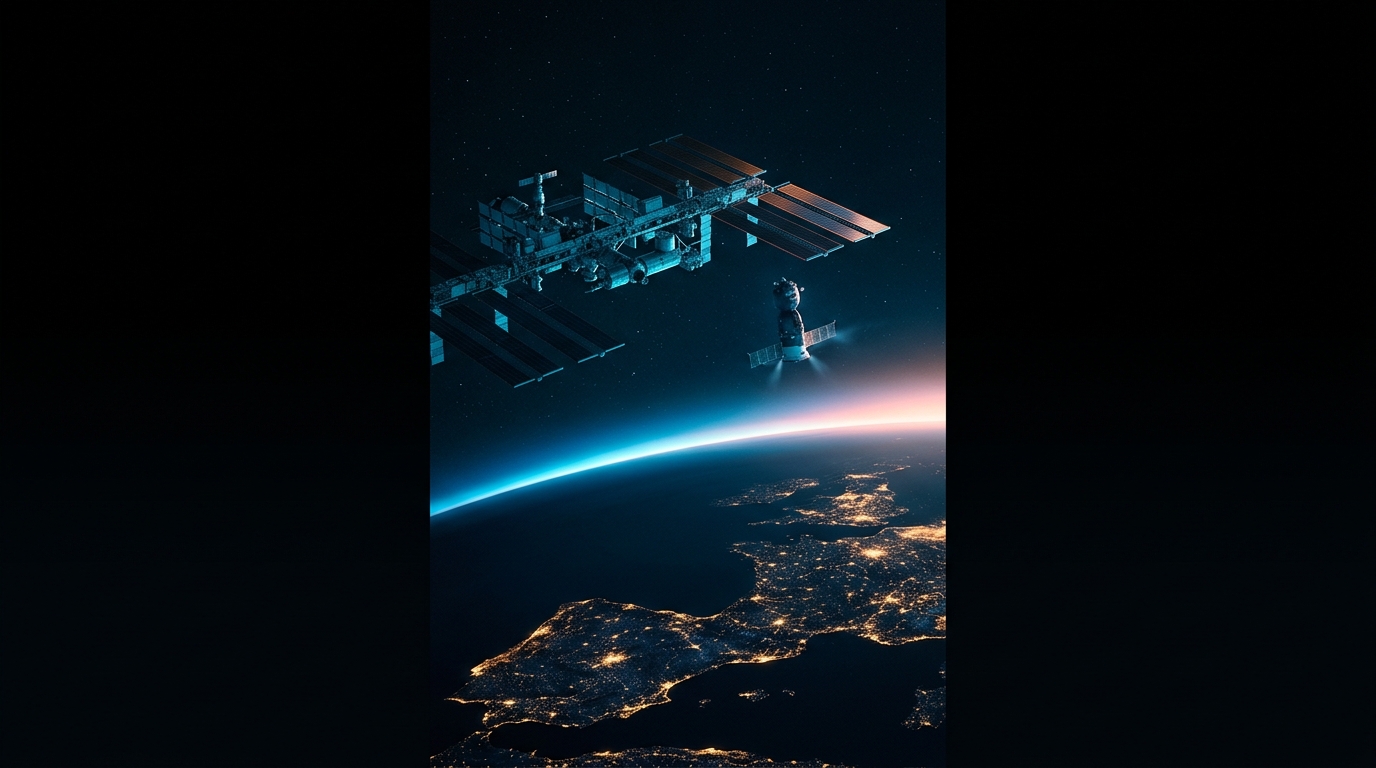
Space Station Crew Swap: Soyuz Returns Home, Changing Life on Board
Every time a spacecraft undocks from the International Space Station, the orbital laboratory alters not only its internal routine but also its visible configuration in the night sky. The upcoming return of a Soyuz capsule to Earth marks the end of a key scientific expedition and begins a new operational phase that every satellite tracking enthusiast should keep in mind. If you regularly scan the night sky for that bright pinpoint of light crossing the darkness, these crew movements directly influence how and when you can experience sightings from your city.
What Happened
A new crew rotation on the orbital complex is about to conclude. As reported by the specialized portal Space.com, NASA astronaut Chris Williams and two cosmonauts from the Russian space agency Roscosmos will wrap up their stay in space to begin their journey back to Earth aboard a Soyuz spacecraft. The return procedure is scheduled for early Sunday morning, July 26, when the capsule will undock from its docking port to initiate its descent.
The return process is one of the most complex and meticulous maneuvers in spaceflight. It begins with the gradual undocking of the Soyuz spacecraft, a delicate maneuver in which the vehicle uses short thruster pulses to back away from the station without altering the complex's orbit. Once at a safe distance, the Soyuz executes its deorbit burn. This engine firing slows the spacecraft just enough for Earth's gravity to pull it down into the denser layers of the atmosphere.
As it plunges into the atmosphere at thousands of kilometers per hour, friction with the air generates extreme heat, enveloping the capsule in a sheath of plasma that is fully absorbed by its heat shield. After surviving this critical stage and shedding speed, a sequence of parachutes deploys at an altitude of about ten kilometers to slow the descent. Finally, just one second before touching down on the steppes of Kazakhstan, landing retrorockets on the base of the vehicle fire to cushion the impact, allowing recovery teams to safely extract the crew.
Why It Matters
Beyond the technical complexity of landing, undocking and rotation maneuvers highlight the unique operational architecture of the International Space Station. The seat-sharing agreement between NASA and Roscosmos ensures that qualified crew members from both agencies are always on board, regardless of whether travel takes place in a Soyuz capsule or an American commercial vehicle.
This strategy addresses a vital technical necessity: the station is divided into two interdependent segments. While the Russian segment provides the propulsion essential for maintaining the complex's altitude and performing debris avoidance maneuvers, the US segment delivers most of the electrical power through its massive solar arrays, alongside managing much of the life support and communications systems. Without an integrated crew on board, an emergency in either segment would leave overall control of the orbital lab compromised.
Furthermore, these return flights represent the moment when months of scientific research are brought home. Astronauts spend the final hours before hatch closure packing biological samples, protein crystals, and technology demonstrations conducted in microgravity. These materials must reach terrestrial laboratories under strict thermal conditions so scientists can analyze the effects of the space environment before their properties alter under Earth's gravity.
What to Look for in the Sky
For those of us tracking the International Space Station from the ground, every undocking maneuver subtly changes the visibility of the orbital complex. According to real-time data from our tracker, the ISS is currently flying at an altitude of 439 km and traveling at a speed of 27,528 km/h. At this pace, the laboratory completes an orbit of Earth every 90 minutes, providing multiple viewing opportunities depending on your geographic location.
Following the undocking, the station remains inhabited by the rest of the crew, who keep experiments running smoothly. You can learn about the background and role of every astronaut currently in orbit in our section dedicated to the crew aboard the ISS.
In the hours before and after a Soyuz spacecraft undocks, a striking optical phenomenon can be seen if a night pass crosses your region. Rather than watching a single bright dot glide across the sky, you can often spot two lights traveling along the same trajectory with gradual separation: the brighter one being the space station and the fainter point of light being the capsule drifting away toward reentry.
If you want to coordinate your viewing sessions so you never miss these passes, consult our guide to spotting the ISS or check exact pass times using our station pass schedule tool. In addition, during the return maneuver, you can follow the live video feed on our ISS live streams page.
Check the exact location of the station on the map and find out if it is about to cross your horizon by visiting our real-time ISS tracker.
Source: Space.com ↗