Soyuz MS-28 Return: What It Means for the ISS and Your Sighting Passes
Every time you look up at the night sky and spot that brilliant point of light gliding across the heavens, you are gazing at an ever-evolving human habitat. Following the undocking and successful landing of the Soyuz MS-28 spacecraft, activity aboard the orbital laboratory is undergoing a complete reset. Understanding these orbital movements not only helps you know who is up there right now, but also transforms the experience of stepping outside to spot the International Space Station from your own backyard.
What happened
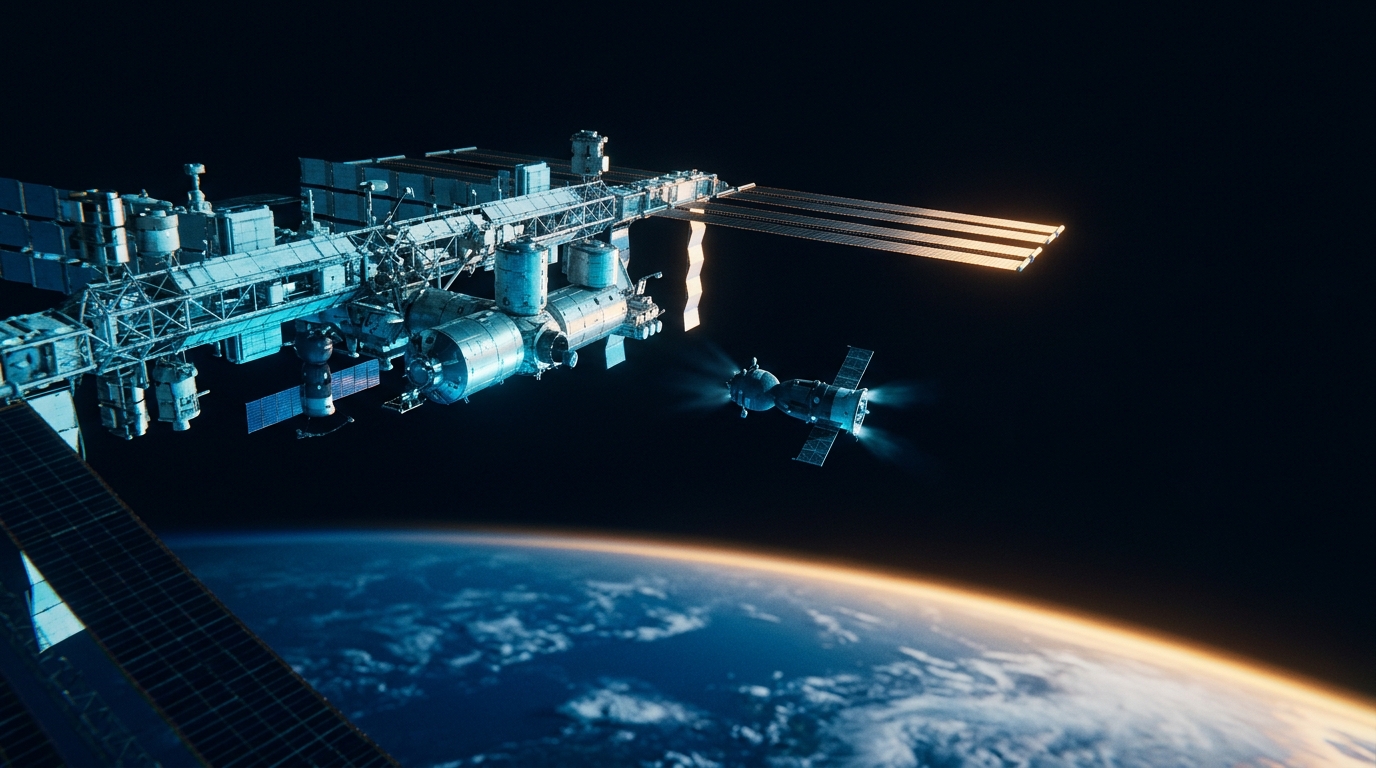
The Russian Soyuz MS-28 spacecraft has successfully completed its mission after touching down on the steppes of Kazakhstan, drawing to a close an extended eight-month stay aboard the International Space Station. Traveling inside the reentry vehicle were NASA astronaut Chris Williams and Roscosmos cosmonauts Sergey Kud-Sverchkov and Sergei Mikaev. The undocking maneuver, subsequent atmospheric braking, and deployment of the main parachute system were carried out with split-second precision, according to the specialized portal SpacePolicyOnline.com.
During the crew's approximately 240 days in microgravity, routine aboard the laboratory never slowed down. The three crew members not only kept their respective agency modules fully operational, but also coordinated multiple spacewalks, orbital reboost maneuvers to raise the station's altitude, and the arrival of uncrewed cargo ships bearing essential supplies. The return is part of regular crew rotation policy, allowing the three spacefarers to travel back to their home bases in Houston and Star City for a comprehensive physical rehabilitation period after eight months without Earth's gravity.
Why it matters
An eight-month mission exceeds the standard six-month stay aboard the orbital complex. This extended duration is essential for space biomedical research. The prolonged mission of Williams, Kud-Sverchkov, and Mikaev has yielded highly valuable data on how the human body adapts to continuous exposure to microgravity and space radiation beyond Earth's protective atmosphere.
Key scientific and operational highlights of this mission include:
- Monitoring bone density and muscle loss after 240 consecutive days in weightlessness.
- Evaluating cardiovascular changes and fluid shifts during long-duration spaceflight.
- Confirming the continued success of the seat-swap agreement between NASA and Roscosmos.
- Ensuring uninterrupted maintenance across both the US and Russian orbital segments.
Furthermore, this flight once again highlights the value of bilateral cross-flight agreements between agencies. This cooperation guarantees that trained crew members are always on board to operate every critical station system, ensuring the outpost keeps running smoothly regardless of which spacecraft is currently docked. Following the departure of MS-28, the station remains occupied by the rest of the crew. You can check the complete list of who is on board right now in our dedicated section.
This joint crew of astronauts and cosmonauts from multiple agencies keeps the complex fully operational 24 hours a day, ensuring that dozens of scientific experiments continue uninterrupted as the station circles the globe at blistering speed.
What to look for in the sky
For those of us tracking the station from the ground, the departure of a spacecraft and the crew reshuffle changes how we connect with what happens overhead. According to data collected by our tracker, the International Space Station is currently flying at an altitude of 439 kilometers and traveling at 27,528 km/h. This means it circles the entire planet roughly every 90 minutes, providing regular sighting opportunities right above your location.
While Soyuz MS-28 was docked, it formed part of the laboratory's integrated structure. After its departure, the complex's total mass drops slightly, but the visibility of each pass across the night sky remains unchanged. That brilliant glint you can see with the naked eye does not come from artificial lights on the spacecraft, but from sunlight reflecting off its massive solar arrays, which span an area equivalent to an entire football field.
Knowing that human beings are living and working at more than 27,000 km/h inside that bright dot silently passing over your roof turns a simple stargazing session into an awe-inspiring experience. To make sure you never miss visible passes over your city, check our guide on what time the ISS passes overhead and review essential viewing tips in our guide to spotting the ISS with the naked eye.
Whenever the station's orbit coincides with dawn or dusk in your area, you get a window of just a few minutes to watch humanity's largest space outpost drift across the sky. Spotting the station right after a crew handover lets you witness firsthand our uninterrupted presence in the cosmos.
We invite you to use our real-time tracker to see the orbital outpost's exact location right now and plan your next night of skywatching.
Source: SpacePolicyOnline.com ↗