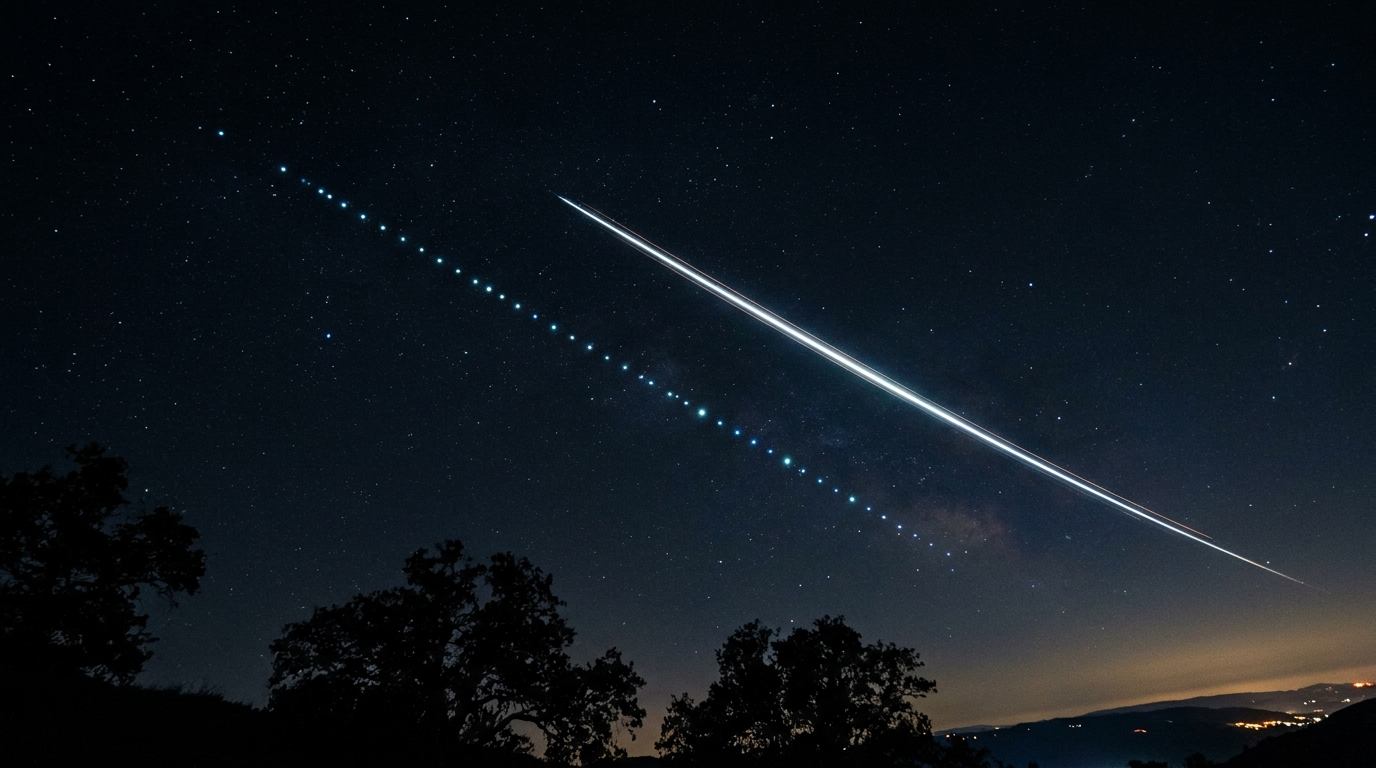
SpaceX Launches 24 Starlink Satellites from California: Spotting Them vs the ISS
If you regularly scan the night sky for the brilliant silhouette of the International Space Station, the coming hours offer a prime opportunity to understand what is truly happening above our heads. The launch of a fresh batch of Starlink satellites from the California coast not only adds new points of light to the night sky, but also reshapes the logistics of low Earth orbit, where our favorite orbital laboratory resides.
What Happened
A SpaceX Falcon 9 rocket launched from Vandenberg Space Force Base on the southern California coast, carrying a batch of 24 satellites bound for the Starlink megaconstellation. According to specialized outlet Spaceflight Now, liftoff was scheduled for 8:51 a.m. Pacific Time (15:51 UTC), kicking off another orbital insertion maneuver across the western United States.
Unlike launches typically seen from Cape Canaveral or Kennedy Space Center in Florida, liftoffs from Vandenberg follow a distinct southerly flight corridor over the open waters of the Pacific Ocean. This direct trajectory is essential for placing payloads into polar or high-inclination orbits without flying over populated areas during the ascent phase.
The mission followed the company's standard operational playbook: after stage separation, the first-stage booster completed a controlled atmospheric reentry to land vertically on an autonomous droneship stationed downrange in the ocean. Meanwhile, the second stage propelled the 24 satellites into a temporary low-altitude orbit, from which they will gradually raise their orbits using their own onboard ion thrusters.
Why It Matters
To understand what happens in near-Earth space, it helps to look at the altitude map. The International Space Station is currently flying at an average altitude of 439 km, traveling at a staggering 27,528 km/h according to real-time data tracked by our platform. Living and working aboard is an international crew conducting scientific research and managing incoming and outgoing cargo traffic.
You can check the full profile and duties of each astronaut in our dedicated section on the current ISS crew. Operating in low Earth orbit has become an exercise in extreme precision. When SpaceX deploys Starlink satellites from Vandenberg into high-inclination orbits, these spacecraft cross high northern and southern latitudes, weaving a web that intersects the ground tracks and paths of other orbital objects, including the space station itself.
The 24 new satellites are initially inserted into a temporary orbit below the operational altitude of the ISS. From there, ground controllers perform system health checks before commanding them to raise their orbits to 550 km, their final altitude where they provide high-speed connectivity to remote areas, maritime routes, and underserved regions. This ongoing orbital traffic requires space agencies to maintain continuous tracking to ensure the flight path of the ISS remains clear of debris or maneuvering satellites.
What to Look For in the Sky
For skywatchers using just their naked eyes, a launch like this produces one of modern stargazing's most fascinating yet easily confused sights: the 'satellite train.' During the initial hours and days following separation from the rocket, the 24 satellites travel bunched tightly together in a straight line, glinting in the sunlight shortly before dawn or just after dusk.
If you look up at the night sky and spot a string of bright dots moving in unison, you are not seeing the ISS or an anomalous phenomenon; it is the newly launched Starlink batch. Over the following days, as they fire their ion engines and deploy their solar arrays, the satellites gradually spread apart and climb in altitude, becoming far less conspicuous to the unaided eye.
By contrast, the International Space Station presents a completely different, far more majestic visual signature. The ISS never appears in formation or as a string of lights: it appears as a single brilliant white dot, outshining virtually every star and planet, gliding steadily and smoothly from horizon to horizon without blinking or flashing.
If you want to learn how to distinguish these objects accurately and understand the weather conditions you need, be sure to check our guide to spotting the ISS in the sky. Likewise, the key to never mistaking an orbital laboratory flyover for a Starlink train is checking precise pass times; you can see when it will fly over your exact location using our ISS pass prediction tool.
The space above us is busier than ever. Before heading outside to gaze at the stars tonight, pull up our real-time ISS tracker to verify the exact position of the space station and enjoy your skywatching session with total confidence.
Source: Spaceflight Now ↗