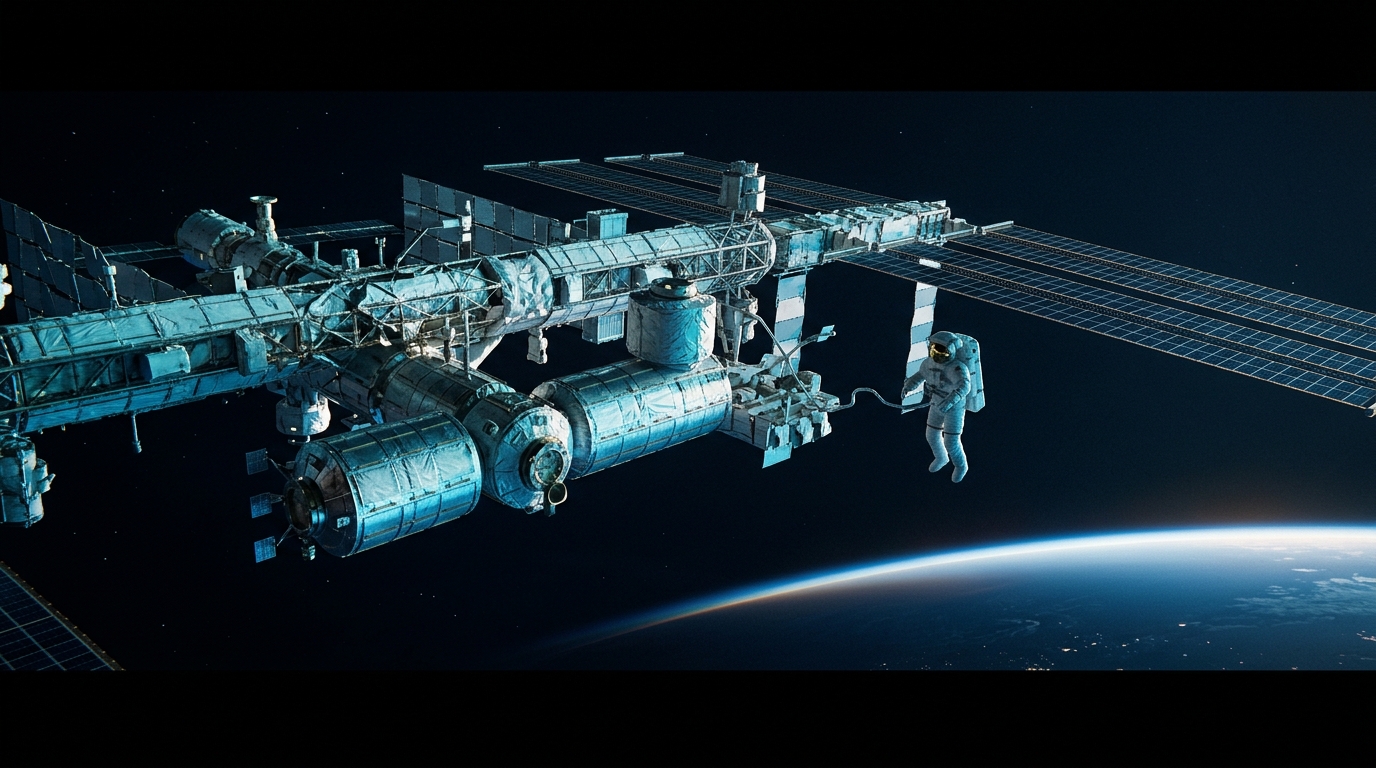
Starliner Defines Its Future: What NASA's Update Means for the ISS
Every time you look up and spot that bright point gliding silently across the night sky, you are looking at an orbital complex where human spaceflight logistics are measured to the millimeter. Updates on Boeing’s Starliner capsule go far beyond technical press briefings: they shape the crew rotation schedule, day-to-day life, and onboard resources of the people traveling aboard the station we track from Earth. For those of us who love spotting the International Space Station over our cities, understanding these technical developments gives us a fresh perspective on every pass overhead.
What happened
NASA and Boeing have scheduled a media briefing to provide an update on the Starliner spacecraft’s development status and outline the path forward for its future regular crew rotation flights to and from the International Space Station, as reported by NASA through its official channels. During the briefing, leadership from the agency’s Commercial Crew Program and Boeing technical executives will address the findings from flight testing and the adjustments required before certifying the capsule for routine missions.
The primary goal of the briefing is to clarify the vehicle's certification timeline. Following the Crew Flight Test (CFT), in which astronauts Butch Wilmore and Sunita Williams flew aboard the spacecraft to the station, engineers have been thoroughly analyzing the reaction control system thrusters' performance and the anomalies detected in the helium system. The briefing focuses on how these analyses will translate into operational modifications, engineering adjustments, or potential additional test flights before the capsule receives the final green light to fully join NASA’s regular crew rotation schedule.
Why it matters
To understand the significance of this situation, it helps to step back and look at the broader strategy of human spaceflight. For more than a decade, NASA has pursued a non-negotiable principle: operational redundancy. Relying on a single vehicle to send astronauts to low Earth orbit—as happened after the retirement of the Space Shuttle, when only Russian Soyuz spacecraft guaranteed access, or more recently with SpaceX’s Crew Dragon operating exclusively from American soil—presents an ongoing strategic vulnerability. If a vehicle experiences a grounding due to any unexpected issue, continuous access to the station is put on hold.
Starliner was conceived specifically to close that gap and provide a reliable, regular second transport option. However, the accumulated delays and setbacks during its certification process have had a direct impact on life aboard the space station itself. When a spacecraft faces technical uncertainties while docked to the complex, the laboratory’s entire logistical planning suffers a domino effect affecting:
- Docking port management: The International Docking Adapters (IDA-2 and IDA-3), located on the Harmony module, have limited availability. An extended or unplanned stay by a spacecraft blocks the arrival of commercial cargo vehicles or upcoming crewed missions scheduled to relieve departing personnel.
- Supplies and consumables: While the station maintains strategic reserves of food, water, and oxygen designed for contingencies, a larger crew than usual accelerates the consumption of filters, urine processors, and Environmental Control and Life Support System (ECLSS) resources.
- Subsequent mission schedules: Missions scheduled under the commercial crew rotation program are forced to adjust their launch dates and crew configurations, requiring astronauts to reshape months of specialized training.
Currently, the orbital complex operates with an expanded crew reflecting these operational circumstances. Knowing how and when Starliner will complete its transition to regular missions is the missing piece for mission managers to restore the normal cadence of six-month expeditions, allowing microgravity science to move forward without the logistical strain caused by crew rotation uncertainties.
What to look for in the sky
While ground teams analyze telemetry data and plan future schedules, the physical reality of the International Space Station continues overhead with mathematical precision. According to real-time data from our tracker, the ISS is currently traveling at an altitude of 422 kilometers, orbiting the planet every 90 minutes at a blistering speed of 27,570 km/h.
At that altitude lives an international crew rotating in roughly six-month increments; Wilmore and Williams, the two crew members of the Starliner test flight, returned to Earth in March 2025 aboard a Crew Dragon after more than nine months aboard the station. You can explore the background of those currently on orbit by checking out our section on the current crew on board.
That human presence offers a fascinating visual experience for any observer on the ground. The station is not a static structure: it is a massive complex of over 450 tons whose enormous photovoltaic solar arrays, thermal radiators, and docked spacecraft reflect sunlight back to Earth when it is already dark at your location or just before dawn. When you step outside into your backyard, onto a balcony, or into open fields and watch that steady, bright, non-blinking point of light appear, you are watching the temporary home of a handful of humans orbiting at more than seven kilometers per second.
To make the most of these sightings, keep a couple of practical tips in mind:
- Identify the pass direction: The station always travels with a west-to-east component due to its 51.6-degree orbital inclination relative to the equator. It generally appears above the western or southwestern horizon and climbs smoothly until reaching its maximum elevation.
- Watch for brightness and shadow: The most spectacular passes are those reaching higher than 40 or 50 degrees above the horizon. Occasionally, you may see the station gradually dim and take on a reddish hue before fading completely in mid-sky: at that precise moment, the ISS has just entered Earth's shadow.
To make sure you never miss one of these visible passes, check what time the ISS passes over your area and find the exact minutes when clear skies will let you catch sight of this engineering marvel.
The next time you check the station's position and look up, remember that every glimpse across the night sky encapsulates decades of international cooperation, engineering challenges, and the dedication of those living on the edge of space. We invite you to follow the complex's path minute by minute using our real-time tracker so you never miss its next pass over your city.
Source: NASA ↗