Starship Flight 13: Record Splashdown and the Future of ISS in LEO
When a 120-meter-tall stainless steel megarocket touches down with extreme smoothness on ocean waters after delivering payload to orbit, we are not just witnessing a milestone in aerospace engineering; we are seeing the dawn of a new era in low Earth orbit infrastructure. As stargazers who track the luminous trail of the International Space Station (ISS) every day, understanding Starship's progress is key to grasping how human exploration will evolve and which objects will cross the night sky above our homes in the coming years. In this analysis, we break down what SpaceX's Flight 13 success means for everyone who loves looking up at the stars and tracking the orbital complex in real time.
What Happened
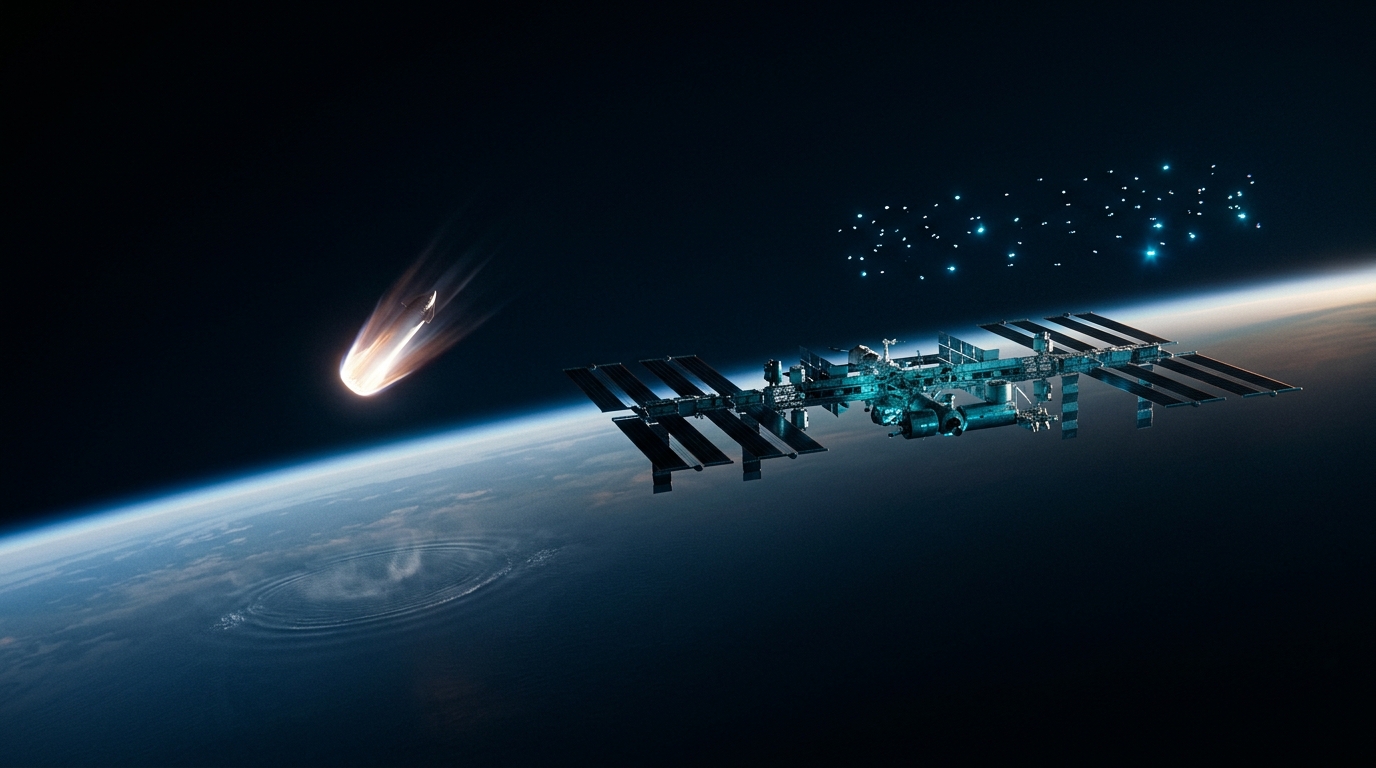
The thirteenth test flight of the Starship system marked a major turning point in SpaceX's roadmap toward the full, rapid reuse of super-heavy launch vehicles. During this operational test, the colossal rocket not only proved its upper stage's ability to maneuver with precision in the space environment, but also executed one of modern spaceflight's most demanding commercial tasks: deploying a batch of next-generation Starlink satellites into orbit. Larger and boasting higher transmission capacity than their predecessors, these satellites require heavy-lift capability that no conventional launcher can provide with the same technical and economic efficiency.
The highlight of the test came during the complex atmospheric reentry phase. After braving the densest layers of the atmosphere and dissipating the extreme temperatures generated by air friction at hypersonic speeds, the spacecraft executed its orientation and braking burns to touch down on the ocean surface. As reported by Space.com, the mission featured an extraordinarily soft final splashdown, marking the gentlest controlled touchdown to date for a vehicle of this scale. This achievement confirms that the guidance systems, thermal protection, and final engine relight perform with mathematical precision under the harshest orbital return conditions.
Why It Matters
For the community tracking low Earth orbit, this test goes far beyond a mere fireworks display or an engineering record. Starship's viability radically reshapes logistics for everything orbiting at an altitude of around 400 kilometers, including the International Space Station itself. Until now, transporting modules, supplies, and oversized replacement parts has been strictly constrained by traditional rockets' payload capacity and internal volume.
A launcher capable of delivering over one hundred metric tons to orbit while remaining fully reusable will completely transform the economics of space operations. In the immediate future, this capability will streamline the development of commercial space stations that will operate alongside or replace the ISS when its operational life ends later this decade. Instead of piecing together small modules across dozens of costly launches, a single super-heavy flight will be able to loft entire modules with more pressurized volume than several sections of the current orbital complex combined.
Furthermore, routinely launching next-generation Starlink satellites directly impacts astronomical observation and satellite tracking from Earth. Low Earth orbit satellite density is climbing steadily. For backyard observers, this means frequently spotting bright satellite trains streaking across the sky minutes or days after each launch—a striking sight that is often mistaken for an ISS pass, even though it follows entirely different orbital dynamics and altitudes.
While these advances are being perfected at test sites, human spaceflight continues at its steady pace. Right now, the International Space Station is gliding overhead at an average altitude of 439 km and a blistering speed of 27,528 km/h. Aboard this massive orbital laboratory, an international crew relies on a continuous logistics pipeline. You can check mission details and backgrounds of those currently on board in our crew section.
Drastically cutting the cost per kilogram to orbit will ensure that current and future crewed missions receive food, water, oxygen, and scientific hardware without the logistical bottlenecks that defined the early decades of the space age.
Our Take
From the standpoint of night-sky observers and space communicators, we are entering a golden yet increasingly crowded era. Starship's successful landing maneuver speeds up the shift toward a night sky where massive structures will become far more common. For over two decades, the ISS has been the brightest and most recognizable human-made object in the heavens, easily spotted with the naked eye as a brilliant, steady golden dot sailing across the sky without blinking.
With the arrival of superstructures carried by megarockets and the boom in communications constellations, visual satellite identification will demand sharper observation skills from enthusiasts. Telling whether that light on your horizon is the crewed orbital station, a freshly deployed satellite train, or an experimental vehicle's reentry test will become an increasingly valuable skill for skywatchers.
To never miss a visible pass of the orbital laboratory and learn how to tell it apart from other bright objects in the night sky, check out our guide to spotting the ISS, where we break down step-by-step how to calculate elevation, read apparent visual magnitude, and predict exact flyover paths from your location.
Pairing a super-heavy transportation system with soft-landing technology ensures that humanity's permanent presence in space will not only continue, but expand dramatically. As Starship refines its maneuvers for future deep-space exploration, low Earth orbit is cementing its role as humanity's floating laboratory, with the ISS serving as its undisputed guiding light.
Want to see if the International Space Station is passing over your location right now? Track its path live and plan your night-sky viewing with our real-time tracker.
Source: Space.com ↗