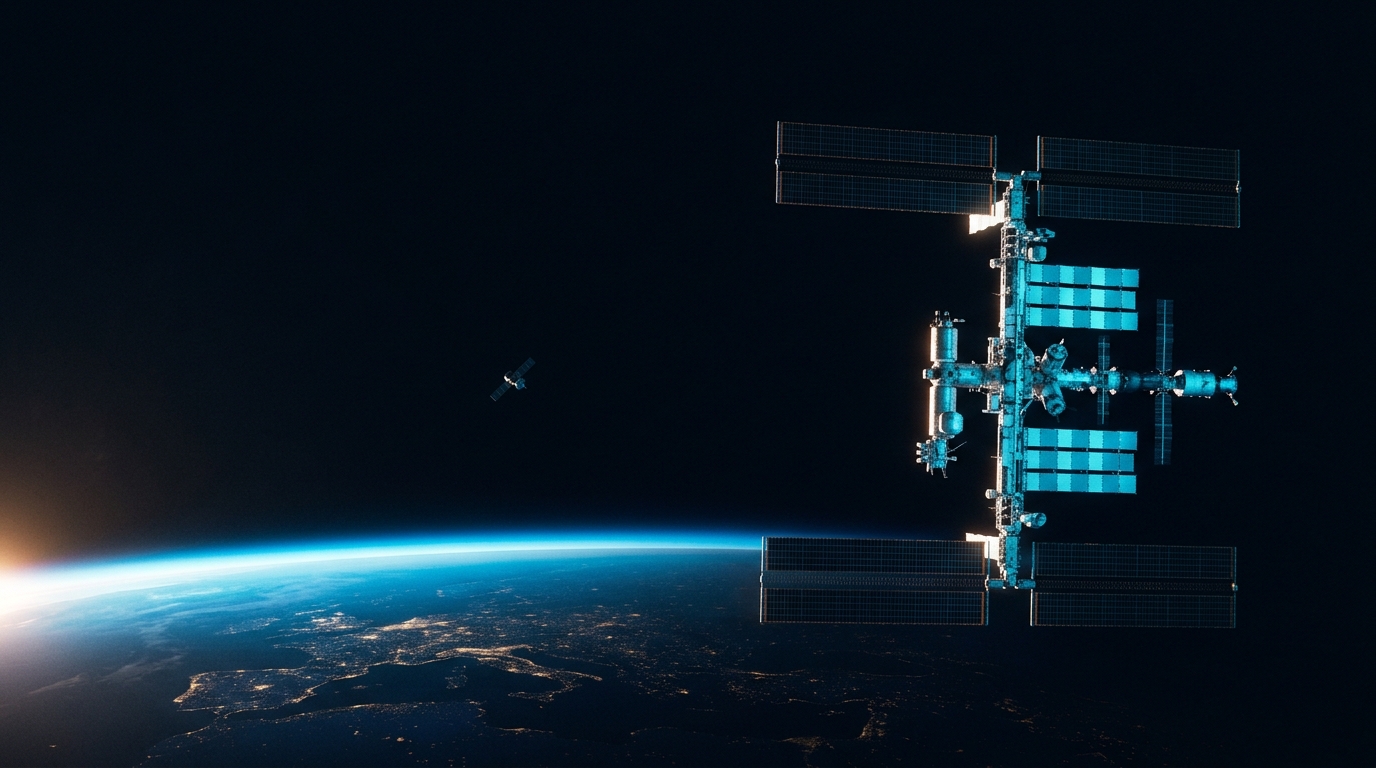
In-Orbit Space Surveillance: How the ISS Will Be Protected from Space Debris
Every time you look up to catch the unmistakable glow of the International Space Station crossing the night sky, you are watching a monumental structure hurtling at blistering speeds along an increasingly crowded orbital highway. Keeping this technological marvel safe requires a constant surveillance network capable of detecting tiny yet lethal fragments of debris. The recent entry of Chinese private firms into the orbital monitoring market is not just a financial move—it is a vital step toward ensuring the space station continues to safely fly over our cities.
What happened
Chinese startup Xingchen Daohe has raised an approximately $14 million funding round to begin deploying its own satellite constellation dedicated to Space Situational Awareness (SSA), according to industry outlet SpaceNews. This milestone marks a significant paradigm shift within the Asian nation's aerospace ecosystem.
Traditionally, low Earth orbit (LEO) monitoring in China has been strictly reserved for state-run military or academic infrastructure. However, the meteoric rise of commercial launches and the planned deployment of broadband megaconstellations—such as Qianfan and Guowang—have forced the sector to open up to private enterprise. Xingchen Daohe aims to lead this transition by developing small satellites equipped with optical and radio frequency sensors, specifically designed to track orbital objects directly from space.
This move aligns with an established international trend in the United States and Europe, where private companies provide space traffic analytics to telecom operators, government agencies, and insurers. The ultimate goal is to build an independent orbital network capable of cataloging active satellites, rocket bodies, and defunct debris far more swiftly than conventional methods.
Why it matters
To grasp the critical importance of these constellations, look no further than the current numbers we track on our platform: the International Space Station is currently flying at an altitude of around 418 kilometers, moving at a dazzling speed of 27,606 km/h. At that speed, the kinetic energy of any object on a collision course becomes destructive. A single bolt or a fleck of paint peeling off an old rocket carries the impact equivalent of a hand grenade.
The ISS permanently hosts an international crew. The physical safety of these professionals relies entirely on accurate early warnings that allow for avoidance maneuvers by firing the station's thrusters or those of docked cargo spacecraft at just the right time.
Yet most orbital debris data today comes from ground-based radars and telescopes. This approach faces insurmountable physical limitations:
- Atmospheric and weather limitations: Clouds, haze, and air turbulence severely degrade ground-based observation accuracy.
- Lighting constraints: Ground-based optical observation requires the telescope to be in nighttime darkness while the orbiting object still reflects sunlight, shrinking the usable window to just a few minutes around dawn and dusk.
- Distance and viewing geometry: Spotting fragments measuring just a few centimeters from over 400 kilometers away creates margins of uncertainty that are simply too wide for trajectory calculations.
By placing sensors directly in orbit, as Xingchen Daohe and other global firms propose, tracking takes place above the atmosphere and without weather disruptions. This drastically sharpens the precision of pass predictions, cutting down on false alarms and ensuring that ISS emergency maneuvers are only performed when the threat is real. Avoiding unnecessary maneuvers preserves the station's valuable propellant and prevents disruptions to scientific experiments on board.
Our take
From the perspective of anyone who enjoys stargazing and tracking the orbital complex's night passes, the state of low Earth orbit traffic has a much more direct impact than it might seem at first glance.
When the ISS detects a close conjunction risk with space debris and executes an unscheduled engine burn to alter its path, its orbital parameters change immediately. If you are preparing your evening viewing session by checking the pass schedule for your city, a last-minute evasive maneuver shifts the exact minute the station will cross your horizon, while also slightly altering its orientation relative to the Sun.
The proliferation of new commercial space-tracking constellations ensures that the orbital laboratory's trajectory is monitored second by second with greater reliability. As low Earth orbit fills with new commercial satellites, transparency and precision in space traffic management directly benefit amateur astronomy: the lower the orbital uncertainty, the more accurate the mathematical models powering our tracking algorithms become.
Furthermore, mitigating orbital risks helps curb the threat of the Kessler syndrome—the chain reaction where cascading collisions multiply debris until space exploration becomes unfeasible. Protecting the ISS ultimately means protecting the transparent window that lets you witness humanity's presence in the cosmos right from your backyard.
Check our real-time tracker right now to see the exact position of the ISS and plan your next sighting under clear, safe skies.
Source: SpaceNews ↗