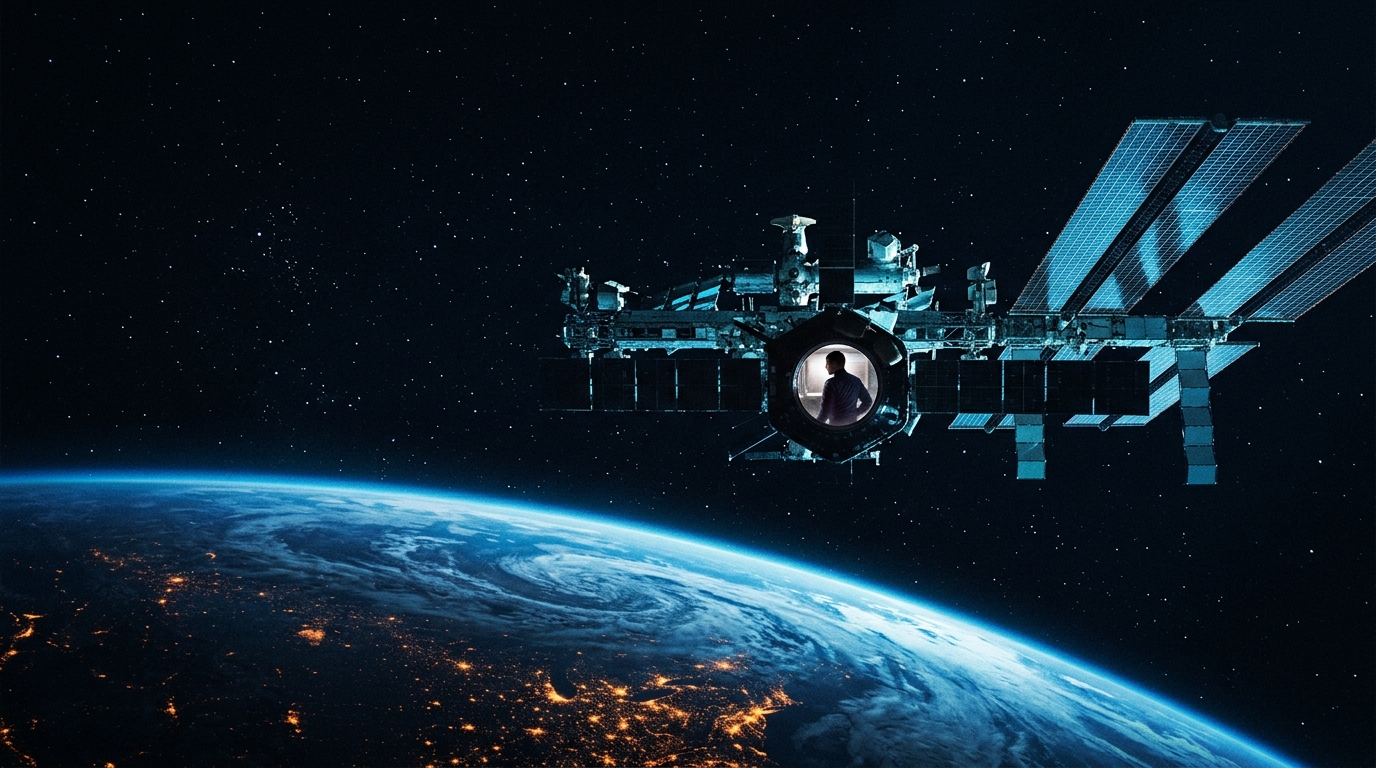
Living Confined: From Sci-Fi Bunkers to Reality on the Space Station
When you look up at the night sky waiting to catch the steady glow of the International Space Station, it is easy to forget the extreme conditions endured by those on board. Popular culture often returns to the fantasy of a hermetic shelter guarding against a lethal exterior, but that challenge belongs neither to the future nor to the underground: it is happening right now above our heads.
What happened
Space news site Space.com has published a selection of standout underground sci-fi films, tapping into the buzz generated by recent productions like the television series Silo. These stories revolve around a recurring scenario: human communities surviving confined underground within self-sufficient technological complexes, while Earth's surface remains uninhabitable, toxic, or barren.
The roundup explores how cinema has tackled claustrophobia, social control, and an extreme reliance on mechanical life support systems to survive. Spanning classic dystopias to tales of isolation inside fallout shelters or automated underground cities, these works share a core premise: a closed habitat is not just a dwelling, but a critical machine where the slightest environmental glitch or interpersonal conflict can trigger an immediate catastrophe.
Why it matters
Beyond on-screen entertainment, the fascination with self-sufficient bunkers connects directly to modern aerospace engineering. In the real world, humanity did not need to dig kilometres into Earth's crust to learn how to sustain life inside an isolated capsule; we had to do it in the absolute vacuum of outer space.
A closed habitat introduces physiological and technical challenges that fiction often oversimplifies, but which space engineering must solve down to the millimetre:
- Closed-loop life support: In a sealed structure, every molecule of air and water must be recovered. In Earth orbit, the Environmental Control and Life Support System (ECLSS) recovers around 98% of water from the crew's sweat and condensed urine, while oxygen generators split water via electrolysis to continuously replenish breathable air.
- Carbon dioxide management: In an environment with no natural air currents, exhaled breath forms stagnant, lethal pockets of gas if circulation fans fail to move the internal atmosphere. Zeolite scrubbers and chemical removal technologies are essential to prevent CO2 toxicity.
- Psychological isolation and prolonged confinement: Spending months in cramped metallic corridors, without direct contact with nature and under a rigid schedule, subjects crews to continuous stress where group cohesion is vital.
- Vulnerability to the outside: Unlike a subterranean shelter shielded by solid rock, an orbital habitat relies merely on thin aluminium walls and layered composite shielding to stop micrometeoroids and mitigate constant cosmic radiation.
What appears on screen as an apocalyptic metaphor serves, in modern scientific practice, as a daily testbed to prepare for future permanent bases on the Moon or Mars.
Our take
While fictional narratives insist on burying humanity to save it, space exploration proves that our collective survival depends on looking up. At this very moment, as recorded by our tracker’s instruments, the International Space Station is cruising at an altitude of 423 km at 27,594 km/h, completing an orbit around Earth every 90 minutes.
Aboard this pressurised structure lives a small human community that embodies—in a peaceful, scientific form—those shelter-dwellers, rotating in shifts of roughly six months. You can learn about the background and missions of the current members in our dedicated crew section.
Far from living buried underground, these professionals witness sixteen sunrises and sixteen sunsets every single day through the orbital complex's Cupola. Their days are spent carrying out microgravity experiments, servicing hydraulic pumps, and conducting biomedical analyses that you can frequently watch on official live streams.
The contrast could not be clearer. Fiction turns to shadows and subterranean dread to explore human fragility; space science, on the other hand, places its most sophisticated haven in plain sunlight, sweeping across the sky visible to the naked eye from our cities as a bright, unmistakable point of light.
Check our real-time tracker to see when this small technological fortress will pass over your area, and witness the greatest habitable sanctuary ever built with your own eyes.
Source: Space.com ↗