How to Experience the ISS Without Leaving Your City
You do not need to slip into a spacesuit or endure years of rigorous training to experience the thrill of being aboard humanity's most complex laboratory. Through full-scale mockups, immersive virtual reality tech, and direct viewing from your own backyard, the International Space Station is closer to your daily life than you might think. Discover how to connect with this orbital superstructure that circles our skies daily and what it represents for those of us watching from Earth's surface.
What happened
Walking the metallic corridors of the International Space Station without leaving the ground is becoming increasingly accessible thanks to visitor centers, astronaut training mockups, and high-fidelity digital recreations. As a recent account published by the specialized outlet Space.com reflects, stepping inside ground-based training modules reveals a human perspective that informational videos cannot fully convey: living space on board is narrow, functional, and optimized down to the last cubic millimeter.
At these training facilities—such as those located at NASA's Johnson Space Center in Houston or the European Astronaut Centre in Cologne—laboratory modules, connecting nodes, and life support systems are faithfully reproduced. Walking through these mockups makes it possible to grasp the tactical layout of scientific equipment, the restraint harnesses required to exercise in microgravity on treadmills and resistance machines, and the workstations where the crew spend their days.
One of the highlights that most impresses visitors during these simulations is the recreation of the Cupola module, the famous seven-window observation deck installed on the Tranquility node. Gazing at a simulation of Earth's curvature from that vantage point conveys the absolute isolation and, at the same time, the profound connection to the blue planet that astronauts experience in orbit. Yet beyond the technical sophistication of the Columbus, Kibo, or Destiny laboratories, the real revelation of these experiences lies in realizing that this gigantic structure is not a static display, but a real spacecraft flying overhead around the clock.
Why it matters
Bringing the space station experience closer to the general public goes far beyond mere technical entertainment or scientific curiosity. We are in the mature phase of a historic project that has been permanently inhabited since November 2000 with the arrival of Expedition 1. For nearly a quarter of a century, human presence in outer space has not been interrupted for a single second, turning the station into living proof of international cooperation among agencies such as NASA, Roscosmos, ESA, Japan's JAXA, and Canada's CSA.
Understanding the inner workings of this orbital complex takes on a sense of historical urgency as we look toward the near future. With a timeline set for the 2030s, the progressive decommissioning of the multinational station is planned to make way for commercial orbital platforms and missions bound for the Moon and Mars. Appreciating the engineering that keeps astronauts alive in an environment as harsh as the vacuum of space helps us grasp the scale of the challenge: maintaining atmospheric pressure, managing radiation, filtering water, and providing a continuous supply of oxygen 400 kilometers above Earth.
Today, the station is a hive of advanced scientific activity, hosting experiments in fluid physics, cell biology, space medicine, and novel materials that directly benefit life on Earth. The crew aboard the ISS rotates in roughly six-month increments, and you can see who is up there right now in our dedicated section. Envisioning the real living conditions of these scientists and engineers in microgravity helps us appreciate the true value of the daily work they carry out above our heads.
What to look for in the sky
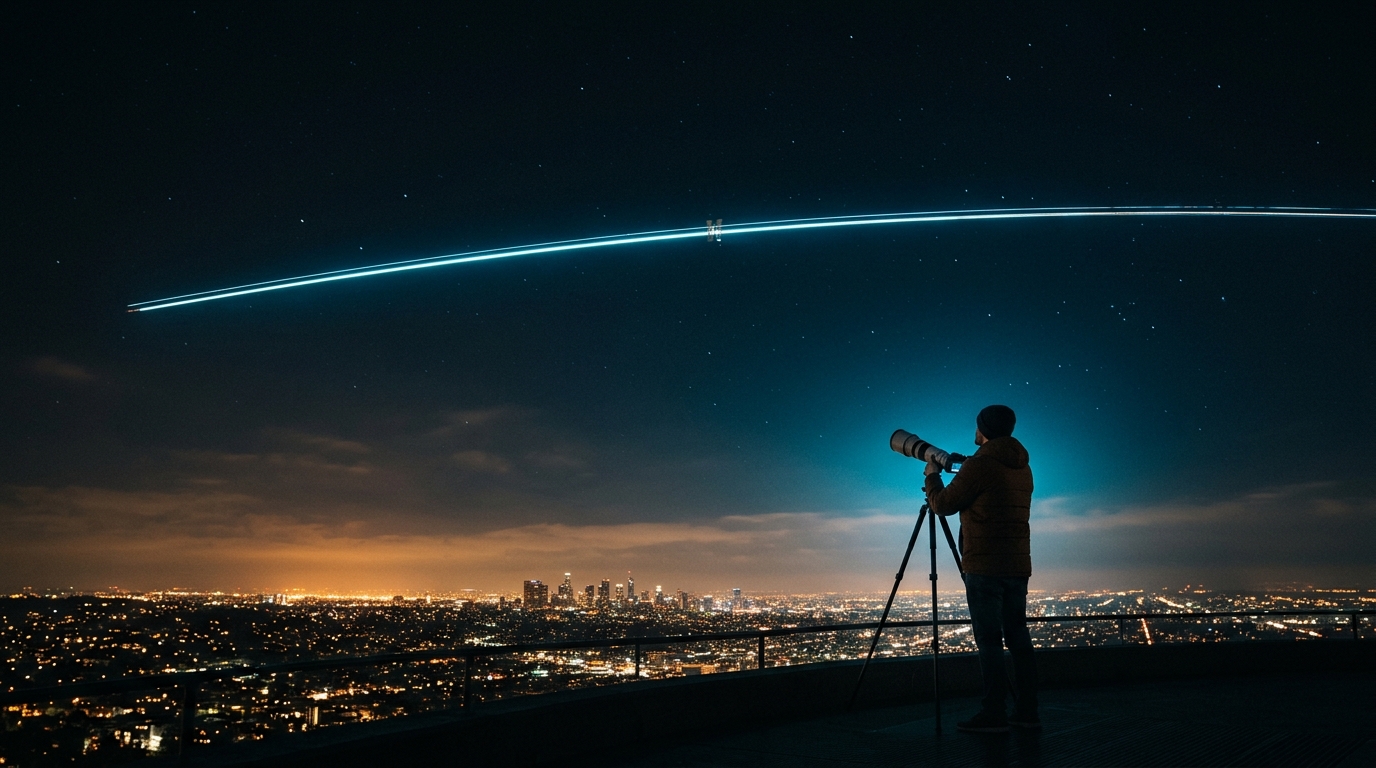
While ground-based mockups and virtual tours let us understand the complex's interior architecture, the most direct and thrilling way to connect with the space station is simply looking up at the night sky. There is no need for expensive telescopes or professional equipment; the complex's solar arrays reflect sunlight so intensely that it ranks among the brightest objects in the sky, outshining most stars and planets.
According to real-time data gathered by our tracker, the International Space Station is currently flying at an altitude of 439 kilometers above Earth's surface, traveling at a staggering speed of 27,528 kilometers per hour. At this pace, the spacecraft completes an entire orbit around Earth every ninety minutes, witnessing 16 sunrises and 16 sunsets in a single Earth day.
To see the station fly over your own city, you only need to know the exact time the spacecraft will cross your local horizon while illuminated by the Sun and when the sky on the ground is dark enough (around dawn or dusk). You can check accurate sighting times for your location in our guide on what time the ISS passes over your area, or review the guide to spotting the ISS to learn how to identify its path without mistaking it for an airplane or a conventional satellite.
When you watch that bright white dot glide across the sky swiftly and silently without blinking, you are witnessing a truly unique spectacle. Traveling within that streak of light is not just tons of aluminum, high-efficiency solar panels, and cutting-edge laboratories—there are human beings working at the frontier of exploration. If you prefer to follow its journey live through its external cameras, you can also tune in to our live streams to view Earth exactly as the astronauts see it from the Cupola.
We invite you to check our real-time tracker to find out when the next visible pass will occur over your city and experience connecting with the International Space Station right from home.
Source: Space.com ↗