Why Every ISS Tracker Shows a Different Position: TLEs Explained
Open two International Space Station trackers at the same time, and they won't point to the exact same spot. The difference can easily be dozens of kilometers. It's not that one of them is broken—neither of them actually knows where the ISS is in real time. They all calculate a prediction, and that prediction ages.
Nobody Measures the ISS Position Live
The first surprise is that no tracker receives a continuous GPS signal from the station. Instead, space surveillance networks periodically observe orbiting objects using radar and optical telescopes, publishing orbital parameters based on those observations.
These parameters are distributed in a legacy, compact format known as a TLE (two-line element set): two lines of text, 69 characters each, that describe the object's orbit. Encoded inside are its inclination, eccentricity, orbital period, reference position at a specific epoch, and a drag term that models atmospheric resistance.
Using those two lines and a mathematical propagation model called SGP4, any application can calculate where the station will be at any given moment. That is exactly what your tracker does every time it refreshes the map: it doesn't query a live position—it calculates it.
Why Orbital Predictions Degrade
A TLE is a snapshot of the orbit at a specific moment in time, known as the element's epoch. The further you get from that epoch, the further the prediction drifts from reality.
The primary culprit is Earth's atmosphere. At an altitude of 400 kilometers, there is still enough air to continuously slow the ISS down, causing it to gradually lose altitude. The problem is that the density of this residual atmosphere isn't constant: it expands and contracts depending on solar activity. An intense solar flare can increase drag for days, and no model can predict that with absolute precision.
On top of that is something no model can anticipate: the ISS fires its thrusters. It performs reboost maneuvers to regain altitude several times a year, as well as collision avoidance maneuvers when space debris drifts too close. Any of these maneuvers instantly invalidates the current TLE until a new one is published.
How Much Error Are We Talking About?
With a freshly published TLE, the typical error is around one kilometer. A day later, it might be a few kilometers. A week later, dozens of kilometers.
And here lies the key to understanding discrepancies between apps: that error is almost entirely along-track, not cross-track. In other words, the station is traveling along the path the tracker shows, but it arrives slightly earlier or later. In practice, an error of 40 kilometers at 27,600 km/h translates to about five seconds early or late during a pass. For visual stargazing, that's negligible. For telescopic astrophotography, it's make-or-break.
When two trackers disagree, the explanation is almost always the same: they are using TLEs from different timestamps. An app that updates every few hours will be far more accurate than one that pulled its element set three days ago.
What Makes an ISS Tracker Reliable
Keeping this in mind, you can evaluate any tool you use:
- TLE update frequency. This is the single most important factor, far more than how sleek the map looks.
- Full SGP4 implementation rather than a simplified circular orbit approximation, which accumulates error much faster.
- Pass predictions calculated for your exact location, rather than the geographic center of your country.
- Transparency about data age. A tracker that doesn't state when its orbital elements were last updated is asking for a leap of faith.
We break down the full criteria for choosing a tool in our article on what makes a great ISS tracker, and you can see the live results in our real-time tracker.
What This Means When You Go Out to Watch
Good news: for naked-eye spotting, none of this will ruin your night. A few seconds' offset is unnoticeable when a pass lasts between three and six minutes and the ISS is the brightest object in the sky.
The ground rules are simple. Check pass predictions on the day of the flyover, not a week in advance, as a seven-day forecast is merely indicative. Head outside a couple of minutes before the scheduled time. And if you are doing tracked photography, refresh your orbital elements right before your session.
With that routine, the timings from our pass calculator will always serve you well.
The ISS doesn't broadcast a live beacon: it runs on physics. And physics, fed with fresh data, is more than accurate enough.
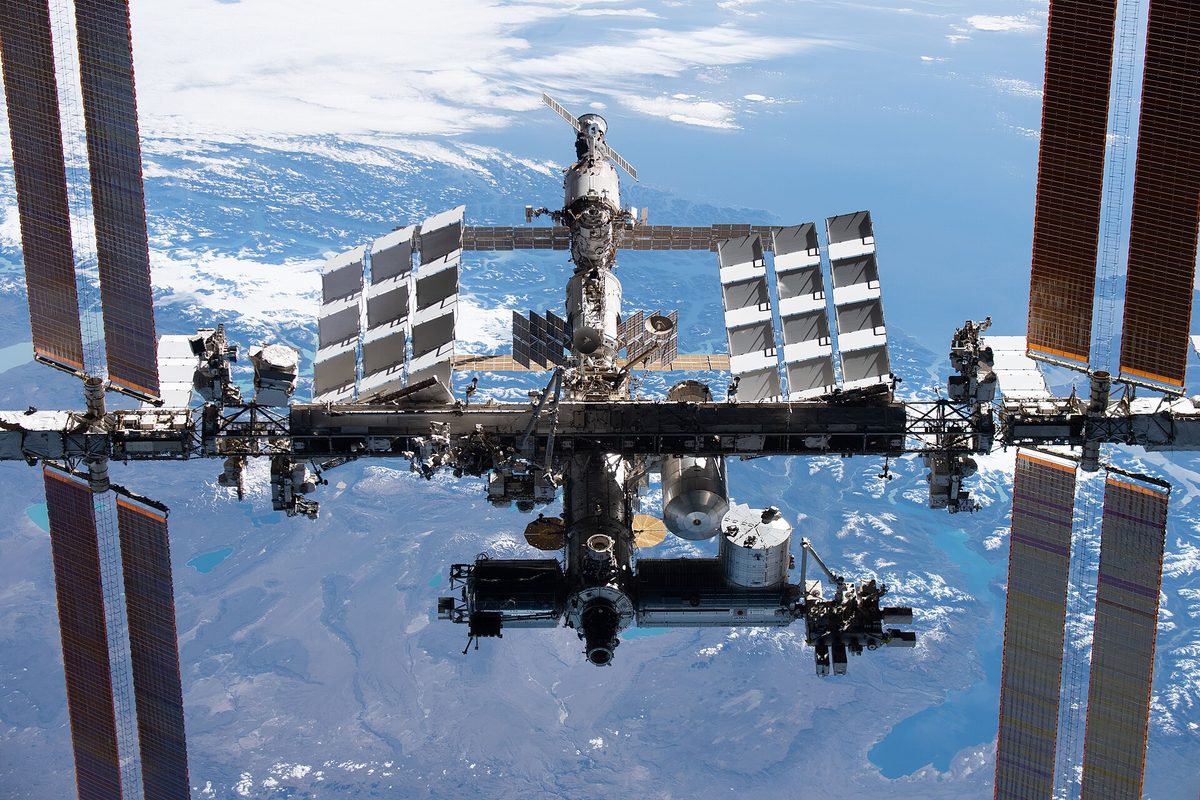
Images: cover, View of the ISS taken during Crew-2 flyaround (ISS066-E-081311) — NASA/Crew-2 (Public domain). Interior, Stars and satellites over SOAR (ann23017a) — CTIO/NOIRLab/SOAR/NSF/AURA/M. Paredes (CC BY 4.0).
Source: ISS Tracker ↗