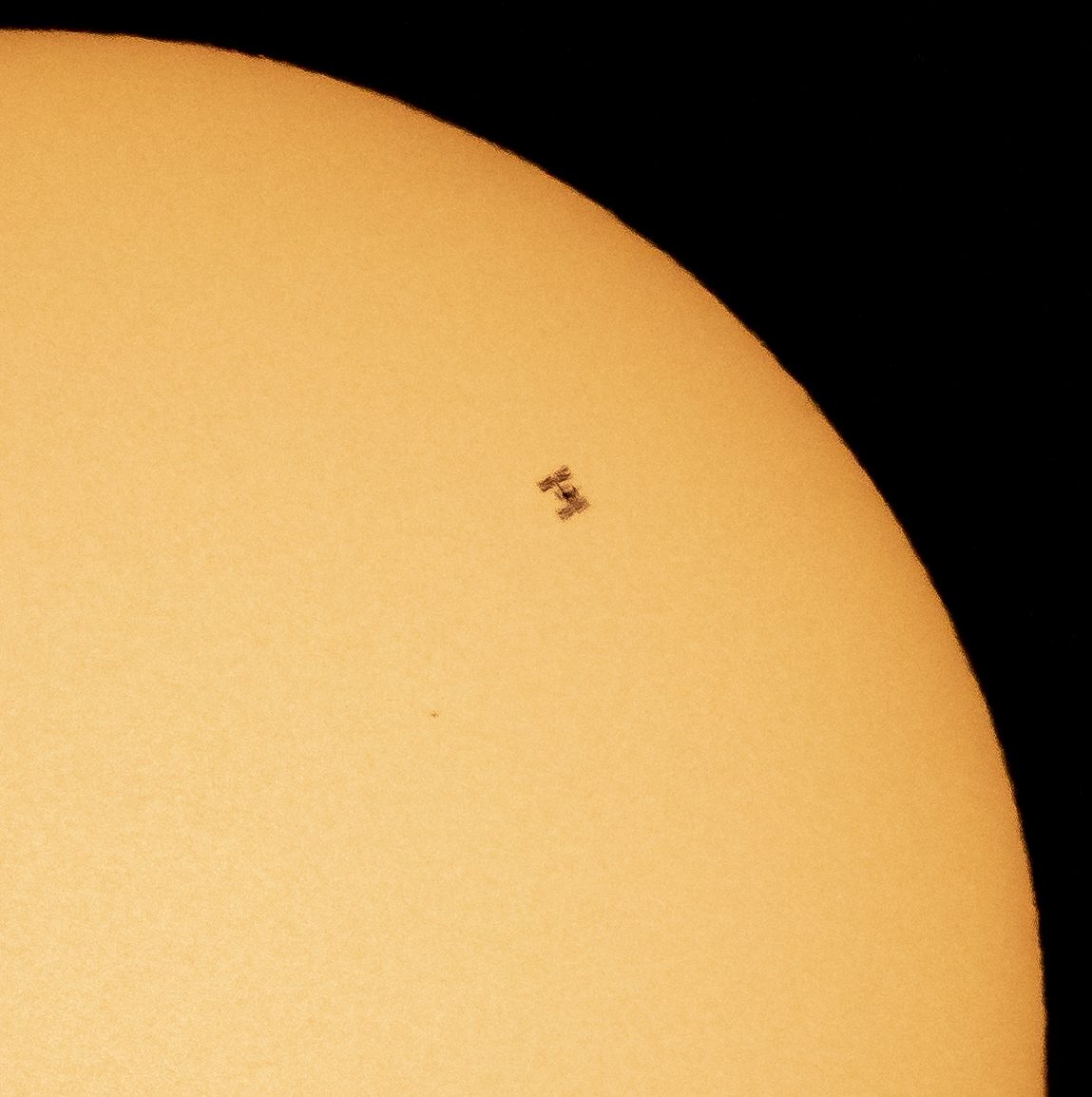
ISS Transits: When the Station Crosses the Sun or the Moon
There is a photograph that seems impossible, yet isn't: the sharp silhouette of the International Space Station crossing in front of the disc of the Sun or the Moon. It is called a transit, it can be captured from Spain or any other country, and it all comes down to being in the exact spot at the exact second.
What is a transit
A transit occurs when the ISS passes directly between your location and the Sun or the Moon. From your point of view, the station appears as a dark, crisp silhouette—with its solar arrays easily recognizable—gliding across the disc.
The difference compared to a regular pass is night and day. During a standard pass, you see a bright point of light for several minutes. During a transit, you see a distinct shape, with structural detail, for less than a second. Typically between half a second and a second and a half.
That brevity is the direct consequence of its speed: 27,600 km/h. That is all the time the station takes to cross the apparent diameter of the Sun or the Moon.
Why it is so difficult
The challenge is not the equipment; it is the geometry. The ground corridor from which a specific transit is visible is only a few kilometers wide. If you are outside that narrow band, even by just three kilometers, the ISS will pass close to the disc but not across it, and there is no shot.
This demands a level of precision we are not used to: you must consult dedicated transit predictions that plot the visibility band on a map and physically travel to it. Transit-hunting enthusiasts drive tens or hundreds of kilometers just to stand right on the center line.
Then comes the second challenge: timing. Predictions provide the exact moment down to the second, so your camera must be firing in burst mode before it happens, as there is zero chance of reacting once you see it.
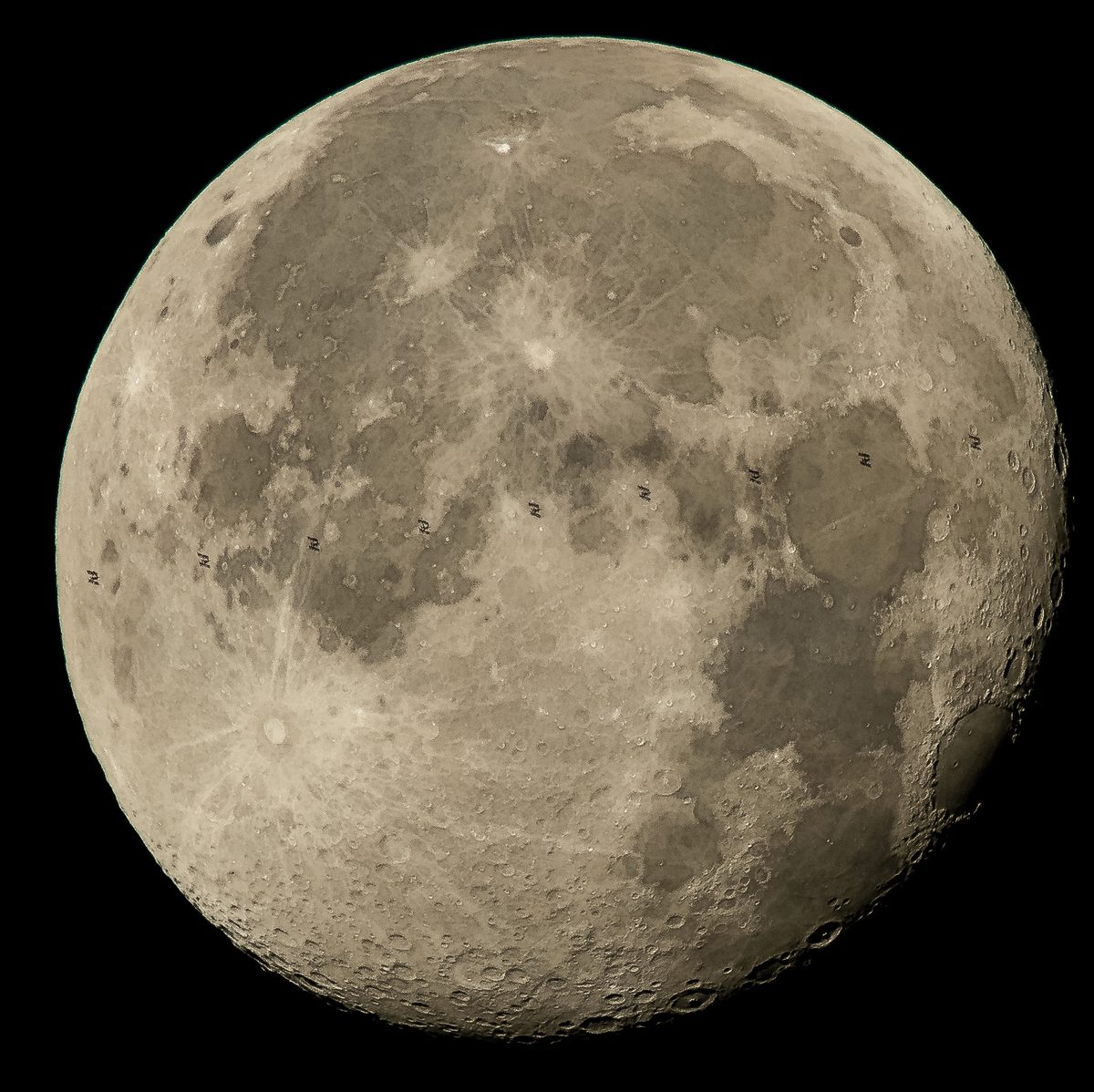
Lunar transit vs. solar transit
A lunar transit is best for beginners. It requires no special protection, can be captured with a standard telephoto lens, and a full or nearly full Moon provides a high-contrast background. The silhouette of the station against the lunar maria is one of the most rewarding images in amateur astrophotography.
A solar transit is more spectacular and far more dangerous. The solar disc is vastly brighter and the silhouette stands out with extraordinary contrast, especially if sunspots are in view. However, it requires a certified solar filter at all times, with no exceptions.
The warning you cannot skip
Never look directly at the Sun—neither with the naked eye, through a camera viewfinder, nor with binoculars or a telescope—without a certified solar filter mounted in front of the lens.
A single split-second is enough to cause permanent, painless retinal damage. One point must be emphasized: sunglasses, smoked glass, exposed X-ray film, and makeshift filters do not work. The filter must be specifically designed for solar observation and always mounted over the front of the instrument, never on the eyepiece.
If you have any doubts about your setup, stick to lunar transits. They are just as thrilling and carry zero risk.
How to prepare
The recipe requires four things: a transit-specific prediction tool that gives you the ground track and exact timing, a telephoto lens or small telescope, a sturdy tripod, and high-speed burst shooting.
The routine that works is to arrive well in advance, focus and expose accurately for the disc—either the Moon or the filtered Sun—and take a test series. Then, start firing in burst mode ten to fifteen seconds before the scheduled time and do not stop until ten to fifteen seconds after. Out of hundreds of frames, one or two will capture the silhouette.
It is also essential to refresh the prediction on the day of the transit: the ISS loses altitude continuously and executes orbital maneuvers, so data from a week ago can shift the ground band by several kilometers. The underlying reasons are explained in how satellite trackers work.
Before the transit, try a regular pass
If you have never photographed the station before, the sensible progression is to start with a standard pass: a long exposure, a bright streak crossing the frame, and no need to position yourself inside any narrow ground track. It is far easier and teaches you almost everything you need to know.
You can check visible passes for your location using the pass time calculator and track its current trajectory on the real-time tracker. The basics of spotting the station are covered in our guide to viewing the ISS.
Under a second of silhouette, after hours of preparation and kilometers of driving. Anyone who captures it once will definitely do it again.
Images: cover, ISS Solar Transit (NHQ202104230051) — NASA Headquarters / NASA/Bill Ingalls (Public domain). Body, ISS Lunar Transit (201508020005HQ) — Bill Ingalls (Public domain).
Source: ISS Tracker ↗