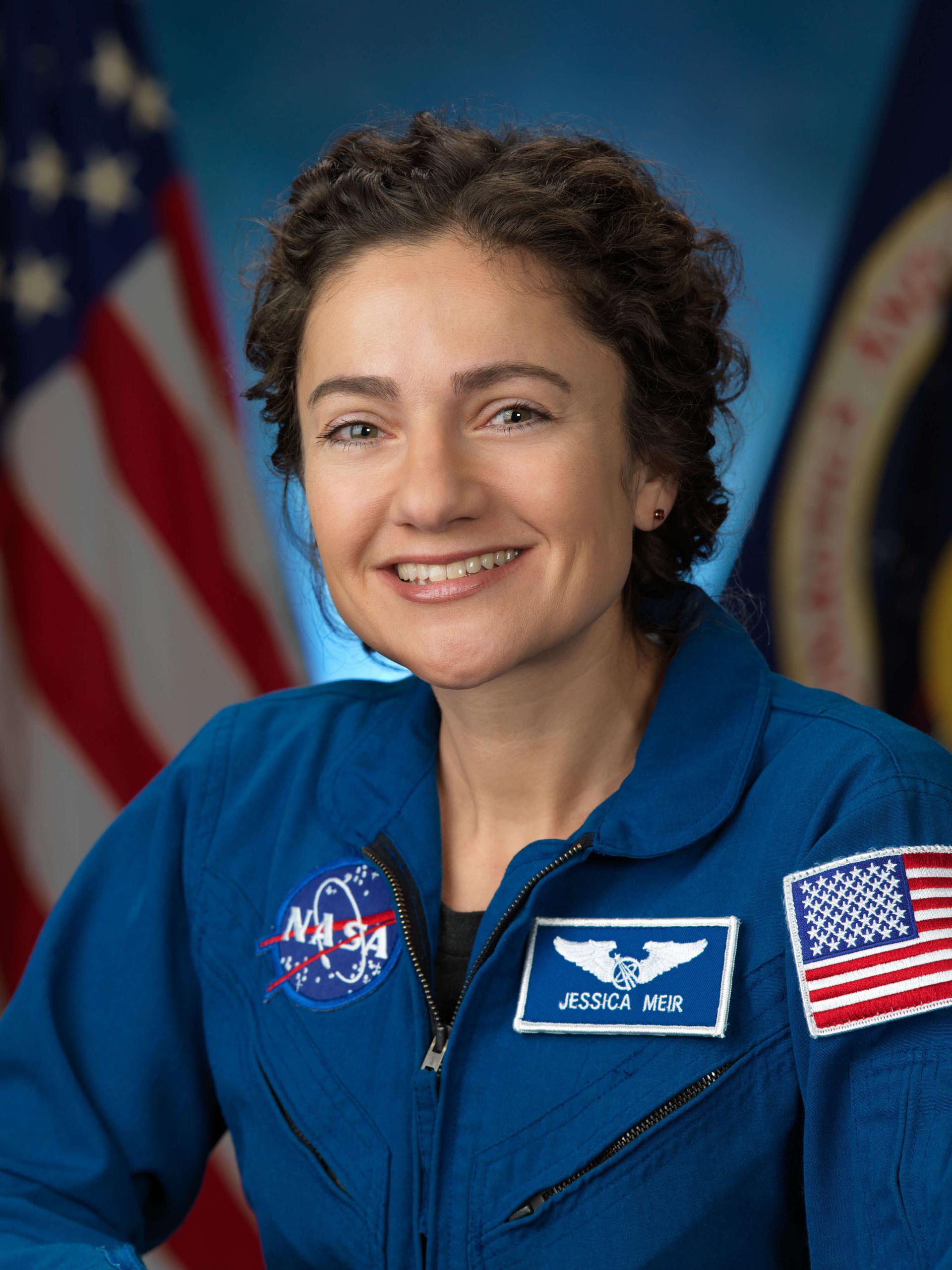
Who is Jessica Meir, and what is she doing on the ISS right now
Jessica Ulrika Meir was born on July 1, 1977, in Caribou, a small town in the state of Maine. She is a NASA astronaut, and as of July 26, 2026, she holds the most senior role aboard the International Space Station: commander of Expedition 75. She took over from the outgoing crew on that date, and since then she has carried final responsibility for the station's safety and for coordinating the crew's day-to-day work.
This is her second stay in space. Flying twice isn't common among NASA astronauts, and returning this time as commander says a lot about how much confidence the agency places in her previous experience on board the station.
Want to know who else is on the current crew?
See the full ISS crewHer first mission: the spacewalk that made history
Meir's first stint on the ISS ran from 2019 to 2020, as part of Expeditions 61 and 62. It was during that stay that she and fellow astronaut Christina Koch carried out the first all-female spacewalk in the history of spaceflight. The two astronauts went outside the station together to carry out maintenance work, in an extravehicular activity that became a symbolic milestone as well as a technical one.
What mattered about that spacewalk wasn't just who was on the team — it was what it reflected: decades of women gradually joining the astronaut corps, to the point where a spacewalk outside the ISS could be fully staffed without needing a male crewmate, something that hadn't happened before due to mission scheduling and the availability of properly sized spacesuits.
From studying penguins to joining the astronaut corps
Meir's path to NASA wasn't built purely on engineering or piloting, as is the case for many of her colleagues. Her background rests heavily on animal physiology. After completing postdoctoral research in comparative physiology at the University of British Columbia, she studied how emperor penguins' bodies behave while diving in Antarctica, and also researched the physiology of bar-headed geese, migratory birds capable of flying over the Himalayas, at extreme altitudes where oxygen is scarce.
That scientific focus on how organisms adapt to extreme conditions — pressure, temperature, limited oxygen — fits naturally with the work of an astronaut, whose own body has to adapt to microgravity and a sealed environment for months at a time. Alongside that background in biology, Meir is an assistant professor of Anaesthesia at Harvard Medical School and Massachusetts General Hospital, and in 2000 she earned a Master's degree in Space Studies from the International Space University in Strasbourg, France.
In September 2002 she took part in NASA's NEEMO 4 mission as an "aquanaut," living in an underwater habitat used to train astronauts under conditions that simulate the isolation and risks of a space mission. More than a decade later, in June 2013, she was selected as an astronaut candidate as part of NASA's Astronaut Group 21.
💡 Fun fact: the physiology of emperor penguin diving and the physiology of spaceflight have more in common than it might seem. Both study how an organism manages limited resources — oxygen, energy, body temperature — in a hostile environment with no room for error. It's no coincidence that NASA values that kind of scientific background when building a crew.
Her career, by the numbers
Across her two missions, Meir has already built a notable record within NASA's astronaut corps:
| Spaceflights | 2 |
| Spacewalks (EVAs) | 4 |
| Total days in space | Over 372 |
| Current role | Commander, Expedition 75 |
You can find more details on her career on her Wikipedia page.
Who else is flying with her on this expedition?
See the full ISS crew